

Does John 1:1 really describe Jesus existing before His birth, or is John speaking about God's Word, wisdom, plan, and purpose? This study examines the original Greek text, the Old Testament background, and the immediate context to understand what John actually wrote.
Chapter 1: John 1:1 — Is the "Word" Jesus?
"In the beginning was the Word, and the Word was with God, and the Word was God." — John 1:1
Perhaps no verse in the entire Bible has generated more discussion than John 1:1. For centuries it has been one of the principal passages used to support the doctrine of the Trinity and the belief that Jesus Christ personally existed alongside God before His birth in Bethlehem.
Yet despite its popularity, John 1:1 is also one of the Bible's most misunderstood passages.
Many sincere Christians assume that "the Word" (Logos) in John 1:1 is simply another name for Jesus. But is that actually what John intended his readers to understand?
This chapter will examine the passage carefully by considering:
- the oldest Greek manuscripts,
- the meaning of the Greek word Logos,
- John's Old Testament background,
- the immediate context of John's Gospel,
- and the testimony of Scripture as a whole.
My purpose is not to ask readers to accept a tradition, whether Trinitarian or Unitarian, but to examine the biblical evidence carefully and allow Scripture to explain itself.
As we shall see, I believe John's opening words are not introducing a second divine person existing beside God before creation. Rather, John begins exactly where Genesis begins—with the One True God speaking His creative word into existence.
The Greek Text
The Greek text reads:
Ἐν ἀρχῇ ἦν ὁ λόγος,
καὶ ὁ λόγος ἦν πρὸς τὸν θεόν,
καὶ θεὸς ἦν ὁ λόγος.
Literally:
"In beginning was the word,
and the word was with God,
and God was the word."
Notice something very important.
The original Greek manuscripts do not contain an upper-case "W" and a lower-case "w" as modern English does. The earliest manuscripts were written in continuous Greek script without the capitalization conventions used in modern English translations.
Therefore, the familiar English translation "Word" with a capital W is not found in the original Greek text. It is an editorial decision made by translators.
This does not automatically mean the translation is wrong. However, it does encourage the reader to understand Logos as a personal title, almost as though John had written the name "Jesus."
John himself did not write "Jesus" here.
He wrote Logos.
Before deciding who or what the Logos is, we must first discover what John meant by that word.
What Does "Logos" Mean?
The Greek word λόγος (Logos) has a broad range of meanings.
It can refer to:
- a word,
- speech,
- a message,
- an utterance,
- a declaration,
- a report,
- a command,
- reason,
- purpose,
- or an expressed thought.
Throughout the New Testament, Logos is translated simply as "word" hundreds of times.
For example:
"Sanctify them in the truth. Your word is truth." (John 17:17)
Here, no translator capitalizes the word "word."
The Greek word is exactly the same: Logos.
Likewise, throughout the New Testament, translators consistently render Logos as "word," "message," or "teaching" without suggesting that it is a personal name.
Only in the opening verses of John's Gospel do most English translations capitalize it as Word, thereby encouraging readers to think immediately of a person.
The capitalization itself is not inspired Scripture; it is an interpretation supplied by translators.
This raises an important question:
Did John intend his readers to understand "Logos" as a person, or was he speaking about God's own word, purpose, wisdom and self-expression?
That question deserves to be answered from Scripture itself.


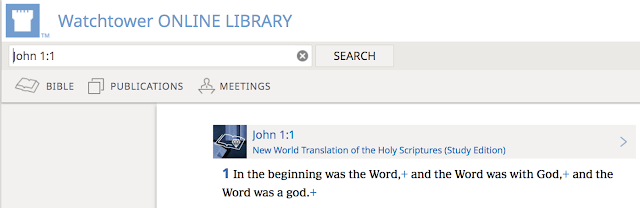
And the Jehovah Witnesses have their own translation saying:


Berean Literal Bible
And the Word became flesh and dwelt among us. And we beheld His glory, a glory as of an only begotten from the Father, full of grace and truth.
Did you see that: And the 👉Word👈 became flesh.
So the Word of GOD tells us how, GOD's 👉Word👈became flesh.
Notice what we do NOT read: And 👉GOD👈became flesh!


WHEN did Jesus BEGIN to EXIST?



No comments:
Post a Comment