Simon Brown.

Join me on this journey. Let's seek the truth together! 💡 Proverbs 8:34-36 Blessed is the man who hears me, watching daily at my gates, waiting at my door posts. For whoever finds me finds life, and will obtain favor from Yahweh. But he who sins against me wrongs his own soul. All those who hate me love death.” Psalm 84: 11 For Yahweh God is a sun and a shield. Yahweh will give grace and glory. He withholds no good thing from those who walk blamelessly. 12 Yahweh of Armies, blessed is the man who trusts in you. 1 John 5:5 Now who is the one overcoming the world, except the one believing that Jesus is the Son of God.

Sunday, 16 June 2019

The Pagan Gods and the Catholic Trinity


Infographic examining the relationship between ancient pagan triads, the Catholic Trinity doctrine, early Church history, and biblical teaching.

Infographic examining the relationship between ancient pagan triads, the Catholic Trinity doctrine, early Church history, and biblical teaching.

The Pagan Gods and the Catholic Trinity

Did the doctrine of the Trinity originate with Jesus Christ and His apostles—or did it develop later?

For many centuries, the majority of Christianity has accepted the doctrine of the Trinity as the foundation of the Christian faith. Many churches teach that unless a person believes Jesus is God Himself, they cannot truly be saved.

For example, John MacArthur writes:

"You need to believe that Jesus is God."
(Assurance of Victory—1 John 5, Moody Press, p.12).

Likewise, many Trinitarian teachers argue that unless Jesus is Almighty God, His death could not provide salvation for mankind.

This raises an important question:

Who should we believe—God Almighty, or later church tradition?


What did Jesus teach?

When Jesus was asked the greatest commandment, His answer was simple and unmistakable:

"Hear, O Israel: The Lord our God, the Lord is one."
(Mark 12:29)

Jesus did not teach that God is three persons.

He did not say the Father, Son and Holy Spirit together are the one God.

Instead, Jesus affirmed the same truth that God had revealed throughout the Old Testament—that the God of Israel is one.

Throughout Scripture, God repeatedly describes Himself as one and incomparable.

"I am God, and there is no other; I am God, and there is none like Me."
(Isaiah 46:9)

This raises another question.

If God declares there is no one like Him, why does the doctrine of the Trinity describe God in a way never explicitly stated anywhere in Scripture?


Did the Trinity come from the Bible?

The word "Trinity" never appears in the Bible.

Neither do the expressions:

  • One God in three persons
  • God the Son
  • God the Holy Spirit
  • Three co-equal persons
  • Three co-eternal persons

These expressions developed centuries after the New Testament period and were formally defined in the Nicene and Constantinopolitan creeds.


The Similarity with Ancient Pagan Triads

Long before Christianity, many ancient civilizations worshipped groups of three deities or divine triads.

Examples include Babylon, Egypt, Rome, India, and other ancient religions.

Although these pagan triads were not identical to the later Christian doctrine of the Trinity, they demonstrate that the concept of a threefold divine grouping existed long before the Council of Nicaea.

This naturally raises an important historical question:

Why did the earliest Christians worship one God—the Father—while centuries later the official church defined God as three distinct persons?


God's Warning

God repeatedly warned Israel not to adopt the religious beliefs of the surrounding nations.

"It is the LORD your God you shall fear... You shall not go after other gods, the gods of the peoples who are around you..."
(Deuteronomy 6:13–15)

God's people were commanded to worship Him alone and to reject every form of false worship.


The Real Question

The issue is not whether pagan religions had groups of three gods.

The real question is this:

Did Jesus and His apostles ever teach that the one true God is three persons?

If not, where did this doctrine originate?

That is the question this article will examine using Scripture, history, and the earliest available evidence.

DID THE CATHOLIC CHURCH CREATE THE DOCTRINE OF THE TRINITY?

DID THE CATHOLIC CHURCH CREATE THE DOCTRINE OF THE TRINITY?

Quick Facts

  • The word "Trinity" does not appear anywhere in the Bible.
  • Neither Jesus nor His apostles ever taught that God is three persons.
  • The doctrine developed gradually after the apostolic age.
  • It was formally defined during the fourth century through church councils.
  • History shows that the Roman Catholic Church played the central role in defining and promoting the doctrine that later became orthodox Christianity.

Introduction

One of the most important questions every Christian should ask is:

Did Jesus Christ and His apostles teach the doctrine of the Trinity, or did it develop later in church history?

The answer should not be based upon church tradition, denominational loyalty, or theological opinion.

Instead, we should examine the evidence found in Scripture and compare it with the historical record.

As Jesus said:

"Sanctify them in the truth; Your word is truth."
(John 17:17)


Three Questions

This article examines three straightforward questions.

1. Was there a doctrine of the Trinity during the lifetime of Jesus and His apostles?

2. When was the doctrine formally defined?

3. What role did the Catholic Church play in establishing and defending it?


1. Was the Trinity taught by Jesus?

According to historical scholarship, the answer is no.

Even standard Christian reference works acknowledge that the doctrine was not fully formulated during the apostolic period.

Wikipedia summarizes the historical consensus:

"The doctrine did not take its definitive shape until late in the fourth century."

It also states:

"Scripture contains neither the word Trinity nor an expressly formulated doctrine of the Trinity."

Likewise, The Oxford Dictionary of the Christian Church explains that the doctrine was formulated during the fourth century and continued to be developed afterwards.

These statements do not come from anti-Trinitarian writers.

They come from mainstream historical and theological sources.

Therefore, history itself acknowledges that Jesus and His apostles did not leave behind a fully formulated doctrine of the Trinity.


2. When Was the Trinity Defined?

History records that the doctrine gradually developed during the third and fourth centuries.

The First Council of Nicaea met in A.D. 325.

The Council of Constantinople followed in A.D. 381.

These councils produced the Nicene-Constantinopolitan Creed, which became the official statement of Trinitarian belief for the Catholic Church and later for much of Christianity.

This demonstrates an important historical fact.

If the doctrine required centuries of debate, councils, and official creeds before being defined, then it was not presented by Jesus or His apostles in its later form.


3. What Role Did the Catholic Church Play?

Historical records show that the Roman Catholic Church became the principal institution responsible for defining, defending, and promoting the Nicene doctrine of the Trinity.

Wikipedia notes:

  • The Council of Nicaea condemned Arianism.
  • Trinitarian belief became official doctrine.
  • The bishops of Rome defended and promoted this teaching.
  • The Edict of Thessalonica (A.D. 380) established Nicene Christianity as the official religion of the Roman Empire.

These events marked a turning point in church history.

From this period onward, belief in the Nicene doctrine of the Trinity became the defining mark of Catholic orthodoxy.


Athanasius

One of the greatest defenders of the Nicene doctrine was Athanasius of Alexandria.

History remembers him as the leading defender of Trinitarian theology.

The Catholic Encyclopedia even refers to him as:

"The Father of Orthodoxy."

His influence on later Christian theology cannot be overstated.

The Athanasian Creed, although probably not written by Athanasius himself, bears his name and became one of the strongest historical statements supporting Trinitarian belief.


Sir Isaac Newton's Opinion

Sir Isaac Newton is remembered as one of history's greatest scientists.

Few people realise that he devoted more time to studying the Bible than to science.

According to historian Karl Giberson, Newton became convinced that the doctrine of the Trinity was not part of original Christianity but was introduced centuries later.

Newton believed that Scripture had been altered in places and that early Christianity had gradually departed from the faith taught by Jesus and His apostles.

Whether one agrees with Newton or not, his conclusions demonstrate that serious biblical scholars have questioned the historical development of the Trinity for centuries.


The Biblical Question

The real issue is not whether church councils defined the doctrine.

The real question is this:

Where did Jesus ever teach that God is three persons?

Where did Peter teach it?

Where did Paul teach it?

Where does the Bible define the Father, the Son, and the Holy Spirit as one God consisting of three co-equal, co-eternal persons?

The answer is nowhere.


Conclusion

History records how the doctrine of the Trinity was gradually developed, debated, defined, and defended during the fourth century.

The Roman Catholic Church played the central role in that process.

The remaining question is not historical but biblical.

Did Jesus and His apostles teach the doctrine that later became known as the Trinity?

That is the evidence every Christian should examine carefully.

"Test all things; hold fast what is good."
1 Thessalonians 5:21


Part 2


Part 3


John Fullerton MacArthur Jr. is an American pastor and author known for his internationally syndicated Christian teaching radio program Grace to You, SAYS:  American pastor SAYS: 
You need to believe that Jesus is God. 
 (Assurance of Victory--1 John 5, Moody Press, p.12).   

According to this Trinitarian teacher: If Jesus is not GOD, 

Poster examining the Trinitarian claim that unless Jesus is God His sacrifice could not be sufficient to save humanity, with references to Jesus as the Son of God, Messiah and Lamb of God.

This Bible study examines the Trinitarian argument that Jesus could not be the Savior, Messiah or Lamb of God unless He were God Himself. Scripture declares that the Father sent His Son to be the Savior of the world and identifies Jesus as the Lamb of God who takes away the sin of the world. The central question is whether the Bible ever says that God's own Son was not sufficient to die for our sins unless He was God Himself.

IMPORTANT NOTE: I am not suggesting that all Trinitarian Christians believe or express the teaching quoted above in this way. The statement shown in the image represents the teaching of the particular Trinitarian source being quoted. My purpose is to examine this claim biblically and compare it carefully with what Scripture says about God, His Son Jesus Christ, and the Lamb of God.

THE SHOCKING TRINITARIAN CLAIM: If Jesus is not God, He could not be the Savior, the Messiah, the Lamb of God who takes away the sin of the world John 1:29. leave everything else the same?

One argument frequently made by Trinitarian teachers is this:

“Unless Jesus is God, He could not die for the sins of the whole world.”

Or expressed another way:

“If Jesus were only the Son of God and not God Himself, His sacrifice could never be sufficient to save humanity.”

But stop and consider what this argument is really saying.

Is it saying that God's own Son was not good enough to be the sacrifice for our sins?

Is it saying that the perfect, sinless Messiah whom God Himself sent into the world was somehow insufficient to become the Lamb of God?

That is an extraordinary claim—because this is not how Scripture describes the saving work of Jesus Christ.

GOD HIMSELF CHOSE HIS SON TO BE OUR SAVIOR

The Bible does not tell us that Jesus had to be God in order to save us.

Instead, Scripture tells us that God sent His Son to be our Savior:

“The Father has sent the Son as Savior of the world.” — 1 John 4:14

Notice carefully who sends whom.

The Father sends.
The Son is sent.

God Himself determined that His Son was sufficient for this great work.

John 3:16 does not say that God became His own Son and gave Himself.

It says:

“For God so loved the world, that he gave his one and only Son...”

The gift was God's Son.

JESUS IS THE LAMB OF GOD

When John the Baptist saw Jesus, he declared:

“Behold, the Lamb of God, who takes away the sin of the world!” — John 1:29

Think about those words:

THE LAMB OF GOD

Jesus is God's appointed Lamb.

God chose Him.

God sent Him.

God anointed Him.

And Jesus willingly gave His life in obedience to His Father.

If God Almighty Himself determined that His Son was the perfect Lamb who could take away the sins of the world, who are we to say that the Son was not good enough unless He was actually God Himself?

JESUS WAS THE SINLESS MESSIAH

Jesus did not need to be sinful humanity's Savior because He was God.

Scripture emphasizes that He was without sin.

“He committed no sin, neither was deceit found in his mouth.” — 1 Peter 2:22

He was the perfect, obedient Son of God.

Peter confessed:

“You are the Christ, the Son of the living God.” — Matthew 16:16

Notice what Peter confessed.

He did not say:

“You are God the Son.”

He said:

“You are the Christ, the Son of the living God.”

And Jesus blessed Peter for that confession.

GOD RAISED HIS SON FROM THE DEAD

The apostles repeatedly preached that God raised Jesus from the dead.

Peter proclaimed:

“This Jesus God raised up, to which we all are witnesses.” — Acts 2:32

Again, Scripture distinguishes between:

God — the One who raised Jesus

and

Jesus — the Messiah whom God raised.

The Gospel message preached by the apostles was not that God Himself died and raised Himself.

Their proclamation was that God's Messiah died for our sins and that God raised Him from the dead.

WAS GOD'S OWN SON “NOT GOOD ENOUGH”?

This is where the argument becomes deeply troubling.

If someone says:

“Unless Jesus is God, He is not good enough to die for our sins,”

then we must ask:

Who decided whether Jesus was good enough?

Was it later theologians?

Was it church councils?

Or was it God Almighty Himself?

God chose His Son.

God sent His Son.

God declared His approval of His Son.

God appointed His Son as Messiah.

God accepted His sacrifice.

And God raised His Son from the dead.

Surely God has the authority to determine whether His own Son's sacrifice was sufficient.

HOW GOD AND HIS SON MUST GRIEVE AT SUCH A CLAIM

Think about what God gave for us.

He gave His beloved Son.

And think about what Jesus willingly endured:

The rejection.

The humiliation.

The beating.

The suffering.

The cross.

And finally, death.

Jesus gave everything in obedience to his Father and out of love for humanity.

How grievous, then, is the suggestion that God's own Son was somehow “not good enough” to save us unless He was actually God Himself?

Scripture never diminishes Jesus in this way.

Quite the opposite.

It gives Jesus the greatest possible honour as God's uniquely begotten Son, His chosen Messiah, His sinless servant, and the Lamb whom God provided for our salvation.

THE BIBLE TELLS US WHY JESUS IS OUR SAVIOR

John explains the purpose of his Gospel in remarkably straightforward words:

“But these are written, that you may believe that Jesus is the Christ, the Son of God, and that believing you may have life in his name.” — John 20:31

Notice what John wanted us to believe:

Jesus is the Christ.

Jesus is the Son of God.

And through believing in Him:

we may have life in His name.

John does not say:

“These things are written so that you may believe Jesus is God, because unless Jesus is God He cannot save you.”

That is not what the text says.

THE GLORY BELONGS TO BOTH GOD AND HIS SON

The biblical message is beautiful:

God loved the world.

God sent His Son.

Jesus obeyed His Father.

Jesus gave His life for us.

Jesus became the Lamb of God.

God raised Him from the dead.

God exalted Him.

And through God's Son, we receive forgiveness and eternal life.

We do not honour Jesus by changing “the Son of God” into something Scripture requires us to call “God the Son.”

And we certainly do not honour Him by suggesting that being God's perfect, sinless and uniquely begotten Son was somehow not good enough to accomplish the salvation God Himself appointed Him to accomplish.

QUICK FACT CONCLUSION

The claim:

“UNLESS JESUS IS GOD, HE IS NOT GOOD ENOUGH TO DIE FOR OUR SINS”

is a theological argument—not a statement found anywhere in Scripture.

The Bible instead declares:

“The Father has sent the Son as Savior of the world.” — 1 John 4:14

And:

“Behold, the Lamb of God, who takes away the sin of the world!” — John 1:29

If Almighty God chose His Son to be the Messiah, the Savior and the Lamb who takes away the sins of the world, then God's Son was unquestionably good enough.

Jesus does not have to be God Himself for His sacrifice to have value. His sacrifice has value because God appointed His sinless Son to give His life for us—and Jesus faithfully accomplished the work His Father gave Him to do.


Who is right GOD Almighty Or the Catholic church? 


DID THE CATHOLIC CHURCH CREATE THE DOCTRINE OF THE TRINITY?


The world is a magnificent creation. 

The world is a magnificent creation.

Which is why GOD is called THE ALMIGHTY GOD.  


The world is a magnificent creation.


The world is a magnificent creation.

From the beginning of GOD’s CREATION, GOD declared one divine truth. 

And that divine truth always was, that He is ONE person, who is THE ONLY ONE who is, THE TRUE GOD.  


And that divine truth always was, that He is ONE person, who is THE ONLY ONE who is, THE TRUE GOD.

And one of the scribes, came up and heard them disputing, with one another, and seeing that, he answered them well, asked him, “Which commandment is the most important of all?” 8. Jesus answered,
 “The most important is, ‘Hear, O Israel: The Lord our God, the Lord is one (PERSON).
Mark 12:28,29.  

However, the MAIN doctrine of the Catholic church teach on the contrary and teach the ONE TRUE GOD is a TRINITY, 
which means the ONE TRUE GOD, IS NOT THE ONE TRUE GOD or a single person, as GOD and His Son has always declared but according to that Catholic doctrine, GOD IS THREE persons who is a “tritheism” (three Gods). 

Just as we see in the Catholic diagram below.  

the MAIN doctrine of the Catholic church teach the ONE TRUE GOD is a TRINITY,


More SHOCKING is how MOST of the Christian population, in MOST churches today have adopted and made the MAIN doctrine of the Catholic church, the foundations of their own faith, which teaches the ONE TRUE GOD is NOT the ONE TRUE GOD, if He is THREE called the TRINITY.  


The Nicene Creed. Jesus is God.
Click on image to enlarge

And yet there is not a single word in the Bible teaching the ONE TRUE GOD equals THREE persons. 


How many CONTRADICTIONS in the TRINITY faith?


Or the ONE TRUE GOD is THREE persons.  

GOD declared hundreds of times, there is none like me, and He is NOT THREE persons, but ONE. 


remember the former things of old; for I am God, and there is no other; I am God, and there is none like me. 
Isaiah 46:9. 

 Was GOD wrong when He said: there is none like me. Isaiah 46:9.  

If the Catholic church are correct, and GOD is a “tritheism” (three Gods) called the TRINITY, then the Catholic church would prove GOD Almighty was wrong. 

Because what we find is the IDENTICAL SAME TRINITY God, as the  concept of the “tritheism” (three Gods), goes right back to Babylon and Egypt and other PAGANS and the pagan god is the SAME and is the IDENTICAL concept of the Catholic TRINITY.  

Is the ONE TRUE GOD, the same as the PAGANS gods from Babylon and Egypt.       


http://www.mother-god.com/triple-goddess.html The Triple Goddess The Original Holy Trinity  NOTICE THE TRIPLE (THREE DEITY’) IS IDENTICAL WITH THE TRINITY WHICH MOST CHRISTIANS WORSHIP TODAY.   


How is it possible that the ONE TRUE GOD is the same as the PAGAN gods from Babylon and Egypt, when GOD said: I am God, and there is none like me. Isaiah 46:9.  

The shocking truth is the concept of the TRINITY (one god as three) was worshiped by PAGANS from Babylon and Egypt and other PAGANS which was CONDEMNED, prohibited and forbidden, by THE ONE TRUE GOD of Abraham, Isaac and Jacob. 


The shocking truth is, what God CONDEMNED and prohibited which was and still is the worship of any gods, including the concept of the  Babylon TRINITY (one god as three) by PAGANS from Babylon and Egypt is NOW believed and taught as the MAIN foundation of most Christians today.  


It is the LORD your God you shall fear. Him you shall serve, and by his name you shall swear.  You shall not go after other gods, the gods of the peoples who are around you for the LORD your God in your midst is a jealous God, lest, the anger of the LORD your God, be kindled against you, and he destroy you from off the face of the earth.  
Deuteronomy 6:13-15.  

WHY have MOST of the CHRISTIAN population replaced, The ONE TRUE GOD with the Catholic TRINITY PAGAN THREE gods from Babylon and Egypt?


  The Catholic TRINITY.  


       WHAT IS THE DIFFERENCE?
------------------------------------------------------
Related Articles:
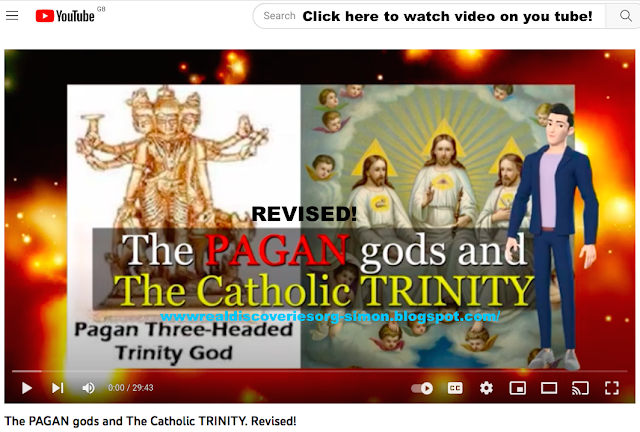
New and updated video on you tube!
The Catholic TRINITY.

Over 100 Questions, If you believe Jesus Is GOD?

SHOCKING QUOTES ABOUT THE TRINITY!

No comments:

Post a Comment