
IMPORTANT UPDATE — NEW RESEARCH AVAILABLE
This subject has now been completely rewritten and expanded with additional research and evidence.
READ THE NEW UPDATED ARTICLE HERE:
Did the Catholic Church Create the Doctrine of the Trinity? And Did Later Church Fathers Reject the Earlier Jewish Understanding of the One God?
OR CLICK ON IMAGE BELOW
PLEASE READ MY UPDATED ARTICLE:

A detailed historical research image examining the development of the doctrine of the Trinity, featuring Simon Brown studying the Bible, the Trinity symbol, the Council of Nicaea, and the question of whether later Church Fathers rejected the earlier Jewish understanding that God is One.
DID THE CATHOLIC CHURCH CREATE THE DOCTRINE OF THE TRINITY?
And Did Later Church Fathers Reject the Earlier Jewish Understanding of the One God?
Research by Simon Brown

DID THE CATHOLIC CHURCH CREATE THE DOCTRINE OF THE TRINITY?
Quick Facts
- The word "Trinity" does not appear anywhere in the Bible.
- Neither Jesus nor His apostles ever taught that God is three persons.
- The doctrine developed gradually after the apostolic age.
- It was formally defined during the fourth century through church councils.
- History shows that the Roman Catholic Church played the central role in defining and promoting the doctrine that later became orthodox Christianity.
Introduction
One of the most important questions every Christian should ask is:
Did Jesus Christ and His apostles teach the doctrine of the Trinity, or did it develop later in church history?
The answer should not be based upon church tradition, denominational loyalty, or theological opinion.
Instead, we should examine the evidence found in Scripture and compare it with the historical record.
As Jesus said:
"Sanctify them in the truth; Your word is truth."(John 17:17)
Three Questions
This article examines three straightforward questions.
1. Was there a doctrine of the Trinity during the lifetime of Jesus and His apostles?
2. When was the doctrine formally defined?
3. What role did the Catholic Church play in establishing and defending it?
1. Was the Trinity taught by Jesus?
According to historical scholarship, the answer is no.
Even standard Christian reference works acknowledge that the doctrine was not fully formulated during the apostolic period.
Wikipedia summarizes the historical consensus:
"The doctrine did not take its definitive shape until late in the fourth century."
It also states:
"Scripture contains neither the word Trinity nor an expressly formulated doctrine of the Trinity."
Likewise, The Oxford Dictionary of the Christian Church explains that the doctrine was formulated during the fourth century and continued to be developed afterwards.
These statements do not come from anti-Trinitarian writers.
They come from mainstream historical and theological sources.
Therefore, history itself acknowledges that Jesus and His apostles did not leave behind a fully formulated doctrine of the Trinity.
2. When Was the Trinity Defined?
History records that the doctrine gradually developed during the third and fourth centuries.
The First Council of Nicaea met in A.D. 325.
The Council of Constantinople followed in A.D. 381.
These councils produced the Nicene-Constantinopolitan Creed, which became the official statement of Trinitarian belief for the Catholic Church and later for much of Christianity.
This demonstrates an important historical fact.
If the doctrine required centuries of debate, councils, and official creeds before being defined, then it was not presented by Jesus or His apostles in its later form.
3. What Role Did the Catholic Church Play?
Historical records show that the Roman Catholic Church became the principal institution responsible for defining, defending, and promoting the Nicene doctrine of the Trinity.
Wikipedia notes:
- The Council of Nicaea condemned Arianism.
- Trinitarian belief became official doctrine.
- The bishops of Rome defended and promoted this teaching.
- The Edict of Thessalonica (A.D. 380) established Nicene Christianity as the official religion of the Roman Empire.
These events marked a turning point in church history.
From this period onward, belief in the Nicene doctrine of the Trinity became the defining mark of Catholic orthodoxy.
Athanasius
One of the greatest defenders of the Nicene doctrine was Athanasius of Alexandria.
History remembers him as the leading defender of Trinitarian theology.
The Catholic Encyclopedia even refers to him as:
"The Father of Orthodoxy."
His influence on later Christian theology cannot be overstated.
The Athanasian Creed, although probably not written by Athanasius himself, bears his name and became one of the strongest historical statements supporting Trinitarian belief.
Sir Isaac Newton's Opinion
Sir Isaac Newton is remembered as one of history's greatest scientists.
Few people realise that he devoted more time to studying the Bible than to science.
According to historian Karl Giberson, Newton became convinced that the doctrine of the Trinity was not part of original Christianity but was introduced centuries later.
Newton believed that Scripture had been altered in places and that early Christianity had gradually departed from the faith taught by Jesus and His apostles.
Whether one agrees with Newton or not, his conclusions demonstrate that serious biblical scholars have questioned the historical development of the Trinity for centuries.
The Biblical Question
The real issue is not whether church councils defined the doctrine.
The real question is this:
Where did Jesus ever teach that God is three persons?
Where did Peter teach it?
Where did Paul teach it?
Where does the Bible define the Father, the Son, and the Holy Spirit as one God consisting of three co-equal, co-eternal persons?
The answer is nowhere.
Conclusion
History records how the doctrine of the Trinity was gradually developed, debated, defined, and defended during the fourth century.
The Roman Catholic Church played the central role in that process.
The remaining question is not historical but biblical.
Did Jesus and His apostles teach the doctrine that later became known as the Trinity?
That is the evidence every Christian should examine carefully.
"Test all things; hold fast what is good."1 Thessalonians 5:21

1. Was there a doctrine of the Trinity in the time of Jesus and His disciples?
Answer.
The simplest outline of the doctrine was formulated in the 4th century, largely in terms of rejection of what was considered not to be consonant with general Christian belief. Further elaboration continued in the succeeding centuries.[10]
Scripture contains neither the word Trinity,[11] nor an expressly formulated doctrine of the Trinity. Rather, according to the Christian theology, it "bears witness to" the activity of a God who can only be understood in Trinitarian terms.[12] The doctrine did not take its definitive shape until late in the fourth century.[13] During the intervening period, various tentative solutions, some more and some less satisfactory, were proposed.
10. "Trinity, doctrine of" in The Oxford Dictionary of the Christian Church (Oxford University Press 2005 ISBN 978-0-19-280290-3)
11. Matt Slick, "The word Trinity is not found in the Bible"
12. McGrath Alister E. Christian Theology: An Introduction Blackwell, Oxford (2001) p.321
13. McGrath, Alister E. Christian Theology: An Introduction Blackwell, Oxford (2001) p.324
The above info answers saying there was NO OFFICIAL Trinity doctrine in the time of Jesus and His disciples, because as we have clearly read. The Trinity doctrine did not take its definitive shape until 300 years later in the 4th century.
Question for Trinitarians?
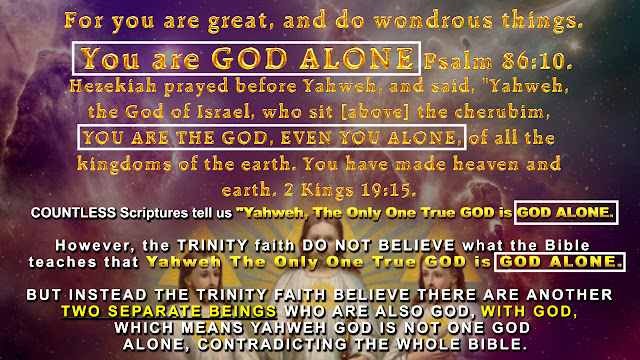
As there was NO TRINITY doctrine for over 300 years after Christ, and the Disciples and millions of Christians did not have the TRINITY doctrine as their MAIN faith, but instead believed GOD was ONE GOD AND ONE PERSON ALONE and that Jesus was the SON of GOD.
Would this mean the Disciples and millions of Christians, including Jesus who only ever taught His Father was ONE PERSON in Mark 12:29, and that He was GODS SON John 10:36, are they all going to HELL?
WHY DO MOST OF CHRISTIANITY BELIEVE IN WHAT WAS NEVER TAUGHT IN THE TIME OF JESUS AND HIS DISCIPLES?
No one needs to be a scientist to read the history of the TRINITY, and see how the TRINITY became a NEW RELIGION in the fourth century.
---------------------------------------------------------
RELATED ARTICLES:


No comments:
Post a Comment