

Who is the "Helper" promised in John 14:16? This study examines the original Greek language, compares Scripture with Scripture, and investigates whether Jesus was speaking about the Holy Spirit as a separate person or about His own continuing presence with His followers.
The "Helper" in John 14:16
One of the most frequently quoted passages used in support of the doctrine of the Trinity is John 14:16-18. Trinitarian theology teaches that the "Helper" (or "Comforter," "Advocate," or "Counselor," depending on the translation) is the third, separate person of the Trinity—the Holy Spirit.
But is that really what Jesus meant?
Rather than relying on tradition, church creeds, or theological assumptions, let us carefully examine the Scriptures and allow the Bible to interpret itself.
John 14:16-18
"And I will ask the Father, and He will give you another Helper, that He may be with you forever—the Spirit of truth, whom the world cannot receive because it neither sees Him nor knows Him. But you know Him, because He remains with you and will be in you. I will not leave you as orphans; I am coming to you."
(John 14:16-18, Berean Literal Bible)
According to traditional Trinitarian teaching, the "Helper" is the third person of the Trinity, distinct from both the Father and the Son.
For example, Matthew Poole's Commentary states:
"Another signifies the personal distinction of the Third from the First and Second Person in the blessed Trinity."
This interpretation assumes that Jesus is introducing an entirely separate divine person.
But does the text itself say that?
Let's investigate.
Who is the "Helper"?
Jesus said,
"I will ask the Father, and He will give you another Helper..."
The obvious question is:
Who is this Helper?
The Greek word translated Helper, Comforter, Counselor, or Advocate is:
Παράκλητον (Paraklēton)
Instead of assuming its meaning, let's see where else this exact Greek word appears.
1 John 2:1 Gives Us the Answer
John uses the identical Greek word only one other time.
"My little children, I write these things to you so that you may not sin. But if anyone sins, we have an Advocate with the Father—Jesus Christ the Righteous One."
(1 John 2:1)
Notice carefully.
The word translated Advocate here is exactly the same Greek word:
Παράκλητον (Paraklēton)
The identical word translated Helper in John 14:16 is translated Advocate in 1 John 2:1.
And who is this Advocate?
Jesus Christ Himself.
This immediately raises an important question:
Could Jesus be speaking about His own continuing presence with His disciples after His resurrection and exaltation?
"That He May Be With You Forever"
Jesus continues:
"...that He may be with you forever."
(John 14:16)
Who would remain with believers until the end of the age?
Later, after His resurrection, Jesus declared:
"And surely I am with you always, to the end of the age."
(Matthew 28:20)
Notice the similarity.
John 14 says the Helper will remain with believers forever.
Matthew 28 records Jesus saying:
"I am with you always."
Could Jesus be explaining that His presence would continue with His followers after His ascension?
The Spirit of Truth
John 14:17 continues:
"The Spirit of truth, whom the world cannot receive because it neither sees Him nor knows Him."
Who was it that the world failed to know?
John had already answered that earlier in his Gospel.
"He was in the world, and though the world was made through Him, the world did not know Him. He came to His own, and His own did not receive Him."
(John 1:10-11)
The world neither knew nor received Jesus.
This closely parallels the description of the Spirit of truth in John 14:17.
"You Know Him"
Jesus then tells His disciples:
"But you know Him, because He remains with you..."
(John 14:17)
Who was already living among them?
Jesus Himself.
The disciples had spent years walking beside Him.
He literally abided with them.
"...And He Will Be In You"
Jesus continues:
"...and He will be in you."
Just a few verses later Jesus explains exactly what He means.
"If anyone loves Me, he will keep My word. My Father will love him, and We will come to him and make Our home with him."
(John 14:23)
Notice something remarkable.
Jesus does not say only the Holy Spirit will dwell within believers.
Instead He says:
"We will come to him."
Both the Father and the Son make their dwelling with believers.
"I Will Not Leave You as Orphans"
Perhaps the clearest statement comes immediately afterward.
Jesus says:
"I will not leave you as orphans; I am coming to you."
(John 14:18)
Jesus does not say,
"The third person of the Trinity is coming to you."
Instead He says plainly:
"I am coming to you."
The following verse continues:
"In a little while the world will see Me no longer, but you will see Me."
(John 14:19)
The focus throughout this passage remains on Christ and His continuing relationship with His disciples.
A Summary of the Evidence
Several observations emerge from comparing these passages:
1. The Greek word Παράκλητον (Paraklēton)
The word translated Helper in John 14:16 is exactly the same Greek word translated Advocate in 1 John 2:1, where it unquestionably refers to Jesus Christ.
2. The Helper remains with believers forever.
Jesus later promises:
"I am with you always, to the end of the age."
(Matthew 28:20)
3. The world did not know Him.
John 14:17 describes the Spirit of truth as One whom the world neither knows nor receives.
John 1:10-11 says precisely the same about Jesus.
4. He already abides with the disciples.
Jesus says,
"You know Him, because He remains with you."
At that moment, Jesus Himself was physically with them.
5. Jesus says He is coming.
John 14:18 leaves little ambiguity:
"I will not leave you as orphans; I am coming to you."
Romans 8 Helps Explain This
Paul writes:
"You, however, are controlled not by the flesh, but by the Spirit, if indeed the Spirit of God dwells in you. And if anyone does not have the Spirit of Christ, he does not belong to Christ."
(Romans 8:9)
Notice how Paul speaks interchangeably of:
the Spirit of God
the Spirit of Christ
The emphasis is not on introducing a third separate divine being, but on God's own presence working in believers through His Son.
Conclusion
Many Christians understand John 14:16 as referring to a third, separate person of the Trinity because that is how the passage has traditionally been interpreted.
However, when Scripture is compared with Scripture, another interpretation emerges.
The same Greek word Paraklēton identifies Jesus Himself as the Advocate in 1 John 2:1.
Jesus promises that He will be with His followers until the end of the age.
He tells the disciples He is coming to them.
He says both He and the Father will make their home with believers.
For these reasons, many conclude that the "Helper" in John 14 is describing Christ's continuing presence with His people through the Spirit, rather than introducing a third separate divine person.
As always, every reader should examine the Scriptures carefully and prayerfully.
"Now these were more noble-minded... for they received the message with great eagerness and examined the Scriptures every day to see if these teachings were true."
(Acts 17:11)
May God's Word be our final authority.
.jpg "Is The THIRD person of the TRINITY?")
John 14:16.
And I will ask the Father, and He will give you 👉 another Helper, 👈 that He may be with you to the age— 17 the Spirit of truth, whom the world is not able to receive, because it does not see Him nor know. But you know Him, for He abides with you and He will be in you.
18 I will not leave you as orphans; I am coming to you.

According to the Trinity faith, they say, teach and believe The "Helper" In John 14:16 is the THIRD and a separate person of the TRINITY
Lets be sure with what the Trinitarians say, believe and teach by going to Matthew Poole's Commentary.
This verse containeth a new argument by which our Saviour relieveth his disciples under their affliction for the want of his bodily presence; that is, the mission of the Holy Spirit,
another Comforter, as our translation reads it. For this he saith that he will pray the Father; not that himself had no concern in the mission of the blessed Spirit; for himself telleth us, John 16:7, that he would send him; only for the attestation,
1. Of his human nature;
2. Of himself, as our Mediator; and:
3. Of his Father’s concern, as well as his own, in sending the Holy Spirit; he here saith, I will pray the Father, and he shall send you another Comforter.
That term
another, signifieth the personal distinction of the Third from the First and Second Person in the blessed Trinity. And the name here given to the blessed Spirit, Paraklhton, (which we too narrowly translate comforter), is a term exceedingly proper to signify all the operations of the blessed Spirit in and upon the souls of his people. The same word, 1Jo 2:1, where it is applied to Christ, (as here it is to the Spirit), is there much better translated Advocate; and it is most probable that our translators here translate it.

Is the Trinity faith correct?
Is The "Helper" In John 14:16 The THIRD and separate person of the TRINITY?
Lets have a look, at the word of God.
Jesus said: And I will ask the Father, and He will give you another 👉Helper,👈 that He may be with you to the age.

The question is:
And who will be another Helper?
Was Jesus talking about Himself, as being the HELPER?
Is the answer in 1 John 2:1?
Lets have a look.

My little children, I am writing these things to you so that you might not sin. And if anyone should sin, we have an👉 advocate 👈with the Father, Jesus Christ the Righteous One.

Did you see that: we have an "advocate" with the Father, Jesus Christ the Righteous One.
Could the "Helper" in John 14:16 be the same ''advocate'' in 1 John 2:1?

Lets now have a look at the Greek word for "advocate" in 1 John 2:1, and see what we discover.

As we see, the Greek word John 14:16 for "HELPER" is Παράκλητον.
Let us now have a look at the Greek word in 1 John 2:1, saying *advocate* and see what we discover!

As we have seen.
The Greek word for *advocate* in 1 John 2:1, is Παράκλητον, which is the IDENTICAL Greek word for HELPER in John 14:16 also saying Παράκλητον.
Lets now move forward to the next part in John 14:16, saying: that He may be with you to the age.

Who could Jesus be referring to by saying: that He may be with you to the age?
Is the answer in Matthew 28:20?
teaching them to observe all things, whatever I commanded you. And behold, I am with you all the days, until the completion of the "age."
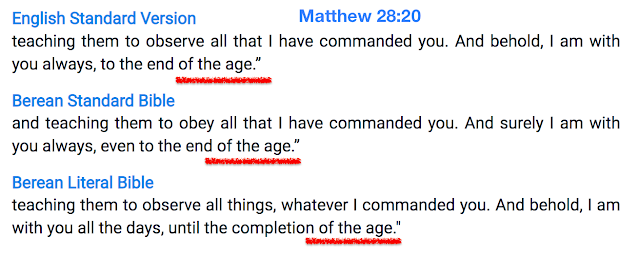
Did you see that?
John 14:16 says: that He (Jesus) may be with you to the age.
And in Matthew 28:20, we also read Jesus saying: And behold, I am with you all the days, until the completion of the "age."
Let's now continue to move forward to verse John 14:17 saying: the Spirit of truth, whom the world is not able to receive, because it does not see Him nor know.

Who could John 14:17 be referring to saying: the Spirit of truth, whom the world is not able to receive, because it does not see Him nor know.
Is the answer in John 1:10?
Lets have a look:
9 The true Light who enlightens every man was coming into the world. 10 He was in the world, and the world came into being through Him, and the world did not know Him. 11 He came to the own, and the own did not receive Him.

Did you see that?
and the world did not know Him. 11 He came to the own, and the own did not receive Him.
John 1:10 is telling us the same thing we read in John 14:17 saying: the Spirit of truth, whom the world is not able to receive, because it does not see Him nor know.
Lets again move forward to the next part in verse John 14:17 saying: But you know Him, for He abides with you and He will be in you.
Who could Jesus be referring to saying: But you know Him, for He abides with you?
Well, I think we can all agree Jesus is referring to Himself, and the disciples: He abides with you, Jesus.
We continue, John 14:17 and He will be in you.
WHO is Jesus referring to by saying: and He will be in you?
Lets turn to John 14:23:
Jesus answered and said to him, "If anyone loves Me, he will keep My word, and My Father will love him, and we will come to him and will make a home with him.

Did you see that?
and we will come to him and will make a home with him.
But there is more in the very next verse of John 14:18 saying: I will not leave you as orphans; I am coming to you

Who is Jesus now talking about?
The answer is in the very next verse of John 14:19 saying: Yet a little while, and the world sees Me no more, but you see Me. Because I live, you also will live.

Lets recap on what we have seen and read.
1. The Greek word Παράκλητον, for HELPER in John 14:16, is the IDENTICAL Greek word in 1 John 2:1 also saying Παράκλητον for *advocate*, which we know applies to Jesus.
2. In John 14:16, Jesus told us how the Helper, would be: with you to the age.
Agreeing with the same person in Matthew 28:20 being Jesus saying: I am with you all the days, until the completion of the "age."
3. The Spirit of truth, in John 14:17 whom the world is not able to receive, because it does not see Him nor know, agrees with what we read in John 1:10, telling us how: the world did not know Him (Jesus). 11 He came to the own, and the own did not receive Him, we also know is Jesus.
4. In John 14:17 saying: But you know Him, for He abides with you and He will be in you.
Agree with John 14:23: Jesus answered and said to him, "If anyone loves Me, he will keep My word, and My Father will love him, and we will come to him and will make a home with him.
Conclusion.
As we have seen in the Biblical facts, how The "Helper" In John 14:16 seems to NOT be a THIRD separate person of the TRINITY!
But the "Helper" is the *advocate*, which seems to be applied to Jesus.
However, you decide.
Romans 8:9 Berean Literal Bible
Now you are not in flesh but in Spirit, if indeed the Spirit of God dwells in you; but if anyone does not have the Spirit of Christ, he is not of Him.


For a great article please click here: What is the Holy Spirit?
https://www.biblicalunitarian.com/articles/what-is-the-holy-spirit

By Sir Anthony Buzzard, biblical scholar, unitarian Christian theologian.
ReplyDeleteThe helper (paraclete) is Jesus returning in spirit after he ascended
Jesus said “I am going away but I will not leave you, ie abandon you.
So Jesus in I John 21:1 is said to be the paraclete, ie helper.
There cannot be two Paracletes. Jesus is the one helper of I John 2:1.
The spirit of the risen Jesus operates to help us now.
In hope,
Anthony
By Sir Anthony Buzzard, biblical scholar, unitarian Christian theologian.
ReplyDeleteThe helper (paraclete) is Jesus returning in spirit after he ascended
Jesus said “I am going away but I will not leave you, ie abandon you.
So Jesus in I John 21:1 is said to be the paraclete, ie helper.
There cannot be two Paracletes. Jesus is the one helper of I John 2:1.
The spirit of the risen Jesus operates to help us now.
In hope,
Anthony