Simon Brown.

Join me on this journey. Let's seek the truth together! 💡 Proverbs 8:34-36 Blessed is the man who hears me, watching daily at my gates, waiting at my door posts. For whoever finds me finds life, and will obtain favor from Yahweh. But he who sins against me wrongs his own soul. All those who hate me love death.” Psalm 84: 11 For Yahweh God is a sun and a shield. Yahweh will give grace and glory. He withholds no good thing from those who walk blamelessly. 12 Yahweh of Armies, blessed is the man who trusts in you. 1 John 5:5 Now who is the one overcoming the world, except the one believing that Jesus is the Son of God.
Showing posts with label Bible archaeology. Show all posts

Wednesday, 19 August 2026

The Dead Sea Scrolls – Ancient Biblical Manuscripts Discovered at Qumran


The Dead Sea Scrolls discovered in caves near Qumran, including ancient biblical manuscripts, the Great Isaiah Scroll and other Jewish writings dating from around the time before and during the beginnings of Christianity.

A detailed Bible archaeology image exploring the Dead Sea Scrolls, the ancient manuscripts discovered in caves near Qumran by the Dead Sea. The collection includes biblical manuscripts, Jewish religious writings, the Great Isaiah Scroll and the mysterious Copper Scroll, providing invaluable evidence for studying the transmission of the Hebrew Scriptures and the Jewish world surrounding the beginnings of Christianity.

THE DEAD SEA SCROLLS

ONE OF THE GREATEST BIBLICAL MANUSCRIPT DISCOVERIES EVER MADE

By Simon Brown

Few archaeological discoveries connected with the Bible have caused as much excitement as the:

DEAD SEA SCROLLS

Hidden away for nearly two thousand years in caves near the Dead Sea, these ancient manuscripts have transformed our understanding of the transmission of the Hebrew Bible and the Jewish world in the centuries surrounding the time of Jesus.

Their discovery has rightly been described as one of the greatest manuscript discoveries of modern times.

And for anyone interested in the historical reliability and preservation of the Bible, the Dead Sea Scrolls are extraordinary.


DISCOVERED NEAR THE DEAD SEA

The first scrolls were discovered in 1947 near Khirbet Qumran, close to the northwestern shore of the Dead Sea.

According to the famous account, Bedouin shepherds discovered ancient manuscripts inside a cave.

What initially appeared to be some old pieces of leather eventually became an archaeological sensation.

Further exploration and excavation followed.

Between 1947 and 1956, manuscripts and fragments were recovered from eleven caves around Qumran.

Altogether, the discoveries represented the remains of roughly 900 manuscripts, although estimates vary depending upon how individual fragments are counted.

Some manuscripts survived remarkably well.

Others were found in thousands of fragments that scholars have painstakingly studied and reconstructed.


MANUSCRIPTS PRESERVED FOR APPROXIMATELY 2,000 YEARS

Many of the manuscripts were written on parchment, while others were written on papyrus.

They were composed primarily in:

HEBREW

ARAMAIC

and a smaller number in:

GREEK.

Some scrolls had been placed inside pottery jars, helping preserve them in the extremely dry climate surrounding the Dead Sea.

Imagine that.

Ancient biblical manuscripts were hidden in caves before or around the time of Jesus and remained there for nearly two thousand years.

Then, in the twentieth century, they were brought back into the light.


WHY ARE THE DEAD SEA SCROLLS SO IMPORTANT TO THE BIBLE?

Before their discovery, the principal complete Hebrew manuscripts used for studying the Old Testament came from many centuries after the time of Jesus.

The Dead Sea Scrolls suddenly provided biblical manuscripts approximately one thousand years older than the great medieval Masoretic codices.

This gave scholars an extraordinary opportunity.

They could compare much older copies of biblical books with Hebrew manuscripts copied many centuries later.

And what did they discover?

There are textual differences—as we should expect from manuscripts copied by hand—but the scrolls also demonstrate substantial continuity in the transmission of the Hebrew Scriptures.

That makes them enormously important for the study of the Old Testament text.


ALMOST EVERY BOOK OF THE HEBREW BIBLE

Among the Dead Sea Scrolls are manuscripts or fragments representing books from almost the entire Hebrew Bible.

Copies were discovered from books including:

Genesis

Exodus

Leviticus

Numbers

Deuteronomy

Joshua

Judges

Samuel

Kings

Isaiah

Jeremiah

Ezekiel

Psalms

and many others.

The major exception is Esther, for which no securely identified manuscript has been found among the Dead Sea Scrolls.

This means we possess biblical texts copied centuries before the medieval manuscripts upon which much traditional Hebrew textual study had previously depended.


THE GREAT ISAIAH SCROLL

Perhaps the most famous biblical manuscript discovered at Qumran is:

THE GREAT ISAIAH SCROLL

Known by scholars as 1QIsaᵃ, it contains all sixty-six chapters of Isaiah.

The scroll dates from approximately the second century BC.

That means this manuscript of Isaiah existed well before the ministry of Jesus.

This is particularly fascinating for Christians because Isaiah contains numerous passages that became extremely important in New Testament teaching and Christian understanding of the Messiah.

Today we can actually examine a copy of Isaiah that was already ancient when Christianity began.

That is remarkable.


BIBLICAL AND NON-BIBLICAL MANUSCRIPTS

The Dead Sea Scrolls are not simply copies of books found in our Bible.

The collection contains several different kinds of writings.

These include:

BIBLICAL MANUSCRIPTS

Copies of books belonging to the Hebrew Scriptures.

JEWISH RELIGIOUS WRITINGS

Ancient works known from Jewish literature outside the biblical canon, including writings connected with figures such as Enoch and other biblical personalities.

COMMUNITY DOCUMENTS

Rules, hymns, commentaries, calendars and other writings associated with the Jewish community or communities responsible for preserving the collection.

Together, these documents provide an extraordinary window into Jewish religious thought during the centuries before and around the time of Jesus.


THE MYSTERIOUS COPPER SCROLL

One of the strangest discoveries came from Cave 3.

Unlike the parchment and papyrus manuscripts, this document was written upon sheets of copper.

It became known simply as:

THE COPPER SCROLL

The text describes dozens of locations where enormous quantities of treasure were supposedly hidden.

Gold.

Silver.

Valuable objects.

The document lists approximately sixty-four locations connected with hidden treasure.

Naturally, this created an enormous mystery.

WHERE IS THE TREASURE?


WAS IT TREASURE FROM SOLOMON'S TEMPLE?

This is where we need to distinguish fascinating speculation from established archaeology.

Some have proposed that the Copper Scroll describes treasure connected with the Jerusalem Temple.

However, we cannot presently establish that these treasures came from Solomon's Temple.

Solomon's Temple was destroyed by the Babylonians centuries before the Dead Sea Scrolls were deposited at Qumran.

Other theories connect the treasure with the Second Temple, which was destroyed by the Romans in AD 70.

The true identity and fate of the Copper Scroll treasure remain debated.

And despite many searches, the enormous treasure described in the document has never been conclusively discovered.

So the mystery remains.


THE SCROLLS TAKE US BACK BEFORE JESUS

This is perhaps the most important point for Bible students.

These manuscripts take us directly into the Jewish world before and during the period in which Christianity emerged.

When Jesus entered a synagogue and read from Isaiah, the book of Isaiah was already an ancient Jewish Scripture.

When Jesus spoke about:

Moses,

David,

Isaiah,

Abraham

and the Law and the Prophets, these writings were already being copied, studied and preserved.

The Dead Sea Scrolls physically demonstrate this.

They are surviving manuscripts from that ancient world.


ARCHAEOLOGY ALLOWS US TO SEE THE ANCIENT BIBLE

We are no longer dealing merely with someone's claim about what ancient Jewish people read.

We have the manuscripts.

Fragments can be photographed.

Letters can be examined.

Different textual readings can be compared.

Languages can be studied.

The age of manuscripts can be scientifically investigated.

And scholars from different religious and non-religious backgrounds can examine the same evidence.

That is one of the things I love about biblical archaeology:

THE EVIDENCE CAN BE INVESTIGATED.


THE DEAD SEA SCROLLS AND THE PRESERVATION OF SCRIPTURE

The Dead Sea Scrolls do not demonstrate that every copy of every biblical book was letter-for-letter identical.

There are genuine textual variants among the manuscripts.

In fact, these differences are extremely valuable because they allow textual scholars to study how the biblical text was transmitted.

But the scrolls also reveal remarkable continuity across enormous periods of time.

Passages copied centuries before Christ can be compared with much later Hebrew manuscripts.

This provides an extraordinary historical window into the preservation and transmission of Scripture.


WHERE CAN THE DEAD SEA SCROLLS BE SEEN?

Some of the most famous Dead Sea Scrolls are preserved in the Shrine of the Book at the Israel Museum in Jerusalem.

The distinctive building was specifically designed to house and display important manuscripts associated with the discoveries.

Modern technology has also made high-resolution images of major scrolls available for scholars and the public to examine digitally.

Think about what this means.

Something hidden inside caves for approximately two thousand years can now be examined by people throughout the world.


ONE OF THE GREATEST BIBLE DISCOVERIES EVER MADE

The Dead Sea Scrolls did not simply give archaeology another interesting ancient artefact.

They gave us an entire library from the ancient Jewish world.

They contain manuscripts of books we still read today.

They preserve Hebrew Scripture from centuries before the medieval biblical manuscripts.

They reveal Jewish beliefs and practices around the period in which Christianity emerged.

And they allow modern scholars to compare the biblical text across more than a thousand years of manuscript transmission.

That is why the discovery of the Dead Sea Scrolls was so important.

THE DEAD SEA SCROLLS

ANCIENT MANUSCRIPTS HIDDEN FOR NEARLY TWO THOUSAND YEARS

DISCOVERED AGAIN IN THE JUDEAN DESERT

AND STILL SPEAKING TO US TODAY.

Don't simply take someone's word for it.

Look at the manuscripts.

Study their dates.

Compare the biblical texts.

Examine the archaeological evidence for yourself.

As Jesus taught:

“Ask, and it will be given to you; seek, and you will find; knock, and it will be opened to you.”
— Matthew 7:7, BLB

Research by Simon Brown

wwwrealdiscoveriesorg-simon.blogspot.com

RELATED ARTICLES

Wonderful Books on Biblical Archaeology – Discover the Evidence for the Bible.

The Astartu Relief – Bible Archaeology at Its Best.

 Did Ancient Clay Tablets Preserve the Story of Noah's Flood?

  Pontius Pilate's Roman Coins – Archaeological Evidence from the Time of Jesus

• The Lachish Letters Reveal the Divine Name of God

Has The Staff, or Rod of Moses been discovered?

• What Did Sir Isaac Newton Really Believe About God, Christ, and the Trinity?

• Josephus on Jesus – One of the Most Important Non-Biblical Witnesses

• Could These Bones Be Those of John the Baptist?

• The Discovery of the Great Stone of Mark 16:4

• The History, Evidence, and Resurrection of Jesus Christ

The History, the Evidence, and the Scientific Facts Behind the Life, Death, and Resurrection of Jesus Christ.

 Josephus on Jesus – One of the Most Important Non-Biblical Witnesses.

 Historicity of Jesus – The Historical Evidence for Jesus Christ

Evidence confirms Jesus crucifixion outside the Bible: The Babylonian Talmud.

Prophecies In The Bible. Researched By Simon Brown.

Did Ancient Clay Tablets Preserve the Story of Noah's Flood?

Pontius Pilate Inscription — Archaeology Confirms the Biblical Governor of Judea.

The Cambrian Explosion — Does It Support Evolution or Creation?

Is Jesus God? What Did Jesus Actually Say About Himself?

Is God One or Three Persons? – A Biblical Examination

The Greatest Commandment Ever Given — Does Modern Christianity Still Believe It?

The World is Like a Ticking Bomb!

What I've noticed when I follow christ!

Videos

Over 100 Old Testament Bible Prophecies fulfilled of Jesus Christ. 1/3.

The Prophet Isaiah 53 Prophecy Part 1/3

DISCOVERED: The True Tomb of Jesus & The GREAT Stone to The Tomb.


Tuesday, 18 August 2026

The Gallio Inscription – Archaeological Evidence for the Roman Governor Who Judged Paul in Acts 18:12


The Gallio Inscription from Delphi naming Lucius Junius Gallio, proconsul of Achaia, compared with Acts 18:12 where Paul is brought before Gallio for judgment.

A detailed Bible archaeology image examining the Gallio Inscription, also known as the Delphi Inscription. The ancient inscription records Lucius Junius Gallio as proconsul, while Acts 18:12–17 describes Paul being brought before Gallio in Achaia, providing an important connection between the New Testament and independently preserved Roman history.

THE GALLIO INSCRIPTION

ARCHAEOLOGICAL EVIDENCE FOR THE ROMAN GOVERNOR WHO JUDGED PAUL IN ACTS 18:12

By Simon Brown

Archaeology continues to uncover remarkable evidence from the historical world described in the Bible.

Names of rulers, governors, cities and political offices recorded in Scripture can sometimes also be found in inscriptions and other archaeological evidence outside the Bible.

One particularly important discovery concerns a Roman official named:

GALLIO

Why is Gallio important?

Because the book of Acts tells us that the apostle Paul was brought before him for judgment:

“But Gallio being proconsul of Achaia, the Jews rose up with one accord against Paul and led him to the judgment seat.”
Acts 18:12, BLB

Gallio was not merely a character known from the New Testament.

We have important independent historical evidence for him.

And that evidence has become one of the most useful chronological markers for dating the ministry of the apostle Paul.


THE GALLIO INSCRIPTION

In the early twentieth century, fragments of an ancient inscription were discovered at Delphi in Greece, associated with the sanctuary of Apollo.

The reconstructed inscription preserves part of a letter from the Roman emperor:

CLAUDIUS

The inscription is commonly called the:

DELPHI INSCRIPTION

or:

GALLIO INSCRIPTION

Among its most important surviving words is a reference to:

LUCIUS JUNIUS GALLIO

and identifies him as the emperor's:

“FRIEND AND PROCONSUL.”

This is extraordinary when compared with Acts.

The inscription identifies Gallio as a proconsul.

And what does Luke call Gallio?

“Gallio being proconsul of Achaia…”
— Acts 18:12, BLB

The title fits the historical setting.


PAUL IS BROUGHT BEFORE GALLIO

Acts 18 describes Paul preaching in Corinth, the capital of the Roman province of Achaia.

Opposition eventually arose against him.

Acts records:

“But Gallio being proconsul of Achaia, the Jews rose up with one accord against Paul and led him to the judgment seat, saying, ‘This man persuades men to worship God contrary to the law.’”
— Acts 18:12–13, BLB

Paul was preparing to defend himself when Gallio intervened.

Gallio regarded the dispute as an internal religious matter rather than a Roman criminal offence and refused to judge it.

The account therefore places Paul within a very specific historical setting:

Corinth.

The Roman province of Achaia.

The office of proconsul.

And:

GALLIO.

Then archaeology gives us an independent inscription naming that same Roman official.


WHY IS THE GALLIO INSCRIPTION SO IMPORTANT?

The importance goes far beyond simply demonstrating that Gallio existed.

The inscription can be approximately dated because it records the imperial titles of Claudius Caesar.

This allows historians to place Gallio's period as proconsul of Achaia around AD 51–52.

That provides historians with an extremely valuable chronological anchor for Paul's life.

In other words, Acts does not merely mention an otherwise unknown man named Gallio.

It places Paul before a genuine Roman provincial governor whose period in office can be connected with independent Roman evidence.

That enables scholars to build a chronology around Paul's time in Corinth and, from there, other events in his ministry.


EVEN CLAUDIUS CAESAR APPEARS IN THE BIBLE

There is another fascinating connection.

The emperor responsible for the Delphi inscription was:

CLAUDIUS CAESAR

And Claudius himself appears in the New Testament.

Acts 11:28 records the prophet Agabus predicting a severe famine:

“And one of them named Agabus, having risen up, signified through the Spirit that a great famine was about to be over the whole world, which came to pass under Claudius.”
— Acts 11:28, BLB

Acts therefore places its narrative within the reign of a genuine Roman emperor independently known from abundant historical evidence.

Later, Acts 18:2 refers to Claudius again when Paul meets Aquila and Priscilla:

“…because Claudius had commanded all the Jews to depart out of Rome.”
— Acts 18:2, BLB

So within the historical setting surrounding Paul we encounter real Roman rulers and administrators whose existence is known independently of Scripture.


COMPARE THIS WITH PONTIUS PILATE

There is an interesting parallel with another famous New Testament figure:

PONTIUS PILATE

Pilate governed Judaea and presided over the proceedings that resulted in the crucifixion of Jesus.

Then, in 1961, archaeologists at Caesarea Maritima discovered the famous Pilate Stone, bearing Pilate's name and Roman title.

Once again, archaeology supplied independent evidence for a government official appearing in the New Testament.

The Gallio inscription provides another example.

Luke writes about Gallio.

Roman evidence identifies Gallio.

Luke identifies him as proconsul of Achaia.

The Delphi inscription likewise associates Gallio with the office of proconsul.


THIS IS WHY BIBLE ARCHAEOLOGY IS SO FASCINATING

Think about what we have.

The New Testament records:

PAUL

standing in:

CORINTH

before:

GALLIO

the:

PROCONSUL OF ACHAIA

during the reign of:

CLAUDIUS CAESAR.

Then we step outside the Bible and examine the historical and archaeological evidence.

Claudius was unquestionably a genuine Roman emperor.

Gallio was unquestionably a genuine historical individual.

The Delphi inscription identifies Gallio in connection with his position as proconsul.

And its dating places him remarkably close to the period in which Acts says Paul appeared before him.

These are not imaginary places and rulers.

They belong to the genuine political world of the first-century Roman Empire.


DOES THE GALLIO INSCRIPTION “PROVE THE BIBLE”?

As with all archaeological evidence, we should describe exactly what the discovery demonstrates.

The inscription does not mention Paul or describe Paul's trial.

Therefore, it would be going beyond the evidence to say the inscription independently proves that the trial itself occurred.

What it does provide is powerful independent confirmation of an important historical person and office described by Acts.

It confirms that Gallio was a real Roman official.

It supports the title Acts gives him.

And crucially, it helps historians establish the chronology of Paul's ministry in Corinth.

That is substantial historical evidence.

We do not need to exaggerate it.

THE REAL EVIDENCE IS REMARKABLE ENOUGH.


THE BIBLE IS ROOTED IN REAL HISTORY

This is what I find so fascinating about biblical archaeology.

Again and again Scripture places its narratives within identifiable historical settings.

It names:

Kings.

Governors.

Emperors.

Cities.

Nations.

Political offices.

And archaeology and ancient historical sources allow us to investigate many of these people and places independently.

The Gallio inscription is an excellent example.

Nearly two thousand years after Paul stood in Roman Corinth, fragments of an imperial inscription help us reconstruct the same historical world described in Acts.


THE GALLIO INSCRIPTION

ARCHAEOLOGICAL EVIDENCE FOR THE ROMAN GOVERNOR WHO JUDGED PAUL

The Bible records:

“Gallio being proconsul of Achaia…”
— Acts 18:12, BLB

And an ancient inscription from Delphi preserves evidence for:

GALLIO — PROCONSUL

This discovery does not require blind faith.

The inscription can be examined.

The archaeology can be studied.

The chronology can be investigated.

And the evidence can be compared with the book of Acts.

SEARCH THE EVIDENCE.

STUDY THE HISTORY.

COMPARE IT WITH SCRIPTURE.

Jesus said:

“Ask and it will be given to you; seek and you will find; knock and it will be opened to you.”
— Matthew 7:7, BLB

I pray that discoveries such as the Gallio inscription encourage people to investigate the historical foundations of the Bible and ultimately to seek the one true God and His Messiah, Jesus Christ.

Research by Simon Brown

wwwrealdiscoveriesorg-simon.blogspot.com

RELATED ARTICLES

Wonderful Books on Biblical Archaeology – Discover the Evidence for the Bible.

The Astartu Relief – Bible Archaeology at Its Best.

 Did Ancient Clay Tablets Preserve the Story of Noah's Flood?

  Pontius Pilate's Roman Coins – Archaeological Evidence from the Time of Jesus

• The Lachish Letters Reveal the Divine Name of God

Has The Staff, or Rod of Moses been discovered?

• What Did Sir Isaac Newton Really Believe About God, Christ, and the Trinity?

• Josephus on Jesus – One of the Most Important Non-Biblical Witnesses

• Could These Bones Be Those of John the Baptist?

• The Discovery of the Great Stone of Mark 16:4

• The History, Evidence, and Resurrection of Jesus Christ

The History, the Evidence, and the Scientific Facts Behind the Life, Death, and Resurrection of Jesus Christ.

 Josephus on Jesus – One of the Most Important Non-Biblical Witnesses.

 Historicity of Jesus – The Historical Evidence for Jesus Christ

Evidence confirms Jesus crucifixion outside the Bible: The Babylonian Talmud.

Prophecies In The Bible. Researched By Simon Brown.

Did Ancient Clay Tablets Preserve the Story of Noah's Flood?

Pontius Pilate Inscription — Archaeology Confirms the Biblical Governor of Judea.

The Cambrian Explosion — Does It Support Evolution or Creation?

Is Jesus God? What Did Jesus Actually Say About Himself?

Is God One or Three Persons? – A Biblical Examination

The Greatest Commandment Ever Given — Does Modern Christianity Still Believe It?

The World is Like a Ticking Bomb!

What I've noticed when I follow christ!

Videos

Over 100 Old Testament Bible Prophecies fulfilled of Jesus Christ. 1/3.

The Prophet Isaiah 53 Prophecy Part 1/3

DISCOVERED: The True Tomb of Jesus & The GREAT Stone to The Tomb.


King Solomon’s Wall Found – Archaeological Evidence from Ancient Jerusalem

King Solomon’s Wall archaeological research showing ancient Jerusalem fortifications associated by archaeologist Eilat Mazar with the 10th century BC and the biblical account of Solomon building Jerusalem’s wall.

 A detailed Bible archaeology image examining ancient fortifications excavated in Jerusalem and interpreted by archaeologist Eilat Mazar as dating to the 10th century BC. The discovery is compared with 1 Kings 9:15, where the Bible describes King Solomon’s building projects, including the wall of Jerusalem.

KING SOLOMON’S WALL FOUND

DOES ARCHAEOLOGY SUPPORT THE BIBLICAL ACCOUNT OF SOLOMON’S JERUSALEM?

By Simon Brown

Here is another fascinating archaeological discovery from Jerusalem that takes us directly into the period traditionally associated with King Solomon, son of King David.

The Bible describes Solomon as ruling from Jerusalem during the tenth century BC and undertaking major construction projects within the city.

But is there archaeological evidence from Jerusalem dating to this period?

In 2010, archaeologist Eilat Mazar announced the excavation of a substantial section of ancient fortifications in Jerusalem which she dated to approximately the tenth century BC.

The discovery attracted worldwide attention because Mazar argued that the fortifications could be connected with the building activities of:

KING SOLOMON.


A 3,000-YEAR-OLD DEFENSIVE COMPLEX

The excavations uncovered part of an ancient defensive complex on the eastern side of ancient Jerusalem, in the area of the Ophel, between the City of David and the Temple Mount.

The remains included a substantial wall together with associated structures.

Among the discoveries were:

A large section of defensive wall

A monumental gatehouse

An adjacent royal/public building

Pottery and other archaeological remains

The dating was particularly important.

Mazar and her team associated pottery recovered from the excavation with the second half of the tenth century BC.

That places the remains within the period traditionally associated with the reign of:

KING SOLOMON.


WHY IS THIS SO INTERESTING FOR BIBLE STUDENTS?

Because the Bible specifically describes Solomon undertaking major building and fortification projects in Jerusalem.

First Kings records:

“And this is the account of the forced labor that King Solomon raised to build the house of Yahweh, and his own house, and the Millo, and the wall of Jerusalem…”
— 1 Kings 9:15, BLB

Notice that carefully.

The biblical writer specifically associates Solomon with:

THE WALL OF JERUSALEM.

Now archaeology has uncovered substantial fortifications in Jerusalem that their excavator dated to the same general period traditionally associated with Solomon.

That is certainly worthy of investigation.


DID ARCHAEOLOGISTS ACTUALLY FIND “SOLOMON’S WALL”?

Here we need to distinguish the archaeological evidence from its historical interpretation.

Archaeologists did not uncover an inscription saying:

“THIS WALL WAS BUILT BY KING SOLOMON.”

Therefore, we cannot scientifically identify the builder simply from the wall itself.

What was discovered was an impressive fortification complex that Eilat Mazar dated to the tenth century BC and interpreted as fitting the biblical description of construction undertaken during Solomon's reign.

Mazar argued that the size and sophistication of the complex indicated the presence of a strong centralized government capable of undertaking substantial public construction.

She believed the biblical account provided a compelling historical explanation:

THE KINGDOM OF SOLOMON.


ARCHAEOLOGY AND THE BIBLE

This is where biblical archaeology becomes particularly fascinating.

The Bible says Solomon ruled from Jerusalem.

The Bible describes extensive construction during his reign.

The Bible specifically mentions:

“THE WALL OF JERUSALEM.”

And archaeologists have uncovered major fortifications in Jerusalem which their excavator dated to approximately the period traditionally associated with Solomon.

Does that prove every story told about Solomon?

No.

But neither should the archaeological evidence simply be ignored.

It provides physical evidence that can be compared directly with the historical claims contained in Scripture.


THE IMPORTANCE OF THE POTTERY

Archaeologists often use pottery to help date ancient occupation layers and structures.

Ceramic remains recovered during these excavations were important to Mazar's dating of the fortification complex.

She placed the pottery assemblage in the latter part of the tenth century BC.

If that dating and the association between the pottery and construction are correct, then the fortifications belong remarkably close to the traditional biblical chronology of Solomon.

This is why the discovery generated such enormous interest.


THE BIBLE DESCRIBES A BUILDING KING

Solomon is repeatedly presented in Scripture as a great builder.

He constructed:

THE TEMPLE OF YAHWEH

THE KING'S PALACE

FORTIFICATIONS

and other major projects.

First Kings 9:15 even names several of Solomon's building projects:

“…the house of Yahweh, and his own house, and the Millo, and the wall of Jerusalem, and Hazor, and Megiddo, and Gezer.”

The archaeological debate therefore concerns something that the Bible itself specifically claims occurred.


DOES THIS PROVE KING SOLOMON EXISTED?

The fortification alone cannot prove that Solomon personally ordered its construction.

That would require evidence identifying Solomon directly with the structure.

And archaeologists continue to debate the chronology, interpretation and extent of Jerusalem during the tenth century BC.

But the discovery is nevertheless highly relevant to the debate.

It provides archaeological remains of substantial construction in ancient Jerusalem that have been dated by the excavator to the period in which the Bible places David and Solomon.

That deserves serious consideration.


DON'T EXAGGERATE THE EVIDENCE — INVESTIGATE IT

When discussing biblical archaeology, we don't need to claim more than archaeology can actually demonstrate.

The genuine evidence is fascinating enough.

The important facts are:

Ancient fortifications were excavated in Jerusalem.

Eilat Mazar dated them to approximately the tenth century BC.

She interpreted them as potentially belonging to the building program of Solomon.

And:

The Bible independently describes Solomon building and strengthening Jerusalem's wall.

That creates an intriguing correspondence between archaeology and the biblical account.


KING SOLOMON’S WALL?

King Solomon’s Wall archaeological research showing ancient Jerusalem fortifications associated by archaeologist Eilat Mazar with the 10th century BC and the biblical account of Solomon building Jerusalem’s wall.

Perhaps the best way to state the archaeological question is:

HAVE ARCHAEOLOGISTS DISCOVERED PART OF THE JERUSALEM FORTIFICATIONS DESCRIBED IN 1 KINGS 9:15?

Eilat Mazar believed the evidence pointed strongly in that direction.

Other archaeologists have challenged aspects of the dating and interpretation.

So rather than hiding that debate, we should examine it.

Look at the archaeology.

Look at the pottery.

Look at the chronology.

Read the arguments from both sides.

Then compare everything with the biblical account.

That is how serious Bible archaeology should be approached.


ANOTHER REMARKABLE DISCOVERY FROM THE WORLD OF THE BIBLE

Approximately three thousand years after the period traditionally associated with Solomon, ancient walls still stand beneath Jerusalem.

The Bible tells us:

“…King Solomon raised [labor] to build…the wall of Jerusalem…”
— 1 Kings 9:15, BLB

Archaeology has uncovered fortifications dating, according to their excavator, to that same general period.

Is this part of the wall constructed during Solomon's reign?

The evidence deserves investigation.

SEARCH THE ARCHAEOLOGY.

COMPARE THE HISTORY.

READ THE BIBLE.

AND EXAMINE THE EVIDENCE FOR YOURSELF.

Research by Simon Brown

wwwrealdiscoveriesorg-simon.blogspot.com

RELATED ARTICLES

Wonderful Books on Biblical Archaeology – Discover the Evidence for the Bible.

The Astartu Relief – Bible Archaeology at Its Best.

 Did Ancient Clay Tablets Preserve the Story of Noah's Flood?

  Pontius Pilate's Roman Coins – Archaeological Evidence from the Time of Jesus

• The Lachish Letters Reveal the Divine Name of God

Has The Staff, or Rod of Moses been discovered?

• What Did Sir Isaac Newton Really Believe About God, Christ, and the Trinity?

• Josephus on Jesus – One of the Most Important Non-Biblical Witnesses

• Could These Bones Be Those of John the Baptist?

• The Discovery of the Great Stone of Mark 16:4

• The History, Evidence, and Resurrection of Jesus Christ

The History, the Evidence, and the Scientific Facts Behind the Life, Death, and Resurrection of Jesus Christ.

 Josephus on Jesus – One of the Most Important Non-Biblical Witnesses.

 Historicity of Jesus – The Historical Evidence for Jesus Christ

Evidence confirms Jesus crucifixion outside the Bible: The Babylonian Talmud.

Prophecies In The Bible. Researched By Simon Brown.

Did Ancient Clay Tablets Preserve the Story of Noah's Flood?

Pontius Pilate Inscription — Archaeology Confirms the Biblical Governor of Judea.

The Cambrian Explosion — Does It Support Evolution or Creation?

Is Jesus God? What Did Jesus Actually Say About Himself?

Is God One or Three Persons? – A Biblical Examination

The Greatest Commandment Ever Given — Does Modern Christianity Still Believe It?

The World is Like a Ticking Bomb!

What I've noticed when I follow christ!

Videos

Over 100 Old Testament Bible Prophecies fulfilled of Jesus Christ. 1/3.

The Prophet Isaiah 53 Prophecy Part 1/3

DISCOVERED: The True Tomb of Jesus & The GREAT Stone to The Tomb.


The House of David Inscription – The Tel Dan Stele and Archaeological Evidence for the Dynasty of David


The House of David Inscription and Tel Dan Stele showing the ancient Aramaic phrase BYT DWD, commonly translated “House of David,” archaeological evidence for the Davidic dynasty.

A detailed Bible archaeology infographic examining the Tel Dan Stele, also known as the House of David Inscription. The ancient Aramaic inscription contains the expression BYT DWD, widely interpreted as “House of David,” providing significant extra-biblical evidence for the historical Davidic dynasty described in the Bible.

THE HOUSE OF DAVID INSCRIPTION

THE TEL DAN STELE — ARCHAEOLOGICAL EVIDENCE FOR THE DYNASTY OF DAVID

By Simon Brown

King David is one of the most famous people in the entire Bible.

Most people have heard the extraordinary story of the young David confronting the Philistine warrior Goliath, striking him with a stone from his sling and eventually becoming King of Israel.

But for a long time, sceptics questioned whether David was even a genuine historical person.

Where, they asked, was the evidence for David outside the Bible?

Then came one of the most important discoveries in biblical archaeology.

THE TEL DAN STELE

In 1993, archaeologists excavating at Tel Dan in northern Israel discovered a fragment of an ancient basalt monument bearing an Aramaic inscription.

Additional fragments were discovered the following year.

The inscription became known as the:

TEL DAN STELE

But for Bible students, one expression written upon it was particularly remarkable:

“HOUSE OF DAVID”

This was an extraordinary discovery.

For the first time, an ancient inscription discovered archaeologically appeared to contain an extra-biblical reference to the dynasty of David.


WHAT DOES “HOUSE OF DAVID” MEAN?

In the ancient Near East, the expression “house of” could refer to a royal dynasty founded by a particular ruler.

Therefore:

HOUSE OF DAVID

does not mean David's physical house.

It refers to the:

DYNASTY OF DAVID

—the royal line associated with David and the kingdom of Judah.

This is especially significant because the Bible repeatedly presents the kings of Judah as belonging to the royal house established through David.


WHO WROTE THE INSCRIPTION?

The inscription was apparently commissioned by an enemy of Israel and Judah.

The surviving text celebrates military victories by an Aramean king over Israel and Judah.

The author is commonly associated with the kingdom of Aram-Damascus, and Hazael of Damascus is frequently proposed as the king responsible, although the surviving inscription does not preserve his name and the precise attribution remains debated.

That makes the discovery particularly interesting.

This was not an inscription written by a later Jewish or Christian writer attempting to defend the Bible.

It came from an enemy kingdom.

And that enemy referred to a kingdom or dynasty as the:

HOUSE OF DAVID.


HOW OLD IS THE TEL DAN STELE?

The inscription is generally dated to the ninth century BC.

David's reign is conventionally placed around the early tenth century BC.

That means the inscription comes from roughly a century or somewhat more after the traditional period associated with David.

This matters.

If “House of David” is the correct reading—and it is accepted by many scholars—it indicates that David's name had become associated with the ruling dynasty of Judah within a relatively early historical period.


WHY WAS THIS DISCOVERY SO IMPORTANT?

Before the Tel Dan discovery, no widely accepted ancient inscription outside the Bible was known to contain David's name.

Consequently, some scholars questioned whether David had existed as the great historical ruler presented in Scripture.

Then archaeologists uncovered:

BYTDWD

The letters are generally interpreted as:

ביתדוד

BYT DWD — “HOUSE OF DAVID.”

Suddenly the debate changed.

The question was no longer simply:

“Is David mentioned anywhere outside the Bible?”

There was now an ancient inscription that many specialists understood as referring directly to his dynasty.


DOES THE TEL DAN STELE PROVE THE STORY OF DAVID AND GOLIATH?

No—and this distinction is important.

The Tel Dan Stele does not describe David fighting Goliath.

It does not provide an independent biography of David.

Nor does it prove every event attributed to David in Samuel.

What it provides is something different:

EXTRA-BIBLICAL ARCHAEOLOGICAL EVIDENCE FOR A DYNASTY CALLED THE “HOUSE OF DAVID.”

That is powerful historical evidence relevant to the question of whether David was merely a much later fictional invention.

Archaeology should be allowed to say exactly what it says—without either exaggerating it or dismissing it.


WHAT ABOUT THE MESHA STELE?

The Mesha Stele, also known as the Moabite Stone, is a separate ancient inscription.

It should not be confused with the Tel Dan Stele.

Some scholars have argued that a damaged portion of the Mesha Stele may also contain a reference to the “House of David,” but that reading remains disputed.

The Tel Dan Stele therefore provides the much clearer and more widely accepted example.


THE BIBLE'S HOUSE OF DAVID

The expression itself fits naturally with biblical language concerning David's royal dynasty.

God's promise concerning David's house became central to the history of Judah and eventually to biblical Messianic expectation.

The Bible therefore presents David not simply as an isolated king, but as the founder of a continuing royal line:

THE HOUSE OF DAVID.

And centuries later, the New Testament continues using this language.

The angel says concerning Jesus:

“And the Lord God will give Him the throne of His father David.”
— Luke 1:32, BLB

And Jesus is repeatedly identified with David's royal line.


AN ENEMY OF ISRAEL LEFT THE EVIDENCE BEHIND

Perhaps one of the most fascinating aspects of the Tel Dan Stele is where the evidence came from.

It was not discovered inside a medieval Bible.

It was not written by a Christian theologian.

It was not produced by somebody attempting to prove Scripture.

It was carved into stone in the ancient Near East by people involved in the political and military conflicts of the biblical world.

And approximately 2,800 years later, archaeologists uncovered the broken fragments.

Written upon them was an expression that immediately attracted worldwide attention:

HOUSE OF DAVID


BIBLE ARCHAEOLOGY AT ITS BEST

For generations people could read about David in the Bible.

Then archaeology produced evidence that an ancient neighbouring kingdom knew a dynasty identified with his name.

That does not mean archaeology has proven every story about David.

But it does mean that sweeping claims such as:

“THERE IS NO EVIDENCE FOR DAVID OUTSIDE THE BIBLE”

can no longer simply be repeated as though the Tel Dan discovery never happened.

The evidence deserves to be examined.

That is what makes biblical archaeology so fascinating.

Sometimes a broken piece of stone buried for thousands of years can illuminate just a few words—

and those few words can dramatically change an historical debate:

THE HOUSE OF DAVID.

THE TEL DAN STELE

AN EXTRAORDINARY DISCOVERY FROM THE WORLD OF THE BIBLE.

Research by Simon Brown

wwwrealdiscoveriesorg-simon.blogspot.com

RELATED ARTICLES

Wonderful Books on Biblical Archaeology – Discover the Evidence for the Bible.

The Astartu Relief – Bible Archaeology at Its Best.

 Did Ancient Clay Tablets Preserve the Story of Noah's Flood?

  Pontius Pilate's Roman Coins – Archaeological Evidence from the Time of Jesus

• The Lachish Letters Reveal the Divine Name of God

Has The Staff, or Rod of Moses been discovered?

• What Did Sir Isaac Newton Really Believe About God, Christ, and the Trinity?

• Josephus on Jesus – One of the Most Important Non-Biblical Witnesses

• Could These Bones Be Those of John the Baptist?

• The Discovery of the Great Stone of Mark 16:4

• The History, Evidence, and Resurrection of Jesus Christ

The History, the Evidence, and the Scientific Facts Behind the Life, Death, and Resurrection of Jesus Christ.

 Josephus on Jesus – One of the Most Important Non-Biblical Witnesses.

 Historicity of Jesus – The Historical Evidence for Jesus Christ

Evidence confirms Jesus crucifixion outside the Bible: The Babylonian Talmud.

Prophecies In The Bible. Researched By Simon Brown.

Did Ancient Clay Tablets Preserve the Story of Noah's Flood?

Pontius Pilate Inscription — Archaeology Confirms the Biblical Governor of Judea.

The Cambrian Explosion — Does It Support Evolution or Creation?

Is Jesus God? What Did Jesus Actually Say About Himself?

Is God One or Three Persons? – A Biblical Examination

The Greatest Commandment Ever Given — Does Modern Christianity Still Believe It?

The World is Like a Ticking Bomb!

What I've noticed when I follow christ!

Videos

Over 100 Old Testament Bible Prophecies fulfilled of Jesus Christ. 1/3.

The Prophet Isaiah 53 Prophecy Part 1/3

DISCOVERED: The True Tomb of Jesus & The GREAT Stone to The Tomb.


The Astartu Relief – Bible Archaeology at Its Best.

The Astartu Relief from the reign of Assyrian king Tiglath-Pileser III, showing the capture of Astartu and compared with biblical accounts of Assyrian campaigns in 1 Chronicles and 2 Kings.

A detailed Bible archaeology infographic examining the Astartu Relief and the Assyrian campaigns of Tiglath-Pileser III. The image compares ancient Assyrian archaeological evidence with biblical accounts including 1 Chronicles 5:26, 2 Kings 15:29, 2 Chronicles 28:20 and 2 Kings 16:9, illustrating the real historical world of kings, cities, invasions and deportations described in Scripture.

THE ASTARTU RELIEF

BIBLE ARCHAEOLOGY AT ITS BEST

By Simon Brown

Here we have a fascinating example of how archaeology can illuminate and independently confirm the historical world recorded in the Bible.

Thousands of years after the events described in Scripture, ancient Assyrian monuments still preserve records and images from the same kings, military campaigns, cities and peoples encountered in the biblical record.

One remarkable example is a relief associated with:

TIGLATH-PILESER III, KING OF ASSYRIA

—the powerful Assyrian king who appears several times in the Bible.


THE ASTARTU RELIEF

In the collection of the British Museum in London is an ancient Assyrian stone relief from the reign of Tiglath-Pileser III, dating to approximately the eighth century BC.

The relief came from Nimrud, the ancient Assyrian city where Tiglath-Pileser III constructed and decorated his palace.

It depicts an Assyrian military conquest associated with a place identified as Astartu.

Astartu is generally connected with Ashtaroth, an ancient city east of the Jordan associated in the Bible with the territory of Bashan.

What makes this particularly interesting for Bible students is that the Assyrian king responsible for this military campaign is not an unknown figure.

HE APPEARS IN THE BIBLE.


TIGLATH-PILESER III IN THE BIBLE

Tiglath-Pileser III ruled the rapidly expanding Neo-Assyrian Empire during the eighth century BC.

The biblical writers describe Assyria becoming increasingly involved in the affairs of Israel, Judah and their surrounding kingdoms during this period.

And remarkably, 1 Chronicles 5:26 uses two names in connection with the Assyrian king:

“So the God of Israel stirred up the spirit of Pul king of Assyria, even the spirit of Tilgath-pilneser king of Assyria, and he carried them away…”

This passage describes the deportation of the:

Reubenites,

Gadites,

and:

half-tribe of Manasseh.

The biblical account therefore places Tiglath-Pileser directly within the history of the tribes living east of the Jordan.


THE ASSYRIAN CONQUESTS OF ISRAEL

The Bible gives us another important account in 2 Kings 15:29.

During the reign of Pekah, king of Israel, Tiglath-Pileser invaded northern Israel:

“In the days of Pekah king of Israel, Tiglath-pileser king of Assyria came and captured Ijon, and Abel-beth-maacah, and Janoah, and Kedesh, and Hazor, and Gilead, and Galilee, all the land of Naphtali; and he carried them captive to Assyria.”

Look carefully at what the biblical writer is describing:

AN ASSYRIAN INVASION

CAPTURED TERRITORY

CONQUERED CITIES

AND PEOPLE TAKEN INTO CAPTIVITY.

These are exactly the kinds of events represented repeatedly in Assyrian royal reliefs.


WHAT DO WE SEE ON THE RELIEF?

The surviving relief provides a remarkable glimpse into Assyrian warfare during precisely this historical period.

It depicts a fortified settlement under Assyrian control and prisoners being removed following conquest.

Assyrian soldiers are shown participating in the capture.

For a Bible reader, scenes like this help bring passages in Kings and Chronicles vividly to life.

These were not imaginary armies.

Assyria was one of the greatest military powers of the ancient Near East.

Its kings conquered cities, imposed tribute, deported populations and recorded their victories on palace walls and royal inscriptions.

The Bible describes the same historical world.


THE HALF-TRIBE OF MANASSEH

The connection with the territory east of the Jordan is particularly interesting.

According to the biblical record, part of the tribe of Manasseh occupied territory in this region.

First Chronicles records their eventual deportation under the Assyrians:

“…he carried them away, even the Reubenites, and the Gadites, and the half-tribe of Manasseh, and brought them to Halah, and Habor, and Hara, and to the river Gozan…”
— 1 Chronicles 5:26

This provides important historical context for understanding Assyrian expansion into these biblical territories.


TIGLATH-PILESER AND KING MENAHEM

The Bible actually mentions Assyrian involvement even before the later campaign against Pekah.

Second Kings 15:19 records:

“Pul king of Assyria came against the land…”

King Menahem of Israel then paid an enormous tribute to the Assyrian king in order to secure his support.

So the biblical narrative preserves a developing sequence of Assyrian intervention:

Assyrian pressure

Tribute

Military invasion

Territorial conquest

Deportation

These events fit naturally into what historians know about the expansionist policies of the Neo-Assyrian Empire.


TIGLATH-PILESER AND JUDAH

The same Assyrian ruler also appears in the history of King Ahaz of Judah.

When Judah faced enemies from Syria and Israel, Ahaz appealed to Assyria for assistance.

Second Kings 16 describes Tiglath-Pileser's response.

Eventually:

“And the king of Assyria listened to him. And the king of Assyria went up against Damascus and captured it, and carried its people captive to Kir, and put Rezin to death.”
— 2 Kings 16:9

Once again we encounter the same pattern:

ASSYRIAN INVASION

CONQUEST

DEPORTATION

AND THE DEFEAT OF AN ENEMY KING.


THE BIBLE DOES NOT PRESENT ASSYRIA AS A MYTHICAL KINGDOM

This is one of the reasons biblical archaeology is so fascinating.

When the Bible talks about:

Assyria,

Tiglath-Pileser III,

Damascus,

Israel,

Judah,

Galilee,

Gilead

and the Jordan region, these belong to the genuine geography and political history of the ancient Near East.

We can investigate these places and rulers outside the Bible.

We can examine Assyrian inscriptions.

We can study their palaces.

We can examine their artwork.

And we can compare those discoveries with the biblical record.


WHAT ABOUT ISAIAH 9?

There is another fascinating biblical connection.

Isaiah describes humiliation coming upon the northern territories:

“…the land of Zebulun and the land of Naphtali…”
— Isaiah 9:1

These northern territories suffered severely during Assyria's expansion.

Second Kings 15:29 specifically records Tiglath-Pileser taking:

“…Galilee, all the land of Naphtali…”

This provides valuable historical background for Isaiah's reference to these territories being brought into contempt before their later promised restoration and glory.

Centuries later, Matthew 4:13–16 applies Isaiah's prophecy to the ministry of Jesus in Galilee.


DOES THE ASTARTU RELIEF “PROVE THE BIBLE”?

We should use the word prove carefully.

The Astartu relief does not prove every theological statement contained in Scripture.

Nor does one Assyrian relief independently prove every detail of Kings or Chronicles.

What archaeology can do—and repeatedly does—is something extremely valuable:

IT CAN INDEPENDENTLY CONFIRM THE HISTORICAL SETTING OF THE BIBLE.

Here we have an actual Assyrian king known from the biblical record.

We have his palace.

We have his inscriptions and reliefs.

We have evidence of his military campaigns.

And we have the Bible independently describing this same Assyrian ruler invading territories belonging to Israel and its neighbours.

That is genuine historical evidence.

And it deserves to be examined.


THIS IS BIBLE ARCHAEOLOGY AT ITS BEST

Imagine standing in the British Museum looking at a relief produced approximately 2,700 years ago.

Then open your Bible.

Read:

TIGLATH-PILESER

Read about:

ASSYRIA

Read about:

ISRAEL

Read about:

GALILEE

Read about:

GILEAD

Read about:

CAPTIVES BEING CARRIED AWAY.

Then look again at the Assyrian reliefs.

Suddenly, the ancient world described in Scripture becomes tangible.

This is why I encourage believers and unbelievers alike:

DON'T SIMPLY ACCEPT WHAT SOMEONE TELLS YOU ABOUT THE BIBLE.

INVESTIGATE THE EVIDENCE FOR YOURSELF.

Study the archaeological discoveries.

Study the Assyrian records.

Study the biblical texts.

Visit museums where possible.

And then compare the evidence.

The stones themselves still speak of the ancient world in which the events of the Bible took place.

THE ASTARTU RELIEF

BIBLE ARCHAEOLOGY AT ITS BEST

Research by Simon Brown

wwwrealdiscoveriesorg-simon.blogspot.com

RELATED ARTICLES

The House of David Inscription (Tel Dan Stele) showing archaeological evidence for King David and the Davidic dynasty discovered at Tel Dan in northern Israel.

Monday, 27 July 2026

The Discovery of the Great Stone of Mark 16:4!

The Garden Tomb in Jerusalem alongside the Great Stone, presenting a biblical, historical and archaeological investigation into whether the Garden Tomb is the burial place of Jesus Christ. Research by Simon Brown.

Could this peaceful garden in Jerusalem contain the actual tomb where Jesus Christ was buried? This investigation examines the biblical accounts, archaeological discoveries, ancient historical evidence, and geographical features surrounding one of Christianity's most fascinating sites.


The True Tomb of Jesus investigation by Simon Brown featuring the Garden Tomb, the Great Stone, book and documentary exploring biblical, historical and archaeological evidence.


Large infographic examining the Great Stone at Mount Nebo, its archaeological evidence, scientific analysis, biblical significance, and its connection with Mark 16:4 and the tomb of Jesus.
Figure 1. The Great Stone at Mount Nebo examined through archaeology, scientific analysis, and the biblical account of Mark 16:4.

Photograph of Simon Brown measuring the Great Stone at Mount Nebo, Jordan, during archaeological research into its possible connection with the large stone mentioned in Mark 16:4 and the tomb of Jesus.

Figure 2. Simon Brown measuring the Great Stone at Mount Nebo, Jordan, during research into its possible connection with the large stone described in Mark 16:4.


Revealing the True Tomb of Jesus

By Simon Brown.

At the end of 2011, I, Simon Brown, presented the evidence from my research which, I believe, reveals that the Great Stone at Mount Nebo is the very stone described in Gospel of Mark 16:4 and Gospel of Matthew 27:60 — the stone rolled into place to seal the tomb of Jesus Christ.

Most Christians are aware that the tomb of Jesus was sealed by a large rolling stone placed there by Joseph of Arimathea. According to the Gospel accounts, this was not an ordinary stone. Mark specifically describes it as “exceedingly large.”

For nearly two thousand years, the location of this stone remained unknown. I believe that God has now revealed it.

Just as Jim and Penny Caldwell of the Split Rock Research Foundation identified what they believe to be the Split Rock of Exodus 17:6, I believe I have discovered the missing link connected to the tomb of Jesus: the Great Stone of Mark 16:4.


This stone is unlike any other in the world.

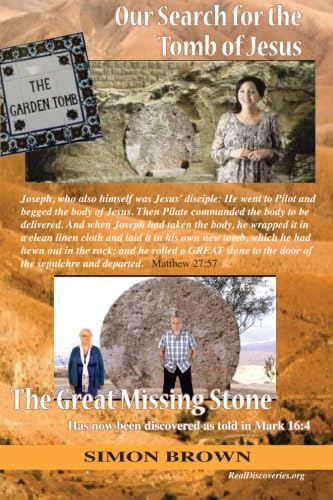
The Beginning of the Search In 2007, after becoming deeply fascinated by the subject of the tomb of Jesus, I produced a documentary film titled Our Search For The Tomb of Jesus.

During the filming, my team and I carefully measured the exterior channel at The Garden Tomb. Our goal was simple: to determine the size of the stone that would have originally sealed the tomb.

Photograph of the Garden Tomb in Jerusalem, Israel, a rock-cut tomb that many Christians believe may be the tomb of Jesus Christ, showing the entrance carved into the limestone hillside.

Figure 3. The Garden Tomb in Jerusalem, a rock-cut tomb regarded by many Christians as a possible site of Jesus' burial, examined here in connection with archaeological research into the large stone described in Mark 16:4.

I believed that if the stone could ever be found, it would identify the true tomb of Jesus.


Why was this important?

Because both Matthew and Mark clearly state that the stone sealing the tomb was not of ordinary size. Mark 16:4 says:

“And having looked up, they saw that the stone had been rolled away, for it was exceedingly large.”

This detail is crucial.


Years passed after my research, and making my documentary film titled Our Search For The Tomb of Jesus.

and I had no expectation that I would ever encounter such a stone. Then one day, while watching a Christian video, I saw something extraordinary — a massive circular stone at Mount Nebo.

I was stunned.


The moment I saw it, I believed there was something deeply significant about it. After studying the footage further, I became convinced that I needed to travel both to Mount Nebo and to the Garden Tomb itself in order to compare measurements, rock samples, and physical characteristics.

I believed God was revealing something remarkable.

Gathering the Evidence At that time, representatives of The Garden Tomb Association agreed, although somewhat reluctantly, to hear my findings. 

They permitted me to collect evidence and later present my research to them.

I travelled to both Mount Nebo and the Garden Tomb to conduct detailed examinations.

What did my research reveal?

The Great Stone at Mount Nebo matched the Garden Tomb in remarkable ways:

The same colour

The same type of stone

The same thickness

The same height

Identical chisel marks

Most significantly, the stone measured approximately 15 inches thick — exactly matching the 15-inch-wide rolling channel at the Garden Tomb.


Research update graphic for "Our Search for the Tomb of Jesus," featuring the Garden Tomb in Jerusalem, measurements of the Great Stone associated with Mark 16:4, and an update celebrating more than 200,000 views of the documentary.

Figure 4. Simon Brown comparing the Great Stone at Mount Nebo with the Garden Tomb in Jerusalem as part of archaeological research into the large stone described in Mark 16:4.

Laboratory analysis in the United Kingdom also indicated that rock samples from the stone and the tomb were consistent with one another.

Photograph of Simon Brown standing beside the Great Stone at Mount Nebo, Jordan, during archaeological research into its possible connection with the large stone described in Mark 16:4 and the Garden Tomb in Jerusalem.

Figure 5. Simon Brown standing beside the Great Stone at Mount Nebo, Jordan, during archaeological research into its possible connection with the large stone described in Mark 16:4 and the Garden Tomb in Jerusalem.

For nearly 2,000 years, this massive stone sat near Mount Nebo at a village until it was found under rubble and then was moved to the location of where it is now at Mount Nebo, with no clear explanation for its existence. Even those guarding it today did not know its age, origin, or purpose. Yet these Christians had continued protecting it as though it were a treasure.

Why?

I believe the answer is now clear.

The Question of Size.

One of the major objections raised by staff associated with the Garden Tomb was that the Mount Nebo stone was “too large” to fit the tomb. They argued that the original stone would only have measured between four and five feet in diameter.

But does a four- or five-foot stone qualify as “exceedingly large”?

I do not believe so.

Stones of that size were common in ancient tombs. The stone at Mount Nebo, however, is enormous — truly deserving the description given in the Gospel of Mark.

In the Greek text, the phrase used can be translated as “very large” or “exceedingly great.” The Mount Nebo stone fits that description perfectly.

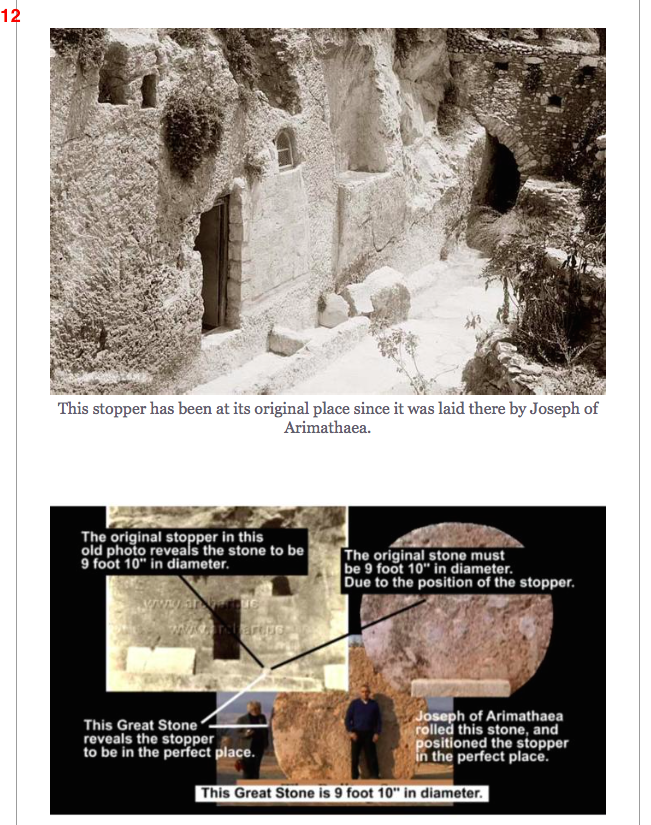
Furthermore, old photographs of the Garden Tomb, dating from approximately 1898 to 1946, reveal what appears to be an additional stopping stone positioned within the channel. This detail is extremely important because it helps establish the likely diameter of the original rolling stone.

Based on this evidence, I concluded that the original stone measured between nine and ten feet in diameter.

That changes everything.

A Stone With No Explanation

An article published by the International Symposium of Heritage Interpretation describes the Mount Nebo stone as a “large circular tomb door.” The article acknowledges that the stone was brought to Mount Nebo from another location and states that its origin and purpose are unclear.

But I believe its purpose is not unclear at all.

I believe this is the missing Great Stone from the tomb of Jesus Christ.


Others have also recognised the unusual nature of this discovery. One commenter on my YouTube channel described the evidence as “potentially explosive.”

Author Perry Stone referred to the Mount Nebo stone in his book Secrets from Beyond the Grave as “a massive rolling stone.”


Bob Mitchell of Shofar Ministries suggested that Byzantine believers may have preserved the stone and moved it to Mount Nebo as a memorial to the Resurrection.


Testing All Things.

Despite the measurements, the laboratory analysis, the matching chisel marks, and the photographic evidence, some still reject the conclusion that this is the original stone from the tomb of Jesus.

But Scripture says:

“Test all things. Hold fast to what is good.”

— 1 Thessalonians 5:21

That is exactly what I have attempted to do.

The evidence should be examined carefully and honestly.

The Bible itself remains reliable and true.

In Acts 13:41 we read:

“Look, you scoffers, wonder and perish, for I am going to do something in your days that you would never believe, even if someone told you.”

Perhaps that verse applies even today.


A Testimony to the Resurrection

I believe the Great Stone at Mount Nebo stands as a testimony to the Resurrection of Jesus Christ.

Overlooking the Promised Land, this stone reminds mankind that God sent an angel to roll away the stone from the tomb — declaring that death had been conquered and the debt of sin fully paid.

Jesus Christ rose from the dead.

And because He lives, those who believe in Him have the promise of eternal life.

“For God so loved the world that He gave His one and only Son, that whoever believes in Him shall not perish but have eternal life.”

— John 3:16

What do you believe?


Up dated article here: The Garden Tomb – Could This Be the Tomb of Jesus?


Related Videos and articles:


DVD cover for Simon Brown's documentary "Tomb of Jesus," exploring the archaeological, historical, and biblical evidence surrounding the Garden Tomb in Jerusalem, the tomb of Jesus Christ, and the resurrection.

Figure 7. Cover of Simon Brown's documentary "Tomb of Jesus," presenting archaeological research into the Garden Tomb, the Great Stone at Mount Nebo, and the biblical account of Mark 16:4.

https://youtu.be/RBNbWLmQ57k?si=A7YaS8r2O5MixUPd


Promotional announcement by Simon Brown presenting the Great Stone at Mount Nebo, Jordan, summarising archaeological research into its possible connection with the large stone described in Mark 16:4 and the Garden Tomb in Jerusalem.
Figure 6. Early research announcement by Simon Brown introducing the Great Stone at Mount Nebo and summarising the archaeological investigation into its possible connection with the large stone described in Mark 16:4.

Promotional banner linking to the main research article "Is the Garden Tomb the Tomb of Jesus?" featuring the Garden Tomb in Jerusalem, the large rolling stone, and an examination of the archaeological, historical, and biblical evidence surrounding the burial place of Jesus Christ.

Garden tomb of Jesus. And the GREAT STONE, Mark 16:4,

Click on image to enlarge
Garden tomb of Jesus. And the GREAT STONE, Mark 16:4,

Garden tomb of Jesus. And the GREAT STONE, Mark 16:4,
Click on image to enlarge
Garden tomb of Jesus. And the GREAT STONE, Mark 16:4,

Garden tomb of Jesus. And the GREAT STONE, Mark 16:4,

Garden tomb of Jesus. And the GREAT STONE, Mark 16:4,
Click on image to enlarge
Garden tomb of Jesus. And the GREAT STONE, Mark 16:4,

Garden tomb of Jesus. And the GREAT STONE, Mark 16:4,

Garden tomb of Jesus. And the GREAT STONE, Mark 16:4,

Garden tomb of Jesus. And the GREAT STONE, Mark 16:4,
the Great Stone at Mount Nebo called The Abu Badd stone. MAJOR DISCOVERY PROVING THE GOSPELS.

Garden tomb of Jesus. And the GREAT STONE, Mark 16:4,
the Great Stone at Mount Nebo called The Abu Badd stone. MAJOR DISCOVERY PROVING THE GOSPELS.

the Great Stone at Mount Nebo called The Abu Badd stone. MAJOR DISCOVERY PROVING THE GOSPELS.

Garden tomb of Jesus. And the GREAT STONE, Mark 16:4,


Our Search for the Tomb of Jesus BOOK. By Simon Brown.
Please click on Simon's book to read for FREE.

Our Search for the Tomb of Jesus FREE DVD. By Simon Brown.
Please click on Simon’s DVD to order.

Garden tomb,

Garden tomb,
Garden tomb,
Garden tomb,
Garden tomb,
Garden tomb,

Garden tomb,
Garden tomb,
Garden tomb,
Garden tomb,
Garden tomb,
Garden tomb,
CORRECTION THE GREAT STONE IS 9’8''
Garden tomb,

For whatever is hidden is meant to be disclosed, and whatever is concealed is meant to be brought out into the open. Mark 4:22. New International Version (©1984)

Here are the correspondents of the emails regarding this discovery of The Great Stone.

I Simon Brown sent an email to the monastery at Mount Nebo asking PLEASE DO YOU KNOW WHERE THIS STONE CAME FROM? and DO YOU KNOW HOW OLD IT IS AND WHY IS IT THERE? 2 days later I received an email from them saying it was found in a old village and was used as a fortified door for a monastery. But here was the exciting bit. They did not know how it got there or why it was made in the first place. Here was their email

Sent: Mon, Jan 10, 2011 9:44 am
Subject: Re: Mount nebo. large rolling stone.

Dear Sir,
The stone was a rolling door (!) found near the Mount Nebo and put there to protect and show it.
Regards
​
Fr. Carmelo Pappalardo
Director
Francisca Archaeological Institute on Mount Nebo

I was so confident this was the stone to the tomb that I sent emails to the Garden tomb in Jerusalem for the attention of the new manger Richard Merion. As you would expect I received no reply. I called the garden tomb staff by phone and asked would they please ask Richard to call me in the UK. To my surprise he called me. I told him who I was and that I was very familiar with the history of the garden tomb, as I had in the past done much research and made a film of it. I decided to pop the big question which I didn't think he would believe. "Richard, if I told you I have discovered the missing rolling stone to the garden tomb would you believe me?" He said at this stage he wouldn't say, but he would be willing to hear my case and would I email him with the updates? Perhaps I could meet him in London to present the evidence. I was very pleased with his cooperation and told him I would gather all the facts together and then call him. After some weeks I emailed Richard again, telling him that I am going to make a trip to take measurements of both the stone and the garden tomb. Getting no reply to my emails I spoke to Richard for the second time. He seemed reluctant to co-operate and told me he had sent me an email, which I never received. I asked him to resend it, but It still did not come. I then received an email from Mr Victor Jack at the Garden Tomb Association in London. He said he was not really bothered about whether the stone is found or not, and that similar claims had been made by Ron Wyatt, which proved to them not to be true. However he said that Richard Merion would hear my case.
Here below you can read all the emails to and from, Mr Richard Merion Director, and Victor Jack Chairman of the Garden Tomb (Jerusalem) Association.

Sent: Wed, Feb 9, 2011 10:42 am
Subject: Re: Subject: URGENT For the attention of Mr TV Jack.
Dear Mr Brown,
Thank you for your email. I have been involved with the Garden Tomb for over 20 years and during that time we have had a number of claims by other individuals to have found the Rolling Stone and even the ark of the Covenant under Skull Hill. None of these have been found to be true.
At the moment I will leave our very efficient Director, Richard Meryon, to correspond with you, as he has asked for further evidence to substantiate your claim. I couldn’t ask our Garden Tomb Council to meet with you until further confirmation of your claim is received.
We have always taken the view that the message of the death and resurrection of Jesus is our prime focus and the reason for the existence of our ministry in Jerusalem. Skull Hill, the empty tomb, the cistern and the wine press are all powerful visual aids that enhance that ministry but we have never claimed that our site is definitely the place where Jesus died and rose again, even though some think it is.
Richard will keep me informed.
Yours sincerley, in our risen Lord, Victor Jack.

From: Simon Brown [mailto:mrsimonbrown@aol.co.uk]
Sent: Friday, February 25, 2011 12:43 PM
To: mail; victor.jack@virgin.net
Subject: For the attention of Mr Richard Merion
The Missing Rolling Stone For The Garden Tomb.

Dear Mr Richard Merion with reference to my previous emails and my telephone conversations with you.
As I agreed with you. I have kept my promises and presented the evidence of my case regarding this being the Great missing stone from the garden tomb.
However you have never once had the decency to acknowledge any of my many emails.
Regardless to you stating to me you would communicate by email.
Mr TV Jack also stated to me you would hear my case.
Is this how you normally treat your brothers in Christ?
I pray you will receive this wonderful news the lord has now revealed to the world with joyful hearts.
In the name of Jesus.
Simon Brown
www.realdiscoveries.org

From: richard meryon
Sent: 26 February 2011 12:22
To: 'mrsimonbrown@aol.co.uk'
Cc: 2 Victor JACK(GTA)
Subject: Your rolling stone

Simon
I am rather hurt by the tone of your e-mail as I have not received anything from you by e-mail.   I have just done another search and cannot find any trace of receiving your thesis.  
I await the evidence and will give it a good read.   Please send it to me; I will acknowledge its receipt, and will then let you know of the ministry’s response.
Yours faithfully
Error! Filename not specified.
Richard Meryon
www.gardentomb.org

From: Simon Brown [mailto:mrsimonbrown@aol.co.uk]
Sent: 26 February 2011 16:50
To: richardmeryon@talktalk.net
Subject: The Missing Rolling Stone For The Garden Tomb.
Dear Richard I don't mean to hurt you in any way. However I did what I said I would do which is to send you all the very hard work I have done. By presenting my case. And when I hear nothing I get hurt also.
Lets continue to be brothers in Christ and move on.
All I ask now is you hear my case so I can then go forward. Here is the link which has much of the facts.
http://www.realdiscoveries.org/modules/articles/item.php?itemid=264&com_mode=nest&com_order=0#comment21
I do have far more evidence which I would be willing to talk to you about at a later date.
In Jesus name
Simon Brown

-----Original Message-----
From: Richard Meryon (TT) <richardmeryon@talktalk.net>
To: 'Simon Brown' <mrsimonbrown@aol.co.uk>
Cc: 2 Victor JACK(GTA) <victor.jack@virgin.net>
Sent: Sat, Feb 26, 2011 3:43 pm
Subject: RE: The Missing Rolling Stone For The Garden Tomb.

Dear Simon
Thank you. Now that I have access to your hyper-link, I will spend some time studying it.
I will also raise the subject at our next trustees’ meeting and let you know if the trustees want to pursue your offer.
For the Glory of God
Richard Meryon

www.gardentomb.org

From: Simon Brown [mailto:mrsimonbrown@aol.co.uk]
Sent: 01 March 2011 17:17
To: richardmeryon@talktalk.net
Cc: victor.jack@virgin.net
Subject: Re: The Missing Rolling Stone For The Garden Tomb.

Dear Richard I have now made a 40 minute film presenting all the evidence of the Great Stone.
Would you like me to send you and Jack a copy?
Simon Brown
www.realdiscoveries.org

-----Original Message-----
From: Richard Meryon (TT) <richardmeryon@talktalk.net>
To: 'Simon Brown' <mrsimonbrown@aol.co.uk>
CC: victor.jack <victor.jack@virgin.net>
Sent: Tue, 1 Mar 2011 16:10
Subject: RE: The Missing Rolling Stone For The Garden Tomb.

Dear Simon
Please feel free to do so:
The Garden Tomb
PO Box 19462
Jerusalem 91193
Israel.
Victor and I will view it next time he is here.
Most sincerely
Richard Meryon

www.gardentomb.org

-----Original Message-----
From: Simon Brown <mrsimonbrown@aol.co.uk>
To: richardmeryon@talktalk.net; victor.jack@virgin.net
Sent: Thu, Mar 10, 2011 12:57 pm
Subject: Re: The Missing Rolling Stone For The Garden Tomb.

The Missing Rolling Stone For The Garden Tomb.

Dear Richard I hope your well.
Richard do you have any dispute with my claim regarding the evidence I have sent you so far please?

Simon Brown

From: Simon Brown [mailto:mrsimonbrown@aol.co.uk]

Sent: 15 March 2011 12:07
To: richardmeryon@talktalk.net; victor.jack@virgin.net
Subject: Fwd: The Missing Rolling Stone For The Garden Tomb. just incase you haven't received this

Dear Richard I am just sending you this email again below as I have not received a reply so just incase you haven't received this here it is again

Blessings In the name of Jesus Christ

Simon Brown

From: richard meryon
Sent: 16 March 2011 21:19
To: Simon Brown
Cc: 2 Victor JACK(GTA)
Subject: RE: The Missing Rolling Stone For The Garden Tomb. just incase you haven't received this

Simon
1.       I have replied very time – have you checked your spam filter?
2.       Please do not continue to saturate me; I have told you that you will hear from the GT Chairman when he has canvassed the trustees’ opinions.   And you will.
For God’s Glory
Richard Meryon

www.gardentomb.org

OK Richard THANKS.
S Brown
​
​Last and final email from Victor Jack, Chairman of the Garden Tomb (Jerusalem) Association.

Dear Simon,
A possible Stone

While you have in the main been corresponding with our Director in Jerusalem, both he and you have kept me fully advised of your enquiry, of your research and of your offer.   Thank you.
Many people approach the Garden Tomb (Jerusalem) Association with a broad variety of requests and suggestions.   Everyone is well-meaning, often genuinely sincere, but not all are in harmony with our own ministry’s purpose.   I have been closely involved with the Garden for over 20 years so I am well versed with all these contacts.
As Chairman of the Board of Trustees of the GT(J)A I presented both your report and the video clip to the whole Board at our trustees’ meeting in London, on Tuesday 15th March 2011.  I regret to inform you that the Board did not believe that what you have offered enhances the ministry of the Garden.  Furthermore, if you raised all the funds and the necessary permissions to re-locate the stone from Mount Nebo to East Jerusalem, the Board will still not accept your offer.
Our Trustees have also asked me to tell you that we are deeply concerned that you have broken two long-standing rules of the Garden Tomb, which is a private Garden, in that you not only took video in the Garden without our permission, you also took away material (the rock that you are seen to pick up from outside the tomb) without are permission.
The Board is also very concerned by your reference, without our being able to verify what you say, to communication with staff of the GT(J)A in your publicity.   I therefore ask you to remove all reference to any communication with the GT(J)A, either positively or negatively, in any publicity.
To avoid any future disagreements that might embarrass either or both parties, let us agree that the GT(J)A neither confirms or denies its position with regard to the Mount Nebo stone.   We also ask you not to allow any of your filmed footage in the Garden Tomb to appear in the public domain.
Our response may disappoint you, but we have a responsibility to uphold the ministry with which we have been entrusted.
Yours sincerely,
Victor Jack
Chairman of the Garden Tomb (Jerusalem) Assoication
PO Box 19462
Jerusalem, 91193
Israel​

Simon Brown to victor.jack, richard, bstreather - 18 Mar 2011

Dear Victor Jack Thank you for your kind email.

May The Lord God Bless you.

In The Name Of Jesus

Simon Brown
www.realdiscoveries.org

There is nothing concealed that will not be disclosed, or hidden that will not be made known. Luke 12

Is the Garden tomb the tomb of Jesus? Fast facts.

Photograph of Simon Brown measuring the Great Stone at Mount Nebo, Jordan, during archaeological research into its possible connection with the large stone mentioned in Mark 16:4 and the tomb of Jesus.

DVD cover for Simon Brown's documentary "Tomb of Jesus," exploring the archaeological, historical, and biblical evidence surrounding the Garden Tomb in Jerusalem, the tomb of Jesus Christ, and the resurrection.

Figure. Cover of Simon Brown's documentary "Tomb of Jesus," presenting archaeological research into the Garden Tomb, the Great Stone at Mount Nebo, and the biblical account of Mark 16:4.

Related articles: