Simon Brown.

Join me on this journey. Let's seek the truth together! 💡 Proverbs 8:34-36 Blessed is the man who hears me, watching daily at my gates, waiting at my door posts. For whoever finds me finds life, and will obtain favor from Yahweh. But he who sins against me wrongs his own soul. All those who hate me love death.” Psalm 84: 11 For Yahweh God is a sun and a shield. Yahweh will give grace and glory. He withholds no good thing from those who walk blamelessly. 12 Yahweh of Armies, blessed is the man who trusts in you. 1 John 5:5 Now who is the one overcoming the world, except the one believing that Jesus is the Son of God.
Showing posts with label Tomb of Jesus. Show all posts

Thursday, 13 August 2026

UPDATE: DOES THE SIZE OF THE GREAT STONE AT MOUNT NEBO MATCH THE GARDEN TOMB?

Simon Brown’s research comparing the 9-foot-8-inch Great Stone at Mount Nebo with measurements of the rolling-stone channel at the Garden Tomb and the “exceedingly large” stone described in Mark 16:4.

A detailed research infographic using Simon Brown’s original photographs and measurements of the Great Stone at Mount Nebo and the rolling-stone channel at the Garden Tomb in Jerusalem. The investigation compares the physical dimensions with Mark 16:4, where the tomb stone is described as “exceedingly large.”

UPDATE: DOES THE SIZE OF THE GREAT STONE AT MOUNT NEBO MATCH THE GARDEN TOMB?

Research by Simon Brown

An objection has been raised against my research into the Great Stone I discovered at Mount Nebo.

Some people argue that this enormous rolling stone could not possibly have been connected with the true tomb of Jesus because it is far too large. They suggest that the original rolling stone at Jesus' tomb would probably have been only around 5 to 6 feet in diameter.

But during my investigation, I discovered something that I believe deserves much closer attention.

The dimensions of the Great Stone at Mount Nebo correspond remarkably closely with the surviving rolling-stone channel outside the Garden Tomb.

And when we return to the Gospel of Mark, we find another fascinating detail:

Mark specifically tells us that the stone was “exceedingly large.”

Let us examine the evidence.


THE GREAT STONE AT MOUNT NEBO

During my investigation at Mount Nebo, I personally measured this enormous circular stone.

My measurements were approximately:

Diameter: 9 feet 8 inches

Thickness: approximately 15 inches

This is certainly not an ordinary-sized rolling stone.

It is enormous.

And this extraordinary size has been used by critics as an argument against its possible connection with the tomb of Jesus.

But then I measured the surviving rolling-stone channel outside the Garden Tomb in Jerusalem.

That produced a remarkable result.


THE GARDEN TOMB CHANNEL IS APPROXIMATELY 16 INCHES WIDE

When I measured the ancient channel outside the Garden Tomb, I found it to be approximately:

16 INCHES WIDE

Compare that with the Great Stone at Mount Nebo:

GREAT STONE — APPROXIMATELY 15 INCHES THICK

GARDEN TOMB CHANNEL — APPROXIMATELY 16 INCHES WIDE

That is a remarkably close dimensional correspondence.

The photographs reproduced with this article show me taking these measurements during my investigation.

Even more interestingly, marks can still be seen along the channel which appear consistent with a large stone having travelled through it.

Therefore, instead of simply asking:

“Is the Mount Nebo stone too large?”

I believe we should ask another question:

Could a stone of these dimensions physically have travelled through the surviving Garden Tomb channel?

According to my measurements, its thickness appears compatible with the width of the channel.

That does not by itself prove that this particular stone once belonged to the Garden Tomb. Its provenance would still need to be established independently.

But it does mean that the dimensional evidence deserves serious investigation rather than dismissal merely because the stone is unusually large.


BUT WHAT ABOUT ITS ENORMOUS 9'8" DIAMETER?

This brings us to the second objection.

Critics may argue:

“A stone almost ten feet in diameter is simply too large to have been the stone at Jesus' tomb.”

But there is an extraordinary detail in Mark's resurrection account that should not be overlooked.

The women came to the tomb early in the morning.

Mark records:

“And having looked up, they see that the stone has been rolled away—for it was exceedingly large.”

— Mark 16:4, BLB

Notice those final words:

“IT WAS EXCEEDINGLY LARGE.”

Mark does not merely call it a stone.

He deliberately draws attention to its exceptional size.


WHAT DOES THE GREEK SAY?

The Greek behind the description is particularly strong.

Mark uses:

μέγας — megas

meaning great or large,

together with:

σφόδρα — sphodra

meaning exceedingly, extremely, or very much.

So Mark's description is emphatic.

The stone was not merely large.

IT WAS EXCEEDINGLY LARGE.

That fact needs to be included whenever someone argues that the stone at Jesus' tomb must have been relatively small.


WHAT ABOUT THE WORDS “HAVING LOOKED UP”?

There is another fascinating detail.

Mark says:

“And having looked up…”

— Mark 16:4, BLB

The Greek verb is ἀναβλέπω (anablepō), which can mean to look up, though in some contexts it can also mean to look again or recover sight.

Therefore, we need to be careful here.

It would be going beyond the text to claim that the expression proves mathematically that the stone had to be taller than the women.

Nevertheless, when combined with Mark's explicit statement that the stone was “exceedingly large,” the wording certainly fits the picture of an imposing stone.

And this is precisely what makes the Mount Nebo stone so interesting.

If the women were somewhere around five feet tall, a stone measuring approximately 9 feet 8 inches in diameter would tower above them.

That is at least visually consistent with the extraordinary stone Mark describes.

But the stronger evidence remains Mark's explicit statement:

“FOR IT WAS EXCEEDINGLY LARGE.”


THREE IMPORTANT FACTS NOW COME TOGETHER

My investigation therefore produced three observations that I believe deserve further examination.

First: the Great Stone at Mount Nebo measures approximately 9 feet 8 inches in diameter—an extraordinarily large stone.

Second: it measures approximately 15 inches thick, while my measurement of the Garden Tomb rolling-stone channel was approximately 16 inches wide.

Third: Mark 16:4 specifically describes the stone at Jesus' tomb as:

“EXCEEDINGLY LARGE.”

These facts do not, by themselves, establish the Mount Nebo stone's provenance.

But neither should its extraordinary size automatically disqualify it.

Indeed, extraordinary size is precisely the feature Mark himself chose to emphasize.


COULD THE GREAT STONE HAVE BEEN MOVED FROM JERUSALEM?

This leaves another major historical question.

If the Mount Nebo stone once belonged to a tomb in Jerusalem, how did it end up many miles away at Mount Nebo?

Was it deliberately transported?

Was it reused?

When did it arrive there?

Who moved it?

And is there historical or archaeological evidence capable of tracing its earlier history?

These questions are extremely important because a dimensional match alone cannot establish where a stone originally came from.

This is where the investigation must continue.


MY UPDATED CONCLUSION

I believe the Great Stone at Mount Nebo remains an extraordinary object worthy of serious investigation.

Its approximately 15-inch thickness corresponds remarkably closely with the approximately 16-inch width I measured in the surviving rolling-stone channel at the Garden Tomb.

Its approximately 9-foot-8-inch diameter makes it exceptionally large.

And rather than contradicting Mark's description, its enormous size is strikingly consistent with one particular detail Mark went out of his way to record:

“THE STONE…WAS EXCEEDINGLY LARGE.”

— Mark 16:4, BLB

Does this evidence alone prove that the Mount Nebo stone is the actual Great Stone that once sealed the tomb of Jesus?

No. More evidence would be needed to establish that identification historically.

But does the objection that the stone is “too large” settle the question?

No.

The Gospel itself describes an exceptionally large stone.

And the physical measurements I recorded present an intriguing dimensional correspondence that I believe deserves further archaeological and historical investigation.

That is why I continue to ask:

COULD THIS REALLY BE THE GREAT STONE OF MARK 16:4?

And could the Garden Tomb in Jerusalem really be the tomb in which our Lord and Savior Jesus Christ was laid before His resurrection?

I encourage everyone to examine the photographs, measurements, biblical text, archaeology and historical evidence for themselves.

The search for the truth should always follow the evidence—wherever that evidence leads.

Research by Simon Brown

wwwrealdiscoveriesorg-simon.blogspot.com

Related articles: 

The Garden Tomb in Jerusalem alongside the Great Stone, presenting a biblical, historical and archaeological investigation into whether the Garden Tomb is the burial place of Jesus Christ. Research by Simon Brown.

Could this peaceful garden in Jerusalem contain the actual tomb where Jesus Christ was buried? This investigation examines the biblical accounts, archaeological discoveries, ancient historical evidence, and geographical features surrounding one of Christianity's most fascinating sites.


The True Tomb of Jesus investigation by Simon Brown featuring the Garden Tomb, the Great Stone, book and documentary exploring biblical, historical and archaeological evidence.


Mystery marker above the entrance of the Garden Tomb in Jerusalem, positioned centrally over the ancient rolling-stone channel and raising the question of whether it could indicate the original height or position of the Great Stone.


The History, the Evidence, and the Scientific Facts Behind the Life, Death, and Resurrection of Jesus Christ.

The Great Stone at Mount Nebo — Does It Match the Garden Tomb?

The True Tomb of Jesus investigation by Simon Brown featuring the Garden Tomb, the Great Stone, book and documentary exploring biblical, historical and archaeological evidence.

The True Tomb of Jesus investigation by Simon Brown featuring the Garden Tomb, the Great Stone, book and documentary exploring biblical, historical and archaeological evidence.


Simon Brown’s research comparing the 9-foot-8-inch Great Stone at Mount Nebo with measurements of the rolling-stone channel at the Garden Tomb and the “exceedingly large” stone described in Mark 16:4.

Simon Brown’s research comparing the 9-foot-8-inch Great Stone at Mount Nebo with measurements of the rolling-stone channel at the Garden Tomb and the “exceedingly large” stone described in Mark 16:4.

Simon Brown’s research comparing the 9-foot-8-inch Great Stone at Mount Nebo with measurements of the rolling-stone channel at the Garden Tomb and the “exceedingly large” stone described in Mark 16:4.

Simon Brown’s research comparing the 9-foot-8-inch Great Stone at Mount Nebo with measurements of the rolling-stone channel at the Garden Tomb and the “exceedingly large” stone described in Mark 16:4.

A detailed research infographic using Simon Brown’s original photographs and measurements of the Great Stone at Mount Nebo and the rolling-stone channel at the Garden Tomb in Jerusalem. The investigation compares the physical dimensions with Mark 16:4, where the tomb stone is described as “exceedingly large.”


Wednesday, 29 July 2026

The Garden Tomb – Could This Be the Tomb of Jesus?

The Garden Tomb in Jerusalem alongside the Great Stone, presenting a biblical, historical and archaeological investigation into whether the Garden Tomb is the burial place of Jesus Christ. Research by Simon Brown.

Could this peaceful garden in Jerusalem contain the actual tomb where Jesus Christ was buried? This investigation examines the biblical accounts, archaeological discoveries, ancient historical evidence, and geographical features surrounding one of Christianity's most fascinating sites.


The True Tomb of Jesus investigation by Simon Brown featuring the Garden Tomb, the Great Stone, book and documentary exploring biblical, historical and archaeological evidence.


The Garden Tomb – Could This Be the Tomb of Jesus?

Part 1 – Beginning the Investigation

For nearly two thousand years, Christians have asked one fascinating question:

Where was Jesus actually buried?

Millions visit Jerusalem every year to see places traditionally associated with the death, burial, and resurrection of Jesus Christ. Yet one location continues to attract particular interest because of how closely it appears to match the biblical description—the Garden Tomb.

Could this really be the tomb in which Joseph of Arimathea laid the body of Jesus?

Or is it simply another ancient tomb that later became associated with the Gospel story?

During my visits to Jerusalem, I wanted to answer that question for myself. Rather than accepting tradition, I decided to examine the evidence exactly as I have with every other subject throughout this book.

As Jesus said:

"Seek, and you will find." (Matthew 7:7)

That became the foundation of my investigation.


What Do the Gospels Tell Us?

Before examining archaeology, we must first understand exactly what the Bible says.

Matthew records:

"Joseph took the body and wrapped it in a clean linen cloth and laid it in his own new tomb, which he had cut out of the rock. He rolled a great stone to the entrance of the tomb and went away." (Matthew 27:59–60)

John adds another important detail:

"Now in the place where He was crucified there was a garden, and in the garden a new tomb in which no one had yet been laid." (John 19:41)

Immediately we can establish several facts from Scripture.

The tomb must have been:

  • a new tomb

  • cut into solid rock

  • located inside a garden

  • owned by Joseph of Arimathea, a wealthy man

  • close to the place of crucifixion

  • sealed by a great rolling stone

These details become our checklist.

Any proposed location must agree with the biblical description.


The Garden Tomb

Decorative ceramic sign reading "The Garden Tomb" mounted on a stone wall at the Garden Tomb in Jerusalem, a historic site associated with the burial and resurrection of Jesus Christ.

The entrance sign to the Garden Tomb in Jerusalem welcomes visitors to one of Christianity's most well-known archaeological sites. Many Christians believe this peaceful garden may preserve the location where Jesus Christ was buried after His crucifixion and where the empty tomb proclaimed His resurrection. Although its identification remains debated, the Garden Tomb continues to inspire millions of visitors who come to reflect on the Gospel accounts and examine the historical and archaeological evidence surrounding the death, burial, and resurrection of Jesus.

Just outside Jerusalem's Damascus Gate lies a peaceful garden containing an ancient rock-cut tomb.

Many Christians believe this is the very tomb in which Jesus was buried.

When I first entered the garden, I was immediately struck by how well the location matched John's description.

It is quite literally a garden containing a rock-cut tomb.

Standing there, I realised this was not simply another ancient burial place. Every feature deserved careful examination.

Inside the tomb are two burial chambers cut into the rock. It is widely believed that Joseph of Arimathea originally prepared the tomb for himself and his family before offering it for the burial of Jesus.

Whether that tradition is correct remains the question.

The evidence would need to speak for itself.


A Wealthy Man's Garden

Matthew describes Joseph of Arimathea as a rich man (Matthew 27:57).

That small detail becomes surprisingly significant.

Within the Garden Tomb complex are the remains of both an ancient wine press and one of the largest cisterns (water reservoirs) in Jerusalem.

These are not features normally associated with an ordinary burial site.

They indicate that this was once an important private garden belonging to a wealthy owner—precisely what we would expect if it belonged to Joseph of Arimathea.

Already the biblical description and the archaeology appear to fit remarkably well.


The Place of the Skull

Rock formation known as the Place of the Skull (Golgotha) near the Garden Tomb in Jerusalem, traditionally associated with the crucifixion of Jesus Christ outside the city walls.

This rocky hillside near the Garden Tomb is known by many as the Place of the Skull (Golgotha). Its appearance has led some to suggest it resembles the outline of a human skull, matching the location described in the Gospels where Jesus was crucified. The Bible records that Jesus suffered outside the city gates at a place called Golgotha, meaning "Place of the Skull" (Matthew 27:33; Mark 15:22; John 19:17; Hebrews 13:12). While scholars continue to debate the exact location, this site remains one of Jerusalem's most recognised places associated with the crucifixion of Jesus Christ.

Matthew records:

"They came to a place called Golgotha (which means Place of a Skull)." (Matthew 27:33)

Just a short distance from the Garden Tomb stands one of Jerusalem's most recognisable rock formations.

Eroded into the limestone cliff is a striking feature that resembles the face of a human skull.

Whether this formation gave Golgotha its name cannot be proved with absolute certainty.

However, the resemblance is remarkable.

Standing between Skull Hill and the Garden Tomb, it is easy to understand why so many researchers—including Major-General Charles George Gordon—became convinced that this was the authentic location described in the Gospels.

For me, this was the beginning of a fascinating journey.

Because the more I investigated...

...the more the evidence seemed to fit.

And I soon discovered that this was only the beginning.

In the next part, we'll examine the tomb itself, the evidence for the great rolling stone, the ancient seal, historical maps, Jeremiah's Grotto, and the remarkable discoveries that convinced me this site deserves to be taken very seriously.


The Garden Tomb – Could This Be the Tomb of Jesus?

The Garden Tomb in Jerusalem with the large rolling stone, examining whether this historic site could be the burial place of Jesus Christ described in the Gospels.

The Garden Tomb is one of Jerusalem's most visited Christian sites and is believed by many to be the place where Jesus Christ was buried following His crucifixion. This study examines the biblical accounts, archaeological discoveries, the nearby Place of the Skull (Golgotha), the Great Stone, and the historical evidence to determine whether this remarkable site could truly be the tomb described in the Gospels.

Part 2 – Examining the Archaeological Evidence

Having compared the biblical description with the location of the Garden Tomb, the next question is obvious:

Does the archaeology agree with the Gospels?

This is where the investigation becomes particularly interesting.

As I explored the Garden Tomb and its surroundings, I found feature after feature that appeared to correspond remarkably well with the biblical record.

Could this simply be coincidence?

Or are we looking at the very place described nearly 2,000 years ago?


A Tomb Cut Out of Solid Rock

Simon Brown pointing to ancient chisel marks carved into the solid rock inside the Garden Tomb in Jerusalem, traditionally associated with the burial of Jesus Christ.

Matthew records that Joseph of Arimathea placed Jesus in "his own new tomb, which he had cut out in the rock" (Matthew 27:60). Inside the Garden Tomb, the walls still display clear chisel marks left by the ancient stonecutters who carved the burial chamber from the solid limestone. These visible features closely match the Gospel description of a tomb hewn out of rock and provide visitors with a remarkable glimpse into the construction methods used for Jewish burial tombs in the first century.

Matthew tells us that Joseph of Arimathea placed Jesus in:

"...his own new tomb, which he had cut out in the rock." (Matthew 27:60)

The Garden Tomb is exactly that.

Unlike many later burial places built from masonry, this tomb was carved directly into the natural limestone bedrock.

Walking inside, you can still see the original chisel marks left by the ancient stone workers.

Standing within the tomb, it is impossible not to wonder whether these very walls witnessed one of the greatest events in human history.


A New Tomb

The Garden Tomb in Jerusalem, a first-century rock-cut tomb believed by many to match the new burial tomb described in John 19:41 where Jesus was laid.

The Garden Tomb is a rock-cut burial chamber in Jerusalem that many believe matches the Gospel description of the new tomb where Jesus was laid after His crucifixion. Its location in a garden near Golgotha continues to make it one of Christianity's most significant archaeological sites.

John tells us another important detail:

"In the garden was a new tomb, in which no one had yet been laid." (John 19:41)

The Gospels emphasise that Jesus was placed in a new tomb.

This prevented any future suggestion that another body had been mistaken for His.

It also fulfilled Isaiah's prophecy:

"He was assigned a grave with the wicked, and with the rich in His death." (Isaiah 53:9)

Joseph of Arimathea, a wealthy member of the Jewish council and a disciple of Jesus, generously provided his own newly prepared family tomb.


Evidence of Wealth

Matthew specifically describes Joseph as:

"...a rich man from Arimathea..." (Matthew 27:57)

That detail becomes surprisingly important.

Within the Garden Tomb complex archaeologists have identified the remains of an ancient wine press together with one of the largest water cisterns in Jerusalem.

Neither feature would normally belong to an ordinary burial site.

Both point to a substantial private garden owned by someone of considerable wealth.

This harmonises remarkably well with Matthew's description of Joseph of Arimathea.


The Garden

John records:

"Now in the place where He was crucified there was a garden." (John 19:41)

Many people overlook this simple statement.

The Bible does not merely say there was a tomb.

It says there was a garden.

Today the Garden Tomb still sits within a peaceful garden setting, containing ancient agricultural features including the wine press and water system.

Again, this is exactly the type of location described in John's Gospel.


The Place of the Skull

Rock formation known as the Place of the Skull (Golgotha) near the Garden Tomb in Jerusalem, traditionally associated with the crucifixion of Jesus Christ outside the city walls.

This rocky hillside near the Garden Tomb is known by many as the Place of the Skull (Golgotha). Its appearance has led some to suggest it resembles the outline of a human skull, matching the location described in the Gospels where Jesus was crucified. The Bible records that Jesus suffered outside the city gates at a place called Golgotha, meaning "Place of the Skull" (Matthew 27:33; Mark 15:22; John 19:17; Hebrews 13:12). While scholars continue to debate the exact location, this site remains one of Jerusalem's most recognised places associated with the crucifixion of Jesus Christ.

Perhaps the most striking feature lies only a short distance from the tomb.

Matthew writes:

"They came to a place called Golgotha (which means Place of a Skull)." (Matthew 27:33)

Embedded within the limestone cliff opposite the Garden Tomb is an extraordinary natural formation.

Weathering has produced what appears to be the outline of a human skull.

Large hollow areas resemble eye sockets, while the surrounding rock gives the appearance of a face.

It is easy to understand why early visitors identified this place with Golgotha—the Place of the Skull.

In 1883, British Major-General Charles George Gordon became convinced that this was the biblical site of the crucifixion.

He was not alone.

Earlier researchers including Otto Thenius, Colonel Churchill, and Fisher Howe had also concluded that this location deserved serious consideration.


Outside the City Walls

Another important biblical detail is often forgotten.

Hebrews tells us:

"So Jesus also suffered outside the city gate." (Hebrews 13:12)

The Garden Tomb lies just outside the ancient northern walls of Jerusalem, close to the Damascus Gate.

This perfectly fits the biblical requirement that Jesus was crucified and buried outside the city.

The location is also known to have been an area where Roman executions took place during the first century.

Once again, the archaeological evidence agrees with Scripture.


The Evidence Continues to Grow

At this stage of my investigation, several important facts had already emerged.

The site contains:

  • A rock-cut tomb.

  • A wealthy man's garden.

  • An ancient wine press.

  • A large water cistern.

  • A location immediately beside Skull Hill.

  • A position outside the ancient city walls.

  • A first-century burial complex consistent with the Gospel accounts.

Each discovery, taken on its own, might simply be coincidence.

But together they begin forming a remarkably consistent picture.

Yet the strongest evidence was still to come.

In the next chapter we will examine the ancient maps, Jeremiah's Grotto, the mysterious seal outside the tomb, the measurements of the burial chamber, and the astonishing discoveries that eventually led me to what I believe is the missing piece of the entire puzzle—the Great Stone of Mark 16:4.


The Garden Tomb – Could This Be the Tomb of Jesus?

Part 3 – Ancient Maps, Jeremiah's Grotto, and Forgotten Evidence

By this stage of my investigation, the Garden Tomb already appeared to satisfy many of the biblical requirements.

It was a rock-cut tomb.

It stood within a garden.

It belonged to a wealthy estate.

It lay beside what many believe is the Place of the Skull.

It was situated outside the ancient city walls.

But one question still remained.

Had anyone before the discovery of the Garden Tomb identified this location as the burial place of Jesus?

The answer surprised me.


Searching Ancient Jerusalem

Rather than relying only on modern archaeology, I began searching for old maps, drawings, and paintings of ancient Jerusalem.

If early Christians had remembered the location of Jesus' tomb, perhaps traces of that tradition still survived.

Eventually I discovered a collection of remarkable historical illustrations showing Jerusalem centuries before the Garden Tomb became famous.

What caught my attention immediately was that several of these ancient illustrations identified the very same area north of Jerusalem as the location associated with Jesus' crucifixion and burial.

This was extraordinary.

These drawings had been produced hundreds of years before the Garden Tomb was rediscovered.

They could not have been influenced by modern archaeology.


Taking the Maps to Jerusalem

Naturally, I wanted expert opinion.

I travelled back to Jerusalem carrying copies of these ancient maps and met Ken Trestrayl, one of the Garden Tomb guides who had spent many years studying the site.

As we examined the maps together, he told me he had never seen them before.

He was genuinely amazed by how accurately they appeared to identify the region surrounding Skull Hill and the Garden Tomb.

For someone who had dedicated many years to studying the site, his reaction was encouraging.


Confirmation at the National Library

Simon Brown examining historic maps and drawings of ancient Jerusalem with researcher Rubin Aylett while investigating the location of the tomb of Jesus.

To better understand the location of Jesus' burial, I examined historic maps, drawings, and paintings of ancient Jerusalem alongside researcher Rubin Aylett. Comparing these historical records with the biblical accounts and modern archaeology provided valuable clues in the search for the true tomb of Jesus.

Wanting further verification, I visited the Jewish National and University Library in Jerusalem, where many of these historical documents had originated.

There I met Rubin Aylett, who confirmed that the illustrations had indeed been produced long before the Garden Tomb was rediscovered in the nineteenth century.

That fact immediately made them historically significant.

If these early artists had independently identified the same location centuries earlier, it suggested that an older tradition concerning the site may have survived through history.

While these paintings cannot prove that the Garden Tomb is the burial place of Jesus, they certainly deserve careful consideration.


Jeremiah's Grotto

Interior of Jeremiah's Grotto in Jerusalem, an ancient rock-cut cave located near the traditional site of Golgotha and the Garden Tomb.

Jeremiah's Grotto is an ancient rock-cut cave situated near the traditional site of Golgotha and the Garden Tomb. Historic maps identifying this grotto provided another clue in my investigation into the location of Jesus' crucifixion and burial.

One of the old maps contained another fascinating clue.

Near the place identified as Golgotha appeared the words "Jeremiah's Grotto."

According to Jewish tradition, this cave was believed to be where the prophet Jeremiah mourned the destruction of Jerusalem and composed the Book of Lamentations.

Curious to see whether such a place still existed, I began searching the area.

To my surprise, I found a large ancient cavern close to the Garden Tomb that local residents still referred to as Jeremiah's Grotto.

At the time of my visit, it was being used as a storage warehouse.

The owner kindly spoke with us and confirmed that local tradition had long associated the cave with the prophet Jeremiah.

Again, this does not prove the Garden Tomb is the tomb of Jesus.

However, it demonstrates that this area has been regarded as historically significant for many centuries.


Ancient Traditions

One of the mistakes we often make is assuming that historical traditions have no value.

Of course, traditions alone cannot establish historical fact.

But when ancient traditions agree with archaeology, biblical descriptions, geographical features, and historical documents, they become pieces of a much larger puzzle.

The Garden Tomb is unusual because several independent lines of evidence appear to converge upon the same location.

Each individual piece may not be decisive.

Together, however, they begin forming an increasingly persuasive picture.


Following the Evidence

Throughout this investigation I made a conscious decision not to begin with a conclusion.

Instead, I simply asked one question after another.

Does the evidence agree with the Bible?

Each discovery either strengthened—or weakened—the case.

So far, every major feature described in the Gospels had found a remarkable parallel at the Garden Tomb.

Yet I still had not reached the evidence that convinced me more than anything else.

In the next chapter, we will examine the remarkable measurements inside the tomb, the mysterious seal outside its entrance, the surprising connection with the Shroud of Turin, and the discovery that would eventually lead me to what I believe is the missing piece of the entire investigation—the Great Stone described in Mark 16:4.

Monday, 27 July 2026

The Discovery of the Great Stone of Mark 16:4!

The Garden Tomb in Jerusalem alongside the Great Stone, presenting a biblical, historical and archaeological investigation into whether the Garden Tomb is the burial place of Jesus Christ. Research by Simon Brown.

Could this peaceful garden in Jerusalem contain the actual tomb where Jesus Christ was buried? This investigation examines the biblical accounts, archaeological discoveries, ancient historical evidence, and geographical features surrounding one of Christianity's most fascinating sites.


The True Tomb of Jesus investigation by Simon Brown featuring the Garden Tomb, the Great Stone, book and documentary exploring biblical, historical and archaeological evidence.


Large infographic examining the Great Stone at Mount Nebo, its archaeological evidence, scientific analysis, biblical significance, and its connection with Mark 16:4 and the tomb of Jesus.
Figure 1. The Great Stone at Mount Nebo examined through archaeology, scientific analysis, and the biblical account of Mark 16:4.

Photograph of Simon Brown measuring the Great Stone at Mount Nebo, Jordan, during archaeological research into its possible connection with the large stone mentioned in Mark 16:4 and the tomb of Jesus.

Figure 2. Simon Brown measuring the Great Stone at Mount Nebo, Jordan, during research into its possible connection with the large stone described in Mark 16:4.


Revealing the True Tomb of Jesus

By Simon Brown.

At the end of 2011, I, Simon Brown, presented the evidence from my research which, I believe, reveals that the Great Stone at Mount Nebo is the very stone described in Gospel of Mark 16:4 and Gospel of Matthew 27:60 — the stone rolled into place to seal the tomb of Jesus Christ.

Most Christians are aware that the tomb of Jesus was sealed by a large rolling stone placed there by Joseph of Arimathea. According to the Gospel accounts, this was not an ordinary stone. Mark specifically describes it as “exceedingly large.”

For nearly two thousand years, the location of this stone remained unknown. I believe that God has now revealed it.

Just as Jim and Penny Caldwell of the Split Rock Research Foundation identified what they believe to be the Split Rock of Exodus 17:6, I believe I have discovered the missing link connected to the tomb of Jesus: the Great Stone of Mark 16:4.


This stone is unlike any other in the world.

The Beginning of the Search In 2007, after becoming deeply fascinated by the subject of the tomb of Jesus, I produced a documentary film titled Our Search For The Tomb of Jesus.

During the filming, my team and I carefully measured the exterior channel at The Garden Tomb. Our goal was simple: to determine the size of the stone that would have originally sealed the tomb.

Photograph of the Garden Tomb in Jerusalem, Israel, a rock-cut tomb that many Christians believe may be the tomb of Jesus Christ, showing the entrance carved into the limestone hillside.

Figure 3. The Garden Tomb in Jerusalem, a rock-cut tomb regarded by many Christians as a possible site of Jesus' burial, examined here in connection with archaeological research into the large stone described in Mark 16:4.

I believed that if the stone could ever be found, it would identify the true tomb of Jesus.


Why was this important?

Because both Matthew and Mark clearly state that the stone sealing the tomb was not of ordinary size. Mark 16:4 says:

“And having looked up, they saw that the stone had been rolled away, for it was exceedingly large.”

This detail is crucial.


Years passed after my research, and making my documentary film titled Our Search For The Tomb of Jesus.

and I had no expectation that I would ever encounter such a stone. Then one day, while watching a Christian video, I saw something extraordinary — a massive circular stone at Mount Nebo.

I was stunned.


The moment I saw it, I believed there was something deeply significant about it. After studying the footage further, I became convinced that I needed to travel both to Mount Nebo and to the Garden Tomb itself in order to compare measurements, rock samples, and physical characteristics.

I believed God was revealing something remarkable.

Gathering the Evidence At that time, representatives of The Garden Tomb Association agreed, although somewhat reluctantly, to hear my findings. 

They permitted me to collect evidence and later present my research to them.

I travelled to both Mount Nebo and the Garden Tomb to conduct detailed examinations.

What did my research reveal?

The Great Stone at Mount Nebo matched the Garden Tomb in remarkable ways:

The same colour

The same type of stone

The same thickness

The same height

Identical chisel marks

Most significantly, the stone measured approximately 15 inches thick — exactly matching the 15-inch-wide rolling channel at the Garden Tomb.


Research update graphic for "Our Search for the Tomb of Jesus," featuring the Garden Tomb in Jerusalem, measurements of the Great Stone associated with Mark 16:4, and an update celebrating more than 200,000 views of the documentary.

Figure 4. Simon Brown comparing the Great Stone at Mount Nebo with the Garden Tomb in Jerusalem as part of archaeological research into the large stone described in Mark 16:4.

Laboratory analysis in the United Kingdom also indicated that rock samples from the stone and the tomb were consistent with one another.

Photograph of Simon Brown standing beside the Great Stone at Mount Nebo, Jordan, during archaeological research into its possible connection with the large stone described in Mark 16:4 and the Garden Tomb in Jerusalem.

Figure 5. Simon Brown standing beside the Great Stone at Mount Nebo, Jordan, during archaeological research into its possible connection with the large stone described in Mark 16:4 and the Garden Tomb in Jerusalem.

For nearly 2,000 years, this massive stone sat near Mount Nebo at a village until it was found under rubble and then was moved to the location of where it is now at Mount Nebo, with no clear explanation for its existence. Even those guarding it today did not know its age, origin, or purpose. Yet these Christians had continued protecting it as though it were a treasure.

Why?

I believe the answer is now clear.

The Question of Size.

One of the major objections raised by staff associated with the Garden Tomb was that the Mount Nebo stone was “too large” to fit the tomb. They argued that the original stone would only have measured between four and five feet in diameter.

But does a four- or five-foot stone qualify as “exceedingly large”?

I do not believe so.

Stones of that size were common in ancient tombs. The stone at Mount Nebo, however, is enormous — truly deserving the description given in the Gospel of Mark.

In the Greek text, the phrase used can be translated as “very large” or “exceedingly great.” The Mount Nebo stone fits that description perfectly.

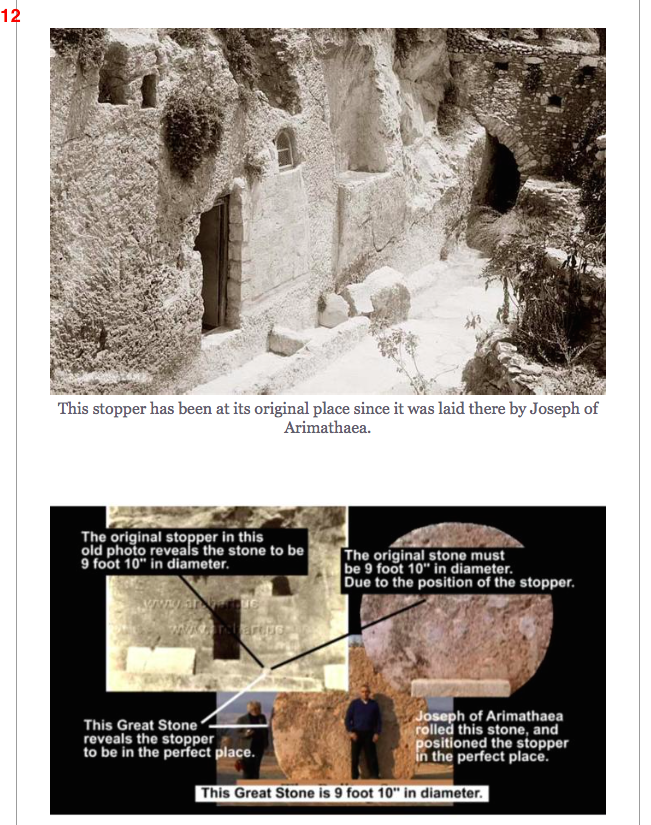
Furthermore, old photographs of the Garden Tomb, dating from approximately 1898 to 1946, reveal what appears to be an additional stopping stone positioned within the channel. This detail is extremely important because it helps establish the likely diameter of the original rolling stone.

Based on this evidence, I concluded that the original stone measured between nine and ten feet in diameter.

That changes everything.

A Stone With No Explanation

An article published by the International Symposium of Heritage Interpretation describes the Mount Nebo stone as a “large circular tomb door.” The article acknowledges that the stone was brought to Mount Nebo from another location and states that its origin and purpose are unclear.

But I believe its purpose is not unclear at all.

I believe this is the missing Great Stone from the tomb of Jesus Christ.


Others have also recognised the unusual nature of this discovery. One commenter on my YouTube channel described the evidence as “potentially explosive.”

Author Perry Stone referred to the Mount Nebo stone in his book Secrets from Beyond the Grave as “a massive rolling stone.”


Bob Mitchell of Shofar Ministries suggested that Byzantine believers may have preserved the stone and moved it to Mount Nebo as a memorial to the Resurrection.


Testing All Things.

Despite the measurements, the laboratory analysis, the matching chisel marks, and the photographic evidence, some still reject the conclusion that this is the original stone from the tomb of Jesus.

But Scripture says:

“Test all things. Hold fast to what is good.”

— 1 Thessalonians 5:21

That is exactly what I have attempted to do.

The evidence should be examined carefully and honestly.

The Bible itself remains reliable and true.

In Acts 13:41 we read:

“Look, you scoffers, wonder and perish, for I am going to do something in your days that you would never believe, even if someone told you.”

Perhaps that verse applies even today.


A Testimony to the Resurrection

I believe the Great Stone at Mount Nebo stands as a testimony to the Resurrection of Jesus Christ.

Overlooking the Promised Land, this stone reminds mankind that God sent an angel to roll away the stone from the tomb — declaring that death had been conquered and the debt of sin fully paid.

Jesus Christ rose from the dead.

And because He lives, those who believe in Him have the promise of eternal life.

“For God so loved the world that He gave His one and only Son, that whoever believes in Him shall not perish but have eternal life.”

— John 3:16

What do you believe?


Up dated article here: The Garden Tomb – Could This Be the Tomb of Jesus?


Related Videos and articles:


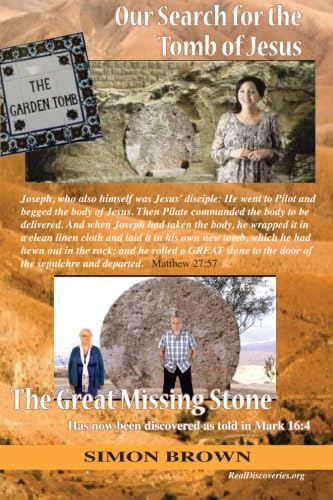
DVD cover for Simon Brown's documentary "Tomb of Jesus," exploring the archaeological, historical, and biblical evidence surrounding the Garden Tomb in Jerusalem, the tomb of Jesus Christ, and the resurrection.

Figure 7. Cover of Simon Brown's documentary "Tomb of Jesus," presenting archaeological research into the Garden Tomb, the Great Stone at Mount Nebo, and the biblical account of Mark 16:4.

https://youtu.be/RBNbWLmQ57k?si=A7YaS8r2O5MixUPd


Promotional announcement by Simon Brown presenting the Great Stone at Mount Nebo, Jordan, summarising archaeological research into its possible connection with the large stone described in Mark 16:4 and the Garden Tomb in Jerusalem.
Figure 6. Early research announcement by Simon Brown introducing the Great Stone at Mount Nebo and summarising the archaeological investigation into its possible connection with the large stone described in Mark 16:4.

Promotional banner linking to the main research article "Is the Garden Tomb the Tomb of Jesus?" featuring the Garden Tomb in Jerusalem, the large rolling stone, and an examination of the archaeological, historical, and biblical evidence surrounding the burial place of Jesus Christ.

Garden tomb of Jesus. And the GREAT STONE, Mark 16:4,

Click on image to enlarge
Garden tomb of Jesus. And the GREAT STONE, Mark 16:4,

Garden tomb of Jesus. And the GREAT STONE, Mark 16:4,
Click on image to enlarge
Garden tomb of Jesus. And the GREAT STONE, Mark 16:4,

Garden tomb of Jesus. And the GREAT STONE, Mark 16:4,

Garden tomb of Jesus. And the GREAT STONE, Mark 16:4,
Click on image to enlarge
Garden tomb of Jesus. And the GREAT STONE, Mark 16:4,

Garden tomb of Jesus. And the GREAT STONE, Mark 16:4,

Garden tomb of Jesus. And the GREAT STONE, Mark 16:4,

Garden tomb of Jesus. And the GREAT STONE, Mark 16:4,
the Great Stone at Mount Nebo called The Abu Badd stone. MAJOR DISCOVERY PROVING THE GOSPELS.

Garden tomb of Jesus. And the GREAT STONE, Mark 16:4,
the Great Stone at Mount Nebo called The Abu Badd stone. MAJOR DISCOVERY PROVING THE GOSPELS.

the Great Stone at Mount Nebo called The Abu Badd stone. MAJOR DISCOVERY PROVING THE GOSPELS.

Garden tomb of Jesus. And the GREAT STONE, Mark 16:4,


Our Search for the Tomb of Jesus BOOK. By Simon Brown.
Please click on Simon's book to read for FREE.

Our Search for the Tomb of Jesus FREE DVD. By Simon Brown.
Please click on Simon’s DVD to order.

Garden tomb,

Garden tomb,
Garden tomb,
Garden tomb,
Garden tomb,
Garden tomb,

Garden tomb,
Garden tomb,
Garden tomb,
Garden tomb,
Garden tomb,
Garden tomb,
CORRECTION THE GREAT STONE IS 9’8''
Garden tomb,

For whatever is hidden is meant to be disclosed, and whatever is concealed is meant to be brought out into the open. Mark 4:22. New International Version (©1984)

Here are the correspondents of the emails regarding this discovery of The Great Stone.

I Simon Brown sent an email to the monastery at Mount Nebo asking PLEASE DO YOU KNOW WHERE THIS STONE CAME FROM? and DO YOU KNOW HOW OLD IT IS AND WHY IS IT THERE? 2 days later I received an email from them saying it was found in a old village and was used as a fortified door for a monastery. But here was the exciting bit. They did not know how it got there or why it was made in the first place. Here was their email

Sent: Mon, Jan 10, 2011 9:44 am
Subject: Re: Mount nebo. large rolling stone.

Dear Sir,
The stone was a rolling door (!) found near the Mount Nebo and put there to protect and show it.
Regards
​
Fr. Carmelo Pappalardo
Director
Francisca Archaeological Institute on Mount Nebo

I was so confident this was the stone to the tomb that I sent emails to the Garden tomb in Jerusalem for the attention of the new manger Richard Merion. As you would expect I received no reply. I called the garden tomb staff by phone and asked would they please ask Richard to call me in the UK. To my surprise he called me. I told him who I was and that I was very familiar with the history of the garden tomb, as I had in the past done much research and made a film of it. I decided to pop the big question which I didn't think he would believe. "Richard, if I told you I have discovered the missing rolling stone to the garden tomb would you believe me?" He said at this stage he wouldn't say, but he would be willing to hear my case and would I email him with the updates? Perhaps I could meet him in London to present the evidence. I was very pleased with his cooperation and told him I would gather all the facts together and then call him. After some weeks I emailed Richard again, telling him that I am going to make a trip to take measurements of both the stone and the garden tomb. Getting no reply to my emails I spoke to Richard for the second time. He seemed reluctant to co-operate and told me he had sent me an email, which I never received. I asked him to resend it, but It still did not come. I then received an email from Mr Victor Jack at the Garden Tomb Association in London. He said he was not really bothered about whether the stone is found or not, and that similar claims had been made by Ron Wyatt, which proved to them not to be true. However he said that Richard Merion would hear my case.
Here below you can read all the emails to and from, Mr Richard Merion Director, and Victor Jack Chairman of the Garden Tomb (Jerusalem) Association.

Sent: Wed, Feb 9, 2011 10:42 am
Subject: Re: Subject: URGENT For the attention of Mr TV Jack.
Dear Mr Brown,
Thank you for your email. I have been involved with the Garden Tomb for over 20 years and during that time we have had a number of claims by other individuals to have found the Rolling Stone and even the ark of the Covenant under Skull Hill. None of these have been found to be true.
At the moment I will leave our very efficient Director, Richard Meryon, to correspond with you, as he has asked for further evidence to substantiate your claim. I couldn’t ask our Garden Tomb Council to meet with you until further confirmation of your claim is received.
We have always taken the view that the message of the death and resurrection of Jesus is our prime focus and the reason for the existence of our ministry in Jerusalem. Skull Hill, the empty tomb, the cistern and the wine press are all powerful visual aids that enhance that ministry but we have never claimed that our site is definitely the place where Jesus died and rose again, even though some think it is.
Richard will keep me informed.
Yours sincerley, in our risen Lord, Victor Jack.

From: Simon Brown [mailto:mrsimonbrown@aol.co.uk]
Sent: Friday, February 25, 2011 12:43 PM
To: mail; victor.jack@virgin.net
Subject: For the attention of Mr Richard Merion
The Missing Rolling Stone For The Garden Tomb.

Dear Mr Richard Merion with reference to my previous emails and my telephone conversations with you.
As I agreed with you. I have kept my promises and presented the evidence of my case regarding this being the Great missing stone from the garden tomb.
However you have never once had the decency to acknowledge any of my many emails.
Regardless to you stating to me you would communicate by email.
Mr TV Jack also stated to me you would hear my case.
Is this how you normally treat your brothers in Christ?
I pray you will receive this wonderful news the lord has now revealed to the world with joyful hearts.
In the name of Jesus.
Simon Brown
www.realdiscoveries.org

From: richard meryon
Sent: 26 February 2011 12:22
To: 'mrsimonbrown@aol.co.uk'
Cc: 2 Victor JACK(GTA)
Subject: Your rolling stone

Simon
I am rather hurt by the tone of your e-mail as I have not received anything from you by e-mail.   I have just done another search and cannot find any trace of receiving your thesis.  
I await the evidence and will give it a good read.   Please send it to me; I will acknowledge its receipt, and will then let you know of the ministry’s response.
Yours faithfully
Error! Filename not specified.
Richard Meryon
www.gardentomb.org

From: Simon Brown [mailto:mrsimonbrown@aol.co.uk]
Sent: 26 February 2011 16:50
To: richardmeryon@talktalk.net
Subject: The Missing Rolling Stone For The Garden Tomb.
Dear Richard I don't mean to hurt you in any way. However I did what I said I would do which is to send you all the very hard work I have done. By presenting my case. And when I hear nothing I get hurt also.
Lets continue to be brothers in Christ and move on.
All I ask now is you hear my case so I can then go forward. Here is the link which has much of the facts.
http://www.realdiscoveries.org/modules/articles/item.php?itemid=264&com_mode=nest&com_order=0#comment21
I do have far more evidence which I would be willing to talk to you about at a later date.
In Jesus name
Simon Brown

-----Original Message-----
From: Richard Meryon (TT) <richardmeryon@talktalk.net>
To: 'Simon Brown' <mrsimonbrown@aol.co.uk>
Cc: 2 Victor JACK(GTA) <victor.jack@virgin.net>
Sent: Sat, Feb 26, 2011 3:43 pm
Subject: RE: The Missing Rolling Stone For The Garden Tomb.

Dear Simon
Thank you. Now that I have access to your hyper-link, I will spend some time studying it.
I will also raise the subject at our next trustees’ meeting and let you know if the trustees want to pursue your offer.
For the Glory of God
Richard Meryon

www.gardentomb.org

From: Simon Brown [mailto:mrsimonbrown@aol.co.uk]
Sent: 01 March 2011 17:17
To: richardmeryon@talktalk.net
Cc: victor.jack@virgin.net
Subject: Re: The Missing Rolling Stone For The Garden Tomb.

Dear Richard I have now made a 40 minute film presenting all the evidence of the Great Stone.
Would you like me to send you and Jack a copy?
Simon Brown
www.realdiscoveries.org

-----Original Message-----
From: Richard Meryon (TT) <richardmeryon@talktalk.net>
To: 'Simon Brown' <mrsimonbrown@aol.co.uk>
CC: victor.jack <victor.jack@virgin.net>
Sent: Tue, 1 Mar 2011 16:10
Subject: RE: The Missing Rolling Stone For The Garden Tomb.

Dear Simon
Please feel free to do so:
The Garden Tomb
PO Box 19462
Jerusalem 91193
Israel.
Victor and I will view it next time he is here.
Most sincerely
Richard Meryon

www.gardentomb.org

-----Original Message-----
From: Simon Brown <mrsimonbrown@aol.co.uk>
To: richardmeryon@talktalk.net; victor.jack@virgin.net
Sent: Thu, Mar 10, 2011 12:57 pm
Subject: Re: The Missing Rolling Stone For The Garden Tomb.

The Missing Rolling Stone For The Garden Tomb.

Dear Richard I hope your well.
Richard do you have any dispute with my claim regarding the evidence I have sent you so far please?

Simon Brown

From: Simon Brown [mailto:mrsimonbrown@aol.co.uk]

Sent: 15 March 2011 12:07
To: richardmeryon@talktalk.net; victor.jack@virgin.net
Subject: Fwd: The Missing Rolling Stone For The Garden Tomb. just incase you haven't received this

Dear Richard I am just sending you this email again below as I have not received a reply so just incase you haven't received this here it is again

Blessings In the name of Jesus Christ

Simon Brown

From: richard meryon
Sent: 16 March 2011 21:19
To: Simon Brown
Cc: 2 Victor JACK(GTA)
Subject: RE: The Missing Rolling Stone For The Garden Tomb. just incase you haven't received this

Simon
1.       I have replied very time – have you checked your spam filter?
2.       Please do not continue to saturate me; I have told you that you will hear from the GT Chairman when he has canvassed the trustees’ opinions.   And you will.
For God’s Glory
Richard Meryon

www.gardentomb.org

OK Richard THANKS.
S Brown
​
​Last and final email from Victor Jack, Chairman of the Garden Tomb (Jerusalem) Association.

Dear Simon,
A possible Stone

While you have in the main been corresponding with our Director in Jerusalem, both he and you have kept me fully advised of your enquiry, of your research and of your offer.   Thank you.
Many people approach the Garden Tomb (Jerusalem) Association with a broad variety of requests and suggestions.   Everyone is well-meaning, often genuinely sincere, but not all are in harmony with our own ministry’s purpose.   I have been closely involved with the Garden for over 20 years so I am well versed with all these contacts.
As Chairman of the Board of Trustees of the GT(J)A I presented both your report and the video clip to the whole Board at our trustees’ meeting in London, on Tuesday 15th March 2011.  I regret to inform you that the Board did not believe that what you have offered enhances the ministry of the Garden.  Furthermore, if you raised all the funds and the necessary permissions to re-locate the stone from Mount Nebo to East Jerusalem, the Board will still not accept your offer.
Our Trustees have also asked me to tell you that we are deeply concerned that you have broken two long-standing rules of the Garden Tomb, which is a private Garden, in that you not only took video in the Garden without our permission, you also took away material (the rock that you are seen to pick up from outside the tomb) without are permission.
The Board is also very concerned by your reference, without our being able to verify what you say, to communication with staff of the GT(J)A in your publicity.   I therefore ask you to remove all reference to any communication with the GT(J)A, either positively or negatively, in any publicity.
To avoid any future disagreements that might embarrass either or both parties, let us agree that the GT(J)A neither confirms or denies its position with regard to the Mount Nebo stone.   We also ask you not to allow any of your filmed footage in the Garden Tomb to appear in the public domain.
Our response may disappoint you, but we have a responsibility to uphold the ministry with which we have been entrusted.
Yours sincerely,
Victor Jack
Chairman of the Garden Tomb (Jerusalem) Assoication
PO Box 19462
Jerusalem, 91193
Israel​

Simon Brown to victor.jack, richard, bstreather - 18 Mar 2011

Dear Victor Jack Thank you for your kind email.

May The Lord God Bless you.

In The Name Of Jesus

Simon Brown
www.realdiscoveries.org

There is nothing concealed that will not be disclosed, or hidden that will not be made known. Luke 12

Is the Garden tomb the tomb of Jesus? Fast facts.

Photograph of Simon Brown measuring the Great Stone at Mount Nebo, Jordan, during archaeological research into its possible connection with the large stone mentioned in Mark 16:4 and the tomb of Jesus.

DVD cover for Simon Brown's documentary "Tomb of Jesus," exploring the archaeological, historical, and biblical evidence surrounding the Garden Tomb in Jerusalem, the tomb of Jesus Christ, and the resurrection.

Figure. Cover of Simon Brown's documentary "Tomb of Jesus," presenting archaeological research into the Garden Tomb, the Great Stone at Mount Nebo, and the biblical account of Mark 16:4.

Related articles: