Simon Brown.

Join me on this journey. Let's seek the truth together! 💡 Proverbs 8:34-36 Blessed is the man who hears me, watching daily at my gates, waiting at my door posts. For whoever finds me finds life, and will obtain favor from Yahweh. But he who sins against me wrongs his own soul. All those who hate me love death.” Psalm 84: 11 For Yahweh God is a sun and a shield. Yahweh will give grace and glory. He withholds no good thing from those who walk blamelessly. 12 Yahweh of Armies, blessed is the man who trusts in you. 1 John 5:5 Now who is the one overcoming the world, except the one believing that Jesus is the Son of God.
Showing posts with label Is Jesus the creator?. Show all posts

Wednesday, 13 November 2024

IS GOD THE CHRIST! 1 Corinthians 2:8.

IS GOD THE CHRIST! 1 Corinthians 2:8.

Where does the Word of GOD say we MUST believe GOD is the Christ?
Or that Jesus is GOD?
Let's look in 1 Corinthians 2:8 to read what we MUST believe!
Notice what we read in 1 John 5:1 Berean Literal Bible Everyone believing that �� Jesus is the Christ �� has been born of God, and everyone loving the One having begotten Him also loves the one having been begotten from Him. Did you see that Everyone believing that �� Jesus is the Christ �� So how will most of Christianity be saved? because MOST believe Jesus is GOD, When, GOD is NOT the Christ!
Nor does ANYWHERE in the whole Bible does it say Christians MUST believe Jesus is GOD, or that GOD is the SON.
So Why do MOST of Christianity believe in what's NOT taught in the Bible, that they MUST believe Jesus is GOD.
THIS ALONE, PROVES GOD THE SON, IS A FALSE CHRIST!

Tuesday, 6 July 2021

The FALSE Interpretation of Colossians 1:16

.

The FALSE Interpretation of Colossians 1:16


The FALSE Interpretation of Colossians 1:16

Does Colossians 1:16 Really Teach That Jesus Created the Genesis Universe?

Research by Simon Brown

One of the most frequently quoted passages used to prove that Jesus is God and the Creator of the universe is Colossians 1:16.

A good example can be found on the popular Trinitarian website CompellingTruth.org, where Colossians 1:16 is cited in support of the belief that Jesus created all things.

The English Standard Version (ESV) reads:

"For by him all things were created, in heaven and on earth, visible and invisible, whether thrones or dominions or rulers or authorities—all things were created through him and for him."

At first glance, this appears to teach that Jesus personally created the heavens and the earth described in Genesis.

But does Paul actually say that?


The First Translation Difference

The Greek text begins with the words:

ἐν αὐτῷ

These words literally mean:

"In Him."

For this reason, translations such as the Berean Study Bible translate the verse:

"For in Him all things were created..."

rather than:

"For by Him all things were created..."

This difference is significant.

The Greek preposition ἐν (en) normally means "in." Some translators understand it as expressing agency and therefore translate it "by Him," while others retain the more literal wording "in Him."

Whether Paul intended "in," "through," or "by" is therefore an interpretive decision rather than something explicitly stated by the Greek text.

For that reason, every reader should carefully examine the context before deciding what Paul meant.


The Greek Verb

The next words translated:

"were created"

come from the Greek verb:

ἐκτίσθη (ektisthē)

This is the aorist passive form of κτίζω (ktizō), meaning:

  • to create

  • to make

  • to form

  • to build

After examining the Greek more carefully, I realised that the words "were created" are a correct translation of this Greek verb.

Therefore, the issue is not whether the verb has been mistranslated.

The real question is much more important.


Which "All Things" Is Paul Talking About?

The crucial question is:

What are the "all things" Paul is referring to?

Most Christians immediately assume Paul is speaking about the original creation recorded in Genesis.

However, the surrounding context suggests another possibility.

Throughout the New Testament we are repeatedly told that God exalted Jesus after His resurrection and gave Him supreme authority.

Jesus Himself said:

"All authority has been given to Me in heaven and on earth."
(Matthew 28:18)

Peter declared:

"Therefore let all the house of Israel know assuredly that God has made this Jesus, whom you crucified, both Lord and Christ."
(Acts 2:36)

Paul also writes:

"Therefore God highly exalted Him and bestowed on Him the name that is above every name."
(Philippians 2:9)

Likewise Paul writes elsewhere:

"...He raised Him from the dead and seated Him at His right hand... far above every rule and authority and power and dominion... and He put all things under His feet."
(Ephesians 1:20–22)

Notice the order.

God first raises Jesus.

God then exalts Jesus.

God then gives Jesus all authority.

God then places all things under Him.

This raises an important question.

Could Colossians 1:16 be describing everything God established under Christ's authority after His exaltation, rather than describing the original creation in Genesis?


Notice What Paul Actually Mentions

Instead of describing the creation account found in Genesis, Paul immediately says:

"...whether thrones or dominions or rulers or authorities..."

These are positions of authority and government.

Paul does not mention:

  • Adam

  • Eve

  • the Garden of Eden

  • the sun

  • the moon

  • the stars

  • the animals

  • the sea

  • or the six days of creation.

Instead, his emphasis is on thrones, dominions, rulers, authorities, Christ's supremacy, His resurrection, and the reconciliation of all things through Him.

That context deserves careful consideration.


The Context Must Determine the Meaning

The words "all things" do not always mean every individual thing in existence throughout all time.

Throughout Scripture, the phrase "all things" often refers to all things within the context being discussed.

The immediate context of Colossians is Christ's supremacy, His resurrection, His Kingdom, His authority, and God's purpose accomplished through Him.

For that reason, I believe Paul is describing the new order established through God's exalted Messiah rather than teaching that Jesus personally created the Genesis universe.

Whether readers agree or disagree with that conclusion, the context itself should be allowed to determine the meaning instead of assuming Genesis creation is being discussed before the passage has been examined.


Conclusion

Colossians 1:16 does indeed say that "all things were created."

The real question is not whether they were created.

The real question is:

Which "all things" is Paul referring to?

When the surrounding verses are carefully examined, Paul's emphasis is upon Christ's exaltation, His authority, His supremacy, and the reconciliation of all things through Him.

This opens the possibility that Paul is speaking about the new order God established in His Messiah after His resurrection and exaltation, rather than the original creation recorded in Genesis.

Every reader should therefore examine the whole context carefully before concluding that Colossians 1:16 teaches that Jesus created the Genesis heavens and earth.


Research by Simon Brown

"Test all things; hold fast what is good." (1 Thessalonians 5:21)


The FALSE Translations of Colossians 1:16
----------------------------------------------------

Related Articles:

Colossians 1:16 and 1:17.


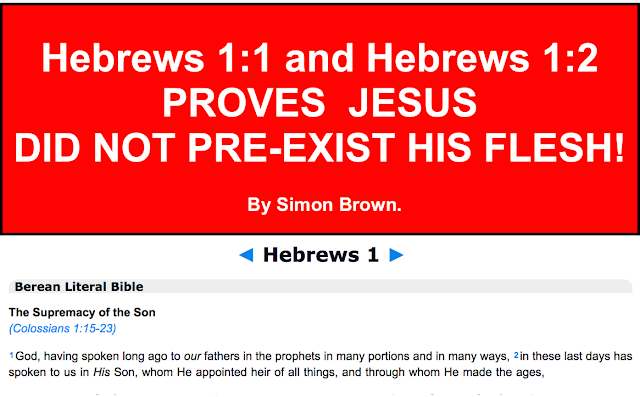
HEBREWS 1:1


Monday, 12 April 2021

The FALSE translations of Hebrews 1:10!

Hebrews 1:10

The FALSE translations of Hebrews 1:10!

New Living Translation

He also says to 👉the Son,👈“In the beginning, Lord, you laid the foundation of the earth and made the heavens with your hands.

Weymouth New Testament

It is also of His 👉Son👈 that God says, "Thou, O Lord, in the beginning didst lay the foundations of the earth, and the heavens are the work of Thy hands.

Many are DECEIVED by using FALSE translations of Hebrews 1:10 as above, and therefore believe is referring to Jesus as the creator.

However, the correct translations do NOT have the name Jesus, in the verse, but say LORD, for the LORD GOD ALMIGHTY alone, NOT Jesus.

And: "You, 👉Lord,👈 laid the foundation of the earth in the beginning, and the heavens are works of Your hands.

And this verse is a quote from Psalm 102:25:

World English Bible

Of old, you laid the foundation of the earth. The heavens are the work of your hands.

And the whole chapter of Psalm 102; is referring to a prayer to Yahweh, the One True Father GOD ALONE, as we read in the beginning Psalm 102:

Do Not Hide Your Face From Me 

1 Hear my prayer, Yahweh! Let my cry come to you.


---------------------------------------------
Related articles:

SCRIPTURES Proving Yahweh The One True GOD Of Israel Is The CREATOR ALONE.

John 1:10.

Hebrews 1:2.


Tuesday, 4 August 2020

The Correct meaning of Revelation 3:14.

Revelation 3:14 Bible study examining what “the Beginning of God's creation” means and whether Jesus was created or created everything.

A detailed Bible-study infographic examining Revelation 3:14 and the meaning of Jesus being called “the Beginning of God's creation.” It compares the major interpretations of the Greek word archē and asks whether Jesus was God's first creation, the source of creation, or the beginning of God's new creation. Research by Simon Brown.

THE CORRECT MEANING OF REVELATION 3:14 — WHAT DOES “THE BEGINNING OF GOD'S CREATION” REALLY MEAN?

Does Revelation 3:14 Say Jesus Was Created, or That Jesus Created Everything?

Research by Simon Brown


IMPORTANT UPDATE TO MY ORIGINAL RESEARCH

I originally published this article in 2020.

Since then I have continued researching Revelation 3:14, the Greek word ἀρχή (archē), Colossians 1:15–18, John 1:1–3 and the wider biblical teaching concerning creation.

As a result, I have substantially revised this article.

Some arguments in my original research were stated too strongly, and a few points concerning the Greek language needed correcting.

Rather than hide those mistakes or simply delete the article, I believe the proper thing to do is acknowledge them and replace the earlier arguments with a more careful examination of the biblical evidence.

My conclusion remains non-Trinitarian, but our conclusions should rest upon what Scripture can actually establish.

WE SHOULD NEVER MAKE THE BIBLE SAY MORE THAN IT SAYS.

So let us reconsider Revelation 3:14.


WHAT DOES REVELATION 3:14 ACTUALLY SAY?

Jesus tells John:

“And to the messenger of the church in Laodicea write: These things says the Amen, the faithful and true Witness, the Beginning of God's creation.”
— Revelation 3:14, BLB

The crucial expression is:

“THE BEGINNING OF GOD'S CREATION”

The Greek is:

ἡ ἀρχὴ τῆς κτίσεως τοῦ Θεοῦ

Hē archē tēs ktiseōs tou Theou

The important word is:

ἀρχή — ARCHĒ

Usually translated here as:

“beginning.”

But what exactly does that mean?


THREE MAJOR INTERPRETATIONS

Revelation 3:14 has been interpreted in several different ways.

INTERPRETATION 1 — JESUS WAS GOD'S FIRST CREATION

Jehovah's Witnesses understand Jesus as God's first created being and therefore understand “the beginning of God's creation” in that general framework.

Under this interpretation, Jesus belongs to God's creation and was its first member.

INTERPRETATION 2 — JESUS IS THE SOURCE OR ORIGIN OF CREATION

Many Trinitarian interpreters understand archē here in an active sense.

Jesus is therefore not the first thing created but the origin, source or ruler of creation.

This interpretation is commonly connected with John 1:1–3 and Colossians 1:15–17.

INTERPRETATION 3 — JESUS IS THE BEGINNING OF GOD'S NEW CREATION

Another interpretation understands Revelation 3:14 in connection with Christ's resurrection and the new creation inaugurated through him.

This interpretation can be compared especially with Colossians 1:18, where Jesus is called both:

“THE BEGINNING”

and

“THE FIRSTBORN FROM THE DEAD.”

This third interpretation is the one I believe deserves much more attention.

But importantly, the Greek word archē by itself does not automatically prove any one of these interpretations.

We have to examine the context.


WHAT DOES THE GREEK WORD ARCHĒ MEAN?

My original article stated too simply that archē meant:

“the initial starting point.”

That was incomplete.

The Greek noun ἀρχή (archē) has a broader range of meanings.

Depending upon context, it can refer to such ideas as:

beginning

origin

first position

rule

authority

or ruler

For example, the same basic Greek word occurs in expressions concerning rulers and authorities.

Therefore, we cannot simply look up one English definition of archē and declare the theological question solved.

CONTEXT MUST DETERMINE ITS SENSE.


DOES “BEGINNING” MEAN “FIRST CREATED”?

Not necessarily.

This is extremely important.

Revelation 3:14 does not use a Greek expression meaning:

“THE FIRST THING GOD CREATED.”

It calls Jesus:

“THE ARCHĒ OF GOD'S CREATION.”

Therefore, someone who argues that Revelation 3:14 proves Jesus was God's first created being must establish that interpretation from the context.

The word archē alone doesn't prove it.

But the same caution must apply to the opposite argument.

Someone cannot merely say:

“Archē means source, therefore Revelation 3:14 proves Jesus created the universe.”

That conclusion also requires contextual evidence.


AN IMPORTANT PARALLEL: COLOSSIANS 1:18

Now we come to a very important passage.

Paul writes concerning Jesus:

“And He is the head of the body, the church, who is the beginning, firstborn out from the dead, so that He might be holding preeminence in all things.”
— Colossians 1:18, BLB

Notice the language:

“HE IS THE BEGINNING”

The Greek word is again:

ἀρχή — ARCHĒ

But Paul immediately connects this with:

“FIRSTBORN OUT FROM THE DEAD”

and then explains the result:

“SO THAT HE MIGHT BE HOLDING PREEMINENCE IN ALL THINGS.”

This is extremely important evidence when considering Revelation 3:14.

Jesus is the beginning in a passage directly concerned with his position as the resurrected firstborn from the dead and his resulting preeminence.


REVELATION ITSELF USES SIMILAR LANGUAGE

Revelation 1:5 describes Jesus as:

“…Jesus Christ, the faithful witness, the firstborn of the dead, and the ruler of the kings of the earth.”
— Revelation 1:5, BLB

Notice again the connection:

Jesus Christ

faithful witness

firstborn of the dead

ruler of the kings of the earth

Then Revelation 3:14 describes him:

the Amen

the faithful and true Witness

the beginning of God's creation

There is an interesting connection within Revelation itself.

Revelation 1:5 calls Jesus the:

“FAITHFUL WITNESS”

Revelation 3:14 calls him the:

“FAITHFUL AND TRUE WITNESS.”

Revelation 1:5 calls him:

“THE FIRSTBORN OF THE DEAD.”

And Revelation 3:14 calls him:

“THE BEGINNING OF GOD'S CREATION.”

This makes Christ's resurrection, rulership and new-creation status highly relevant to interpreting Revelation 3:14.

It does not by itself settle every question, but it is evidence that should not be ignored.


JESUS IS THE FIRSTFRUITS FROM THE DEAD

Paul writes:

“But now Christ has been raised out from the dead, the firstfruit of those having fallen asleep.”
— 1 Corinthians 15:20, BLB

And:

“But each in the own order: Christ the firstfruit, then those of Christ at His coming.”
— 1 Corinthians 15:23, BLB

Jesus therefore occupies the first and supreme position in God's resurrection program.

He is the:

firstborn from the dead

firstfruits

beginning

and the one through whom God's future Kingdom is established.


BUT JESUS WAS NOT THE FIRST PERSON EVER RESTORED TO LIFE

This distinction matters.

People were raised from the dead before Jesus.

Lazarus is an obvious example.

Yet Lazarus eventually died again.

Jesus' resurrection was fundamentally different.

Paul says:

“Christ, having been raised out from the dead, dies no more; death no longer rules over Him.”
— Romans 6:9, BLB

Jesus is therefore the beginning of something radically new:

RESURRECTION TO IMMORTAL LIFE.

That makes the connection between “beginning” and “firstborn from the dead” especially significant.


WHAT ABOUT COLOSSIANS 1:15?

Paul calls Jesus:

“the image of the invisible God, the firstborn of all creation.”
— Colossians 1:15, BLB

This verse is also disputed.

Jehovah's Witnesses understand “firstborn of all creation” as evidence that Jesus was God's first created being.

Traditional Christianity generally understands “firstborn” primarily in terms of Christ's supremacy over creation rather than Christ being part of creation.

But we should remember that the biblical term “firstborn” does not always mean “first-created.”

Psalm 89 provides an important example.

God says concerning the Davidic king:

“Also I will make him My firstborn, the highest of the kings of the earth.”
— Psalm 89:27

Here firstborn clearly carries the idea of rank, supremacy and kingship.

That makes Paul's explanation in Colossians 1:18 especially significant:

“…so that He might be holding preeminence in all things.”


DOES REVELATION 3:14 PROVE JESUS WAS THE FIRST PERSON GOD CREATED?

I do not believe it does.

The verse calls Jesus:

“THE BEGINNING OF GOD'S CREATION.”

It does not explicitly say:

“Jesus was the first creature God made.”

Therefore we should not insert those words into the verse.

If someone wishes to argue that Jesus was created, that case has to be established from the wider biblical evidence—not merely assumed from the English word “beginning.”


BUT DOES REVELATION 3:14 PROVE JESUS CREATED GENESIS?

We must be equally careful here.

Revelation 3:14 itself does not say:

“Jesus created the heavens and the earth.”

Nor does it say:

“Jesus is the God who created everything.”

Those conclusions are usually brought into Revelation 3:14 from passages such as John 1:1–3 and Colossians 1:16.

Those passages therefore need to be investigated separately.

We should not use Revelation 3:14 to prove a particular interpretation of Colossians 1:16 and then use Colossians 1:16 to prove our interpretation of Revelation 3:14.

That would become circular reasoning.


WHO DOES SCRIPTURE IDENTIFY AS THE CREATOR?

One passage that deserves serious consideration is Isaiah 44:24:

“Thus says Yahweh, your Redeemer, and He who formed you from the womb: ‘I am Yahweh, who makes all things; who alone stretches out the heavens; who spreads out the earth by Myself.’”

This is powerful monotheistic language.

Yahweh declares Himself the Creator.

Likewise Genesis begins:

“In the beginning God created the heavens and the earth.”
— Genesis 1:1

And Jesus himself says:

“Have you not read that the One having created from the beginning made them male and female?”
— Matthew 19:4, BLB

These passages are important to the wider creation discussion.

However, I want to correct another argument from my original article.


A CORRECTION TO MY EARLIER GREEK ARGUMENT

My previous article incorrectly suggested that the Greek word ὁ (ho) in Matthew 19:4 meant:

“ONE PERSON.”

That is not grammatically correct.

ὁ (ho) is the masculine singular Greek definite article—essentially “the.”

The ordinary Greek numeral for “one” is εἷς (heis).

Matthew 19:4 still refers to “the One having created,” and I believe the passage is important, but we should not build an argument upon an incorrect definition of the Greek article.

WHEN RESEARCH SHOWS AN ERROR, WE SHOULD CORRECT IT.

Truth has nothing to fear from correction.


ANOTHER CORRECTION: JOHN 1:2–3

My original article also described translations such as “He” in John 1:2 and “Him” in John 1:3 as simply:

“FALSE TRANSLATIONS.”

That was too strong.

The underlying Greek pronouns can be rendered according to how the translator understands their antecedent and according to normal English grammar.

The real debate is not whether English translators invented nonexistent Greek pronouns.

The deeper question is:

WHAT DOES JOHN MEAN BY “THE WORD” — THE LOGOS?

Does John's logos describe a personally pre-existent Son?

Or God's word, wisdom, purpose and self-expression that ultimately became flesh in Jesus?

That is a much larger question and should be investigated in a dedicated study of John 1:1–14, rather than settled by simply calling “he” or “him” a false translation.


WHAT ABOUT JOHN 17:5?

My original article also attempted to prove that Jesus could have glory with God before the world existed without personally existing then.

Jesus prayed:

“And now glorify Me, You Father, with Yourself, with the glory that I had with You before the world existed.”
— John 17:5, BLB

There are genuine interpretive questions here.

Traditional Christianity understands this as evidence of Jesus' personal pre-existence.

Biblical Unitarians have commonly understood the glory as existing beforehand in God's plan, foreknowledge and purpose.

But my old statement that:

“BEING LOVED BY GOD IS HAVING GLORY WITH GOD”

went beyond what John actually says.

John 17:24 connects God's pre-world love for Jesus with his glory, but it doesn't simply define love and glory as identical concepts.

I have therefore corrected that argument.

John 17:5 deserves to be examined independently and carefully rather than being used as a shortcut for interpreting Revelation 3:14.


GOD'S PURPOSE EXISTED BEFORE ITS FULFILMENT

There is nevertheless an important biblical principle concerning God's foreknowledge.

Paul says believers were:

“…chosen… in Him before the foundation of the world…”
— Ephesians 1:4

Peter says Jesus was:

“foreknown indeed before the foundation of the world, but having been revealed in the last times…”
— 1 Peter 1:20, BLB

Jesus speaks of a Kingdom:

“…having been prepared for you from the foundation of the world.”
— Matthew 25:34, BLB

Therefore, Scripture certainly allows things to exist in God's purpose, plan and foreknowledge before their historical manifestation.

Whether that completely explains Revelation 3:14 is another question.

Again:

WE MUST NOT MAKE ONE VERSE PROVE MORE THAN IT ACTUALLY PROVES.


WHAT HAPPENED AFTER JESUS WAS RAISED?

Now we come to something Scripture states very clearly.

Jesus says:

“All authority in heaven and on the earth has been given to Me.”
— Matthew 28:18, BLB

Notice:

“HAS BEEN GIVEN TO ME.”

Jesus receives authority.

Paul likewise says God:

“…highly exalted Him, and granted to Him the name above every name…”
— Philippians 2:9, BLB

And Peter describes Jesus:

“…who is at the right hand of God, having gone into heaven, angels and authorities and powers having been subjected to Him.”
— 1 Peter 3:22, BLB

The risen Christ therefore occupies an extraordinary God-given position of authority.


JESUS IS THE RULER OF GOD'S NEW ORDER

This brings us back to Revelation.

Jesus is:

the faithful witness

the firstborn from the dead

the ruler of the kings of the earth

— Revelation 1:5.

And he is:

the Amen

the faithful and true Witness

the beginning of God's creation

— Revelation 3:14.

Combined with Colossians 1:18:

“He is the beginning, firstborn out from the dead, so that He might be holding preeminence in all things.”

I believe there is a substantial biblical case for understanding Revelation 3:14 in connection with Christ's position at the head of God's new creation.

But I want to state the conclusion more carefully than I did in my original research:

REVELATION 3:14 ALONE DOES NOT EXPLICITLY SAY “NEW CREATION.”

That conclusion comes from comparing the verse with the wider New Testament picture, particularly Christ as “the beginning” and “firstborn from the dead” in Colossians 1:18.

That distinction is important.


SO WHAT CAN REVELATION 3:14 ACTUALLY PROVE?

It tells us explicitly that Jesus is:

THE AMEN.

THE FAITHFUL AND TRUE WITNESS.

THE ARCHĒ OF GOD'S CREATION.

It does not explicitly say:

Jesus is God's first-created creature.

It does not explicitly say:

Jesus is Almighty God.

And it does not explicitly say:

Jesus created Genesis.

Each of those claims requires additional interpretation and supporting passages.


MY UPDATED CONCLUSION

After revisiting my original research, I believe the strongest interpretation is that Jesus' title as “the beginning of God's creation” should be understood in light of his resurrection, supremacy and position at the head of God's new order.

This is particularly supported by:

COLOSSIANS 1:18

“He is the beginning, firstborn out from the dead, so that He might be holding preeminence in all things.”

and:

REVELATION 1:5

“Jesus Christ, the faithful witness, the firstborn of the dead, and the ruler of the kings of the earth.”

Jesus is God's chosen Messiah.

God raised him from the dead.

God exalted him.

God gave him authority.

And God placed him at the head of the coming Kingdom.

That provides a powerful biblical framework for understanding why the risen Jesus can be called:

“THE BEGINNING OF GOD'S CREATION.”

But unlike my original article, I will not claim that the Greek word archē by itself proves this interpretation.

Nor will I claim Revelation 3:14 alone settles every question concerning Christ's pre-existence or his role in creation.

Those questions must be examined from the whole biblical record.


RESEARCH SHOULD BE WILLING TO CHANGE

When I first wrote this article, I believed some of my arguments were stronger than they actually were.

Further research showed me where corrections were necessary.

I do not see that as a weakness.

IF WE ARE SEEKING TRUTH, WE MUST BE WILLING TO CORRECT OURSELVES.

The purpose of Bible study should never be to defend something simply because we previously wrote it.

Our responsibility is to ask:

WHAT DOES THE WORD OF GOD ACTUALLY SAY?

My understanding remains that the Bible presents the Father as the one true God and Jesus as His Son, Messiah, risen Lord and appointed ruler.

But every individual passage deserves to be examined honestly and carefully.

And Revelation 3:14 is no exception.


FINAL QUESTION

When Jesus calls himself:

“THE BEGINNING OF GOD'S CREATION”

does he mean:

the first being God ever created?

the source of the Genesis creation?

or

the beginning and ruler of God's new creation through resurrection?

I believe the biblical evidence, particularly Revelation 1:5 and Colossians 1:18, gives us very good reason to take the third interpretation seriously.

But most importantly:

READ THE VERSE.

READ THE CONTEXT.

COMPARE SCRIPTURE WITH SCRIPTURE.

And never make the text say more than it actually says.

Research by Simon Brown

wwwrealdiscoveriesorg-simon.blogspot.com

John 1:1

Hebrews 1:10 – Did God Really Say to the Son, “You Laid the Foundation of the Earth”?


 IMPORTANT UPDATE — NEW RESEARCH AVAILABLE This subject has now been completely rewritten and expanded with additional research and evidence. READ THE NEW UPDATED ARTICLE HERE: Why I Believe the Teachings of Jehovah's Witnesses Are Mistaken. OR CLICK ON IMAGE BELOW

Infographic comparing key Jehovah's Witness teachings about Jesus, creation, Michael the Archangel, and John 1:1 with the biblical context.


Figure 1. Infographic examining the Jehovah's Witnesses' interpretation of John 1:1, including the translation "the Word was a god," and comparing it with the biblical context.

Friday, 29 November 2019

Adam: 𝗪𝗔𝗦 𝗝𝗘𝗦𝗨𝗦 𝗧𝗛𝗘 𝗦𝗢𝗡 𝗢𝗙 𝗚𝗢𝗗 “𝗕𝗘𝗙𝗢𝗥𝗘” 𝗛𝗜𝗦 𝗜𝗡𝗖𝗔𝗥𝗡𝗔𝗧𝗜𝗢𝗡?

Here is a comment by Adam left on my you tube channel, who correctly believes Jesus is NOT GOD, and teaches the TRINITY is false, but believes Jesus PRE EXISTED His flesh.
My rebuts are under his comments.
Simon Brown.

Adam: 𝗪𝗔𝗦 𝗝𝗘𝗦𝗨𝗦 𝗧𝗛𝗘 𝗦𝗢𝗡 𝗢𝗙 𝗚𝗢𝗗 “𝗕𝗘𝗙𝗢𝗥𝗘” 𝗛𝗜𝗦 𝗜𝗡𝗖𝗔𝗥𝗡𝗔𝗧𝗜𝗢𝗡? 
------------------------

Rebut by Simon Brown:
The incarnation of Christ is a central Christian doctrine that God became flesh, assumed a human nature, and became a man in the form of Jesus, the Son of God and the second person of the Trinity. Wikki.

The incarnation of Christ is another false Trinitarian doctrine, deceiving MOST of Christianity, that was adopted by the Catholics from pagans  with the pagan TRINITY and the false teaching of the SOUL surviving life after death, that was the faith of the Egyptians.
-----------------------
Adam:
Trinitarians often claim that Jesus is only called the Son of God because of His birth in Bethlehem. But being born in human flesh, Christ became the “Son of man” at His incarnation, not the “Son of God” which He already was. 
-------------------
1 Rebut by Simon Brown:
Trinitarians have got many things wrong.
There are NO teachings in the WHOLE bible saying or teaching Jesus was GOD who became flesh, or a PRE EXISTING BEING, or an ANGEL or a SPIRIT, or a LIVING BEING, before He was BORN, in John 1:14.

Jesus BECAME the “Son of MAN” proving He was 100% MAN, and the Son of GOD, from when He was BEGOTTEN from His birth in Bethlehem. 

Jesus is the Son of GOD, because He was BORN directly from GOD in the womb of Mary with NO human Father, which is why GOD is the Father of Jesus Christ.
---------------------
Adam:
Scripture reveals many times and in many ways that Jesus was God's Son “before” God sent Him into the world, not after. The following two verses for instance say that God sent His Son into the world. Hence He was already God's Son before He sent Him. “because that God sent His only begotten Son into the world, that we might live through Him.” (1 John 4:9) “For God sent not His Son into the world to condemn the world, but that the world through Him might be saved.” (John 3:17)
----------------------
2 Rebut by Simon Brown:
SENDING Jesus or Jesus being SENT, does NOT in anyway prove Jesus PRE EXISTED before He was SENT.

This is explained very well in the article below by https://www.biblicalunitarian.com/verses/john-3-13
Jesus is “from God,” “from heaven” or “from above” in the sense that God is his Father and thus his origin.There are also verses that say Jesus was “sent from God,” a phrase that shows God as the ultimate source of what is sent. John the Baptist was a man “sent from God” (John 1:6), and it was he who said that Jesus “comes from above” and “comes from heaven” (John 3:31). When God wanted to tell the people that He would bless them if they gave their tithes, He told them that He would open the windows of “heaven” and pour out a blessing (Mal. 3:10 – KJV). Of course, everyone understood the idiom being used, and no one believed that God would literally pour things out of heaven. They knew that the phrase meant that God was the origin of the blessings they received. Still another example is when Christ was speaking and said, “John’s baptism—where did it come from? Was it from heaven or from men?” (Matt. 21:25). Of course, the way that John’s baptism would have been “from heaven” was if God was the source of the revelation. John did not get the idea on his own, it came “from heaven.” The verse makes the idiom clear: things could be “from heaven,” i.e., from God, or they could be “from men.” The idiom is the same when used of Jesus.
Jesus is “from God,” “from heaven” or “from above” in the sense that God is his Father and thus his origin.

The idea of coming from God or being sent by God is also clarified by Jesus’ words in John 17. He said, “As you sent me into the world, I have sent them into the world” (John 17:18). We understand perfectly what Christ meant when he said, “I have sent them into the world.” He meant that he commissioned us, or appointed us. No one thinks that we were in heaven with Christ and incarnated into the flesh. Christ said, “As you have sent me, I have sent them.” So, however we take the phrase that Christ sent us, that is how we should understand the phrase that God sent Christ. Buzzard, pp. 154-157 Norton, pp. 246-248
--------------------------------------
Adam:
Scripture also informs us that Jesus was the Son of God before all things were created. 
Paul wrote in regards to Christ that, 
“He is the image of the invisible God, the firstborn over all creation.” 
(Colossians 1:15 NKJV)
Note that the latter part of this verse is poorly translated in the KJV which says, “Who is the image of the invisible God, the firstborn of every creature.” (Colossians 1:15 KJV) As a result there are some who use the King James Bible to imply that Christ Himself was a created being. But such an interpretation is contradicted elsewhere in Scripture such as John 1:1-4 and Colossians 1:16-17 Thus we see that Paul is telling us that Christ was “Begotten First or Born Before all creation” because all of creation was by God through His Son Jesus Christ. 

-----------------------------
3 Rebut by Simon Brown:
Jesus being the firstborn over all creation, DOES NOT mean Jesus was the FIRST to exist.

Paul gives us the answer to what He meant by saying: who is the firstborn over all creation, in the next verse of Colossians 1-18: who is the beginning, firstborn out from the dead.

What Paul meant by saying: who is the firstborn over all creation, is in the verses below:

But in fact Christ has been raised from the dead, the first fruits of those who have fallen asleep. 1 Corinthians 15-20:  

But each in his own order: Christ the first fruits, then at his coming those who belong to Christ. 1 Corinthians 15:23  

For those whom he foreknew he also predestined to be conformed to the image of his Son, in order that he might be the firstborn among many brothers. Romans 8:29   

that the Christ must suffer and that, by being the first to rise from the dead, he would proclaim light both to our people and to the Gentiles.” Acts 26:23.  

and from Jesus Christ the faithful witness, the firstborn of the dead, and the ruler of kings on earth. To him who loves us and has freed us from our sins by his blood. Revelation 1:5
---------------------------------------------
Adam:

“And to make all men see what is the fellowship of the mystery, which from the beginning of the world has been hid in God, *who created all things through Jesus Christ.”* (Ephesians 3:9)
---------------------------------------
4 Rebut by Simon Brown:
You are using one of MANY FALSE Trinitarian translations in the King James Bible, that was edited by a Catholic priest, which does NOT say: who created all things through Jesus Christ.”

The correct  translation of (Ephesians 3:9) says: Berean Literal Bible
and to enlighten all what is the administration of the mystery having been hidden from the ages in God, the One having created all things,

Notice it does NOT say: who created all things through Jesus Christ.
_______________________
Adam:
Thayer's Greek Lexicon says, 
“Christ is called, firstborn of all creation, who came into being through God prior to the entire universe of created things.” Barnes New Testament Notes on Colossians 1:15 says, “the word firstborn - pro-tot-ok'-os - properly means the firstborn child of a father or mother.” Jamieson, Fausset and Brown Commentary says, “Begotten (literally, 'born') before every creature.” Matthew Henry's Commentary states, “He was born or begotten before all the creation, before any creature was made” ________________________

5 Rebut by Simon Brown:

WHY are you using commentaries by Thayer’s Greek Lexicon, Barnes New Testament Notes, Jamieson, Fausset and Brown, and Matthew Henry’s?

You know very well these people are TRINITARIANS, who believe GOD became flesh, who continually contradict the word of GOD, and what they say and teach by saying (GOD became flesh), and yet in their other hand say: Jesus was born or begotten before all the creation, before any creature was made, PROVING Jesus is NOT GOD, IF HE WAS born or begotten before all the creation, because BORN and BEGOTTEN means to come into existence, which refutes Jesus being GOD, and pre existing His flesh.
------------------------------------------------
Adam:
Four verses say He was “begotten” prior to His incarnation so this cannot be applied to His birth on earth from Mary as some have chosen to believe. Four verses say that He “proceeded forth from,” “came out from” or “camest forth from” the Father. The evidence on this subject is overwhelming. Christ truly is the literal begotten Son of God who was brought forth from the Father before all creation. 
---------------------------------------------
6 Rebut by Simon Brown:
ALL verses that say Jesus was “begotten” or “born this day" refutes preexistence. 
Begotten or born this day, simply PROVES Jesus has just come into existence and means Jesus was fathered by God, in the womb of Mary. Psalms 2:7; Acts 13:33; Isaiah 9:6; Matthew 1:18; Luke 2:11; John 3:16; John 1:14-18 ; Matthew 1:20.  

Adam:
The example verses below with the help of the Thayer dictionary also reveal that Jesus was born of The Father before the world was, then much later, He came into the world. 
 Thayer's Greek-English Lexicon G1831 - To come forth from physically, arise from, to be born of. G2064 - 
To come from one place to another. “Jesus said unto them, If God were your Father, you would love Me, for I proceeded forth [G1831] and came from God; neither came [G2064] I of Myself, but He sent Me.” (John 8:42) 

 “For the Father Himself loveth you, because you have loved Me, and have believed that I came out [G1831] from God. I came forth [G1831] from the Father, and am come [G2064] into the world: again, 

I leave the world, and go to the Father.” (John 16:27-28) “Now they have known that all things whatsoever You have given Me are of You. For I have given unto them the words which You gavest Me, and they have received them, and have known surely that I came out [G1831] from You, and they have believed that you did send Me.” (John 17:7-8)
---------------------------------------------------------
7 Rebut by Simon Brown:

I leave the world, and go to the Father.” (John 16:27-28)
Notice how Jesus did NOT say: I leave the world, and go (BACK) or (RETURN) to the Father.” (John 16:28, as we would expect Jesus to say if He Pre existed His flesh, and was alive WITH GOD, and was going BACK to where He was before.

Coming from GOD, does NOT prove Jesus was ALIVE with GOD before Jesus was BORN from GOD in the womb of Mary.

James 1:17 tells us:
Every good act of giving and every perfect gift is from above, coming down from the Father of lights, with whom there is no variation or shadow of shifting.

This is precisely WHY Jesus often said He came DOWN from GOD out of heaven, simply because every perfect gift is from above, coming down from the Father of lights, OUT OF HEAVEN.

As GOD is ABOVE, and IN HEAVEN, Jesus was FROM GOD out of heaven, quite different from the first MAN Adam, who was made by GOD from the dust of the earth.

Jesus was making a very important point, that He was NOT from the earth, but is literally from GOD, out of heaven, as GOD is above in heaven, and ALL good things come down from GOD out of heaven, which is why Jesus is the only Begotten Son. John 3:16.

Jesus often spoke FIGURATIVELY, just as He said; I am the living bread, having come down from heaven. If anyone shall have eaten of this bread, he will live to the age. And also, the bread that I will give for the life of the world is My flesh.” John 6:51 

No one actually believes Jesus was LITERAL bread, having come down from heaven, and that people are to eat his flesh.

But we all know Jesus was speaking FIGURATIVELY, just as he told His disciples in the end, when they also were often confused with His teachings.

A pre existing Jesus, is a PRE HUMAN, and therefore would NOT be the second ADAM, if Jesus was a PRE HUMAN, and therefore is another great and terrible deception, deceiving MOST into believing in one of countless FALSE CHRIST, just as Jesus warned us saying there would be FALSE Christ.

------------------------------------------------
Related Articles:
IS THE WORD JESUS IN JOHN 1:1?

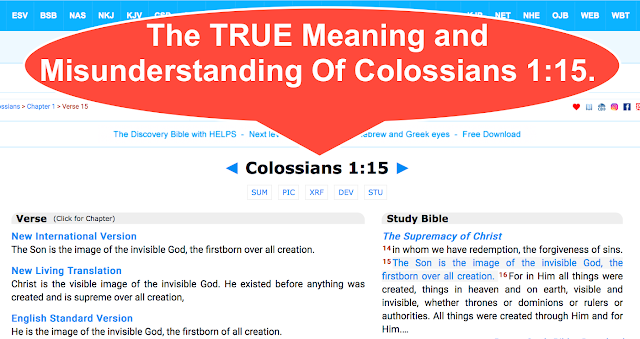
The TRUE Meaning and Misunderstanding Of Colossians 1:15.


The TRUE Meaning and Misunderstanding of Colossians 1:16 and 1:17.