Simon Brown.

Join me on this journey. Let's seek the truth together! 💡 Proverbs 8:34-36 Blessed is the man who hears me, watching daily at my gates, waiting at my door posts. For whoever finds me finds life, and will obtain favor from Yahweh. But he who sins against me wrongs his own soul. All those who hate me love death.” Psalm 84: 11 For Yahweh God is a sun and a shield. Yahweh will give grace and glory. He withholds no good thing from those who walk blamelessly. 12 Yahweh of Armies, blessed is the man who trusts in you. 1 John 5:5 Now who is the one overcoming the world, except the one believing that Jesus is the Son of God.
Showing posts with label Bible Evidence. Show all posts

Wednesday, 5 August 2026

The Tel Dan Stele: Ancient Evidence for the House of David

 IMPORTANT UPDATE — NEW RESEARCH AVAILABLE

This subject has now been completely rewritten and expanded with additional research and evidence.

READ THE NEW UPDATED ARTICLE HERE: The House of David Inscription (Tel Dan Stele) Archaeological Evidence for King David

OR CLICK ON IMAGE BELOW

The House of David Inscription (Tel Dan Stele) showing archaeological evidence for King David and the Davidic dynasty discovered at Tel Dan in northern Israel.

The Tel Dan Stele, also known as the House of David Inscription, is one of the most significant archaeological discoveries relating to the Bible. Dating to approximately 835 BC, it contains the phrase "House of David" and provides important historical evidence that the Davidic dynasty was recognised by Israel's neighbouring kingdoms.


OLD ARTICLE

The House of David Inscription (Tel Dan Stele) showing archaeological evidence for King David and the Davidic dynasty discovered at Tel Dan in northern Israel.

Wednesday, 29 July 2026

Pontius Pilate's Roman Coins – Archaeological Evidence from the Time of Jesus


Infographic showing genuine Roman coins minted by Pontius Pilate, explaining their archaeological significance, their connection with the trial of Jesus Christ, and historical evidence confirming the New Testament.

This promotional banner highlights genuine Roman coins issued by Pontius Pilate, the Roman prefect who presided over the trial of Jesus Christ. The article explores the historical background, archaeological discoveries, and biblical significance of these remarkable coins, demonstrating how they provide valuable evidence for the historical reliability of the New Testament. Research by Simon Brown.

Pontius Pilate's Roman Coins — Archaeological Evidence from the Time of Jesus

Among the many archaeological discoveries that confirm the historical setting of the New Testament are the genuine bronze coins minted by Pontius Pilate, the Roman governor who presided over the trial of Jesus Christ.

Pontius Pilate is best known for the role he played in the final hours before Jesus' crucifixion.

Jesus Before Pilate

Matthew 27:1–2

"When morning came, all the chief priests and the elders of the people took counsel against Jesus to put him to death. They bound Him, led Him away, and delivered Him to Pilate the governor."

These coins were designed and authorised by Pontius Pilate himself during his governorship of Judea (AD 26–36). They were struck in Jerusalem and circulated throughout Judea for many years, remaining in use long after Pilate had left office.

Today, many of these coins have been recovered by archaeologists after lying buried beneath the earth for nearly 2,000 years.

Although Pilate was a Roman governor, the inscriptions on his coins are written in Greek, the common language spoken throughout much of the eastern Roman Empire during the first century.

Every genuine Pilate coin is a remarkable piece of history. These are the very type of coins that circulated while Jesus walked the streets of Judea, preached throughout Galilee, and was ultimately brought before Pontius Pilate for trial.


Did the Shroud of Turin Preserve the Image of Pilate's Coins?

One fascinating theory suggests that Pontius Pilate's coins may even have left their imprint on the Shroud of Turin.

Some researchers have claimed that faint circular impressions over the eyes of the man on the Shroud resemble coins minted by Pontius Pilate, particularly coins dated Year 16 of Tiberius (AD 29/30).

This proposal became well known after photographic enhancement appeared to reveal circular markings over both eyelids.

However, not all researchers accept this conclusion. Shroud expert Barrie Schwortz, among others, has expressed disagreement with the coin-on-the-eyes theory, arguing that the available evidence is not sufficient to establish such a claim.

Although the idea remains debated, it continues to be an interesting aspect of Shroud research.


My Own Pilate Coins

I was delighted to acquire two genuine Bronze Prutah coins struck by Pontius Pilate and dated LIS (Year 16 = AD 29/30).

Holding coins that circulated during the lifetime of Jesus provides a remarkable connection with the events recorded in the Gospels. They serve as tangible reminders that Pontius Pilate was not a legendary figure but a real Roman governor who lived during the very period described in the New Testament.


Did Pontius Pilate Become a Follower of Jesus?

When I purchased these coins, they were accompanied by a note claiming that Pontius Pilate and his wife later became followers of Jesus Christ.

Whether this tradition is true remains uncertain.

Some ancient traditions claim that Pilate later accepted Christianity, while others state that he committed suicide after falling from favour with Emperor Caligula. The tenth-century historian Agapius of Hierapolis records that Pilate died during the first year of Caligula's reign (AD 37–38).

Because these traditions conflict, no firm historical conclusion can be reached.

One fact, however, is recorded in Scripture.

Before Jesus was sentenced, Pilate's wife sent him an urgent message:

"Have nothing to do with that righteous man, for I have suffered many things today in a dream because of him." (Matthew 27:19)

Her warning shows that she believed Jesus was innocent, and this may explain why later Christian traditions remembered her favourably.


Pilate Knew Jesus Was Innocent

The Gospels repeatedly show that Pontius Pilate struggled with the decision to condemn Jesus.

When the Jewish leaders brought Jesus before him, Pilate asked:

"What accusation do you bring against this man?" (John 18:29)

They replied:

"If he were not a criminal, we would not have handed Him over to you."

Pilate answered:

"Take Him yourselves and judge Him according to your own law."

The Jewish leaders responded:

"We are not permitted to put anyone to death."

John explains that this fulfilled Jesus' own prediction concerning the manner of His death.

Attempting to save Jesus, Pilate ordered Him to be scourged rather than executed.

John records that the soldiers mocked Jesus by placing a crown of thorns upon His head, clothing Him in a purple robe, and shouting:

"Hail, King of the Jews!"

Despite Pilate repeatedly declaring that he could find no fault in Jesus, the crowd demanded His crucifixion.

Matthew records that Pilate symbolically washed his hands before the people, publicly distancing himself from the sentence that he reluctantly authorised.


Archaeology Continues to Confirm the Bible

Together with the famous Pilate Stone, these genuine bronze coins provide powerful archaeological evidence that Pontius Pilate was a real historical governor who ruled Judea during the lifetime of Jesus Christ.

Once again, archaeology confirms the historical reliability of the New Testament, demonstrating that the people, places, and events recorded in the Gospels are firmly grounded in history.

Further Reading: The Coins of Pontius Pilate by Jean-Philippe Fontanille.

━━━━━━━━━━━━━━━━━━━━━━━━━━━━━━

RELATED ARTICLES

The Lachish Letters (Lachish Ostraca) Reveal the Divine Name of God

• Pontius Pilate Inscription – Archaeology Confirms the Bible

• Josephus on Jesus – One of the Most Important Non-Biblical Witnesses

• Could These Bones Be Those of John the Baptist?

• The Discovery of the Great Stone of Mark 16:4

• The History, Evidence, and Resurrection of Jesus Christ

━━━━━━━━━━━━━━━━━━━━━━━━━━━━━━

Pontius Pilate Inscription — Archaeology Confirms the Biblical Governor of Judea.


Infographic showing the Pontius Pilate Inscription (Pilate Stone), Pontius Pilate coins, and archaeological evidence confirming the historical Roman governor who presided over the trial of Jesus Christ.

Discovered in Caesarea Maritima in 1961, the famous Pontius Pilate Inscription provides direct archaeological evidence that Pontius Pilate was a real Roman governor of Judea. Together with Pilate's coins and ancient historical writings, this remarkable discovery confirms the historical accuracy of the New Testament accounts surrounding the trial and crucifixion of Jesus Christ.

Pontius Pilate Inscription — Archaeology Confirms the Biblical Governor of Judea

One of the most important archaeological discoveries relating to the trial and crucifixion of Jesus Christ is the famous Pontius Pilate Inscription, often called the Pilate Stone.

Pontius Pilate was the fifth Roman prefect (governor) of Judea, serving from approximately AD 26–36 under the Emperor Tiberius. The New Testament identifies him as the Roman governor who authorised the crucifixion of Jesus (Matthew 27:2), and his name appears more than sixty times throughout the Gospels, Acts, and 1 Timothy.

For many years critics questioned whether Pontius Pilate was a real historical figure. That changed dramatically in 1961, when archaeologists excavating the Roman theatre at Caesarea Maritima discovered a limestone inscription bearing his name.

The inscription, dedicated to Tiberius Caesar Augustus, contains the Latin name Pontius Pilatus, providing direct archaeological evidence that Pilate was a real historical person who governed Judea exactly as the Bible records.

This remarkable discovery confirms that the Gospel writers were recording genuine historical events rather than inventing fictional characters.

Pontius Pilate's existence is also confirmed by several independent historical sources, including the writings of Philo of Alexandria, Flavius Josephus, the Roman historian Tacitus, and later Christian writings such as The Gospel of Nicodemus (Acts of Pilate). While the latter is not regarded as Scripture, it provides additional historical tradition that can be considered alongside other ancient sources.


Pilate's Coins

As part of my own archaeological collection, I purchased two genuine Bronze Prutah coins struck during the governorship of Pontius Pilate. One of these coins is dated Year 16 of Tiberius (AD 29/30), placing it within the very period of Jesus' public ministry.

Holding a coin issued by the very governor who presided over Jesus' trial provides a fascinating and tangible connection with the events recorded in the New Testament. Like the Pilate Stone, these coins serve as physical evidence that Pontius Pilate was a real historical figure.


Did Pontius Pilate Become a Christian?

When I received these coins, they were accompanied by a note claiming that both Pontius Pilate and his wife later became followers of Jesus Christ.

The historical evidence for this claim is uncertain.

Some later Christian traditions suggest that Pilate eventually embraced the Christian faith, while other ancient sources state that he committed suicide after being removed from office. The tenth-century historian Agapius of Hierapolis, for example, records that Pilate died during the first year of Emperor Caligula's reign (AD 37–38).

Because these traditions disagree, it is impossible to state with certainty what became of Pilate after the crucifixion.

What we do know from Scripture is that Pilate's wife believed Jesus was innocent. Matthew records her remarkable warning:

"Have nothing to do with that righteous man, for I have suffered many things today in a dream because of him." (Matthew 27:19)

Her message demonstrates that she recognised there was something extraordinary about Jesus, and later traditions suggesting that she became a believer may have grown from this biblical account.


Pilate's Reluctance to Condemn Jesus

The Gospels consistently portray Pontius Pilate as a reluctant judge who repeatedly declared that he could find no fault in Jesus.

When the Jewish leaders brought Jesus before him, Pilate asked:

"What charges are you bring against this man?" (John 18:29)

When they failed to produce convincing evidence, Pilate replied:

"Take him yourselves and judge him according to your own law."

The Jewish leaders answered:

"We have no right to execute anyone." (John 18:31)

John explains that this fulfilled Jesus' earlier prediction concerning the manner of His death.

Pilate questioned Jesus personally and asked whether He was the King of the Jews.

Jesus answered:

"My kingdom is not of this world... For this reason I was born, and for this I came into the world, to testify to the truth." (John 18:36–37)

After hearing Him, Pilate publicly declared:

"I find no basis for a charge against him." (John 18:38)

In an attempt to satisfy the crowd without condemning an innocent man, Pilate had Jesus scourged. The soldiers mocked Him, placed a crown of thorns upon His head, clothed Him in a purple robe, and ridiculed Him as "King of the Jews."

Despite Pilate's repeated efforts to release Jesus, the crowd demanded His crucifixion. Matthew records that Pilate symbolically washed his hands before the people, declaring that he was innocent of Jesus' blood before reluctantly handing Him over to be crucified.


Archaeology Continues to Confirm the Bible

The discovery of the Pilate Stone, together with Pilate's coins and numerous ancient historical references, provides powerful evidence that the New Testament records genuine history.

Once again, archaeology confirms the accuracy of the biblical record, demonstrating that the people, places, and events surrounding the life, trial, and crucifixion of Jesus Christ are firmly rooted in history.


A Note About the Gospel of Nicodemus

As Roland J. Bell B.A. (Hons), BBI Dip. correctly observes, the term "Apocryphal" does not necessarily mean false or heretical. It simply refers to writings that are additional to the biblical canon. Such works should not be used as the basis for Christian doctrine, but they may provide historical information that can be considered alongside other ancient sources, much like the writings of Flavius Josephus. They are valuable historical witnesses but are not regarded as inspired Scripture.

━━━━━━━━━━━━━━━━━━━━━━━━━━━━━━

RELATED ARTICLES

 Did Ancient Clay Tablets Preserve the Story of Noah's Flood?

  Pontius Pilate's Roman Coins – Archaeological Evidence from the Time of Jesus

• The Lachish Letters Reveal the Divine Name of God

Has The Staff, or Rod of Moses been discovered?

• What Did Sir Isaac Newton Really Believe About God, Christ, and the Trinity?

• Josephus on Jesus – One of the Most Important Non-Biblical Witnesses

• Could These Bones Be Those of John the Baptist?

• The Discovery of the Great Stone of Mark 16:4

• The History, Evidence, and Resurrection of Jesus Christ


Wednesday, 22 July 2026

The Lachish Letters (Lachish Ostraca) Reveal the Divine Name of God

 Infographic explaining the Lachish Letters (Lachish Ostraca), showing the ancient Hebrew inscription containing the divine name YHWH (Yahweh), archaeological evidence from Lachish, biblical references, and the historical significance of the discovery.

The Lachish Letters (Lachish Ostraca) are among the most important archaeological discoveries relating to the Bible. Discovered at ancient Lachish (Tell ed-Duweir), these Hebrew inscriptions date to the final years of the Kingdom of Judah before the Babylonian conquest. Remarkably, they preserve the divine name YHWH (Yahweh), demonstrating that God's personal name was in common use during the biblical period. Together with the historical setting described in Jeremiah, the Lachish Letters provide compelling archaeological evidence supporting the historical reliability of Scripture.

The Lachish Letters (Lachish Ostraca) Reveal the Divine Name of God

Quick Facts

  • The Lachish Letters, also known as the Lachish Ostraca or Lachish Ostracon, are among the most important archaeological discoveries relating to the Old Testament.

  • They were discovered during excavations at Tell ed-Duweir (ancient Lachish) by James Leslie Starkey in January–February 1935.

  • The letters were written in ancient Hebrew using carbon ink on broken pieces of pottery (ostraca).

  • They date to around 589–586 BC, shortly before the Babylonian destruction of Judah.

  • Most importantly, these remarkable letters contain the divine name of God—YHWH (Yahweh)—demonstrating that God's personal name was in everyday use during the final years of the Kingdom of Judah.


One of the Bible's Greatest Archaeological Discoveries

The Lachish Letters provide an extraordinary glimpse into the final days of the Kingdom of Judah before Jerusalem fell to Babylon.

These letters were written by military officials stationed at the fortified city of Lachish, one of Judah's last remaining strongholds. At this time, the Babylonian army under King Nebuchadnezzar was advancing through Judah, destroying fortified cities one after another before laying siege to Jerusalem.

The letters contain real military correspondence exchanged during this desperate period of biblical history, making them one of the most significant archaeological discoveries confirming the historical setting of the Old Testament.

Even more remarkable is that they repeatedly preserve the sacred name of God:

YHWH (Yahweh).


The Divine Name Appears Clearly

One of the letters reads:

"To my lord, Yaush, may YHWH cause my lord to hear tidings of peace today, this very day! Who is your servant, a dog, that my lord has remembered his servant? May YHWH make known to my lord a matter of which you do not know."

This inscription is remarkable because it demonstrates that faithful Israelites were still freely using God's personal name shortly before Jerusalem was destroyed.

Rather than avoiding the divine name, as later Jewish tradition came to do, the writers naturally referred to God as YHWH.

This provides powerful archaeological evidence that the divine name was widely known and commonly used during the biblical period.


The Lachish Letters Confirm the Bible

The historical setting described in the letters agrees remarkably well with the Book of Jeremiah.

Jeremiah records:

"When the army of the king of Babylon was fighting against Jerusalem and against all the cities of Judah that were left, Lachish and Azekah, for these were the only fortified cities of Judah that remained."
Jeremiah 34:7 (ESV)

This verse perfectly matches the circumstances reflected in the Lachish correspondence.

As Babylon advanced, only a few fortified cities remained standing.

Lachish was one of them.


The Expression "A Dog"

The phrase found in the Lachish Letter:

"Who is your servant, a dog..."

was a common Hebrew expression of humility.

The same expression appears elsewhere in the Scriptures.

David's servant Mephibosheth said:

"What is your servant, that you should show regard for a dead dog such as I?"
2 Samuel 9:8 (ESV)

Abishai said to David:

"Why should this dead dog curse my lord the king?"
2 Samuel 16:9 (ESV)

Likewise, Hazael replied to Elisha:

"But what is your servant, who is but a dog, that he should do this great thing?"
2 Kings 8:13 (World English Bible)

The repetition of this expression in both the Bible and the Lachish Letters beautifully illustrates how authentic these ancient documents are.


The Name Yahweh in the Bible

The World English Bible translates 2 Kings 8:13 as:

"Yahweh has shown me that you will be king over Syria."

This reflects the same divine name found in the Lachish Letters.

The archaeological evidence and the biblical text therefore support one another, both preserving God's covenant name:

YHWH (Yahweh).


Why This Discovery Matters

The Lachish Letters demonstrate that:

  • the biblical account accurately describes the final years of Judah;

  • Lachish was indeed one of Judah's last fortified cities;

  • the Hebrew language used in the Bible matches contemporary inscriptions;

  • God's personal name, YHWH, was being written and spoken by faithful Israelites before the Babylonian exile.

These ancient inscriptions provide another powerful piece of archaeological evidence supporting the historical reliability of the Old Testament.


Conclusion

The Lachish Letters are far more than broken pieces of pottery.

They are authentic voices from one of the darkest moments in Israel's history.

Written while Babylon surrounded Judah, they preserve military reports, everyday Hebrew language, and—most significantly—the divine name YHWH (Yahweh).

Nearly 2,600 years later, these remarkable inscriptions continue to testify that the Bible records real people, real places, real events, and the worship of the one true God whose name was known throughout Judah.

As Jesus said:

"Seek, and you will find." (Matthew 7:7)

The more archaeology uncovers the ancient world, the more it continues to illuminate the historical background of the Scriptures and strengthen confidence in the reliability of the biblical record.

The Lachish Letters (Lachish Ostraca) Reveal the Divine Name of God

The Lachish Letters (Lachish Ostraca) Reveal the Divine Name of God

The Lachish Letters (Lachish Ostraca) Reveal the Divine Name of God


Could These Bones Be Those of John the Baptist?

Infographic examining the archaeological discovery of bones believed to belong to John the Baptist, including radiocarbon dating, DNA analysis, historical evidence, expert opinion, and the biblical account.

Could archaeologists have discovered the bones of John the Baptist? This study examines the remarkable discovery made on St. Ivan Island in Bulgaria, including radiocarbon dating, DNA analysis, archaeological evidence, historical records, and expert opinion. While absolute proof remains impossible, the available scientific and historical evidence is consistent with the possibility that these relics belonged to John the Baptist, inviting readers to examine the evidence for themselves.

Could These Bones Be Those of John the Baptist?

One of the Most Remarkable Archaeological Discoveries Connected with the New Testament

When we think about archaeology confirming the Bible, we often imagine ancient cities, inscriptions, or forgotten manuscripts.

But what if archaeologists discovered the actual remains of one of the Bible's greatest prophets?

That is exactly the question raised by an extraordinary discovery made in Bulgaria.

Scientists have examined ancient human bones found beneath the floor of an early Christian church and concluded that they are entirely consistent with someone who lived during the lifetime of John the Baptist.

Although science cannot prove these bones belonged to John, the evidence is remarkable.


Who Was John the Baptist?

John the Baptist was the cousin of Jesus Christ and the prophet chosen by God to prepare Israel for the coming of the Messiah.

The Bible describes him as preaching repentance and baptising thousands of people in the River Jordan.

Jesus Himself declared:

"Among those born of women there has not risen anyone greater than John the Baptist."

Matthew 11:11

John eventually paid for his faithfulness with his life.

After condemning King Herod's unlawful marriage, he was imprisoned and later executed.


The Death of John the Baptist

Mark records the tragic event:

Herod's stepdaughter danced before the king and his guests.

Pleased by her performance, Herod swore an oath to give her whatever she desired.

Following the advice of her mother Herodias, she requested only one thing:

The head of John the Baptist on a platter.

Although Herod was distressed, he honoured his oath.

John was beheaded in prison, and his disciples later buried his body.

(Mark 6:21–29)


The Discovery

In July 2010, Bulgarian archaeologists Kazimir Popkonstantinov and Rossina Kostova made an astonishing discovery beneath the altar of a fourth-century monastery on St. Ivan Island (Sveti Ivan) near Sozopol on Bulgaria's Black Sea coast.

Hidden beneath the church floor was a beautifully crafted marble reliquary.

Inside were:

  • fragments of a skull

  • a jaw bone

  • an arm bone

  • a hand bone

  • leg bones

  • a tooth

Nearby was a smaller stone box bearing an inscription mentioning St. John and asking God to help His servant Thomas.

This immediately suggested that the relics had been identified as those of John the Baptist centuries ago.


Scientific Investigation

Scientists from several universities carried out extensive testing.

The investigations included:

  • Radiocarbon dating

  • DNA analysis

  • Historical research

  • Archaeological examination

The results surprised many researchers.


What Did Scientists Discover?

Radiocarbon Dating

Oxford University's Radiocarbon Accelerator Unit dated the bones to approximately 5 BC–75 AD.

This places them precisely within the period when John the Baptist is believed to have lived.

Professor Thomas Higham described the results as fitting "right in the margin."


DNA Analysis

Scientists also examined mitochondrial DNA.

Their findings showed:

  • all eight bone fragments belonged to one individual

  • the person was male

  • his genetic profile was consistent with Middle Eastern ancestry

This matches what would be expected if the remains belonged to John the Baptist.


Archaeological Context

Experts also considered where the bones were found.

Unlike many medieval relics with uncertain histories, these remains were discovered beneath the altar of an ancient church in their original archaeological setting.

The church dates to only a few centuries after John's death.

This makes deliberate medieval forgery considerably less likely.


What Do Historians Say?

Relic expert Candida Moss described the discovery as highly unusual because the bones were recovered from an undisturbed archaeological context.

She noted that this gives scholars greater confidence than many other relics claimed to belong to biblical figures.

Biblical scholar Paul Middleton also observed that there is good historical evidence for the existence of John the Baptist.


Does This Prove They Are John's Bones?

No.

Science cannot prove the identity of these remains.

Without a known DNA sample from John the Baptist himself, absolute identification is impossible.

However, the evidence does show that:

  • the bones belong to a first-century Middle Eastern man;

  • they come from a remarkably early Christian context;

  • ancient inscriptions associate them with John the Baptist;

  • nothing discovered so far contradicts that identification.

For this reason, many archaeologists regard the discovery as both genuine and historically significant, even while acknowledging that certainty cannot be reached.


My Conclusion

Whether or not these bones ultimately belonged to John the Baptist, this discovery provides another fascinating example of archaeology intersecting with the Bible.

Rather than weakening the biblical record, modern scientific testing has shown that the remains come from exactly the right historical period and geographical region.

For Christians, discoveries like this continue to demonstrate that the people described in Scripture belonged to the real world of history.

As Jesus said:

"Seek, and you will find."

Matthew 7:7

The more we investigate history, archaeology and the ancient world, the more evidence we uncover that supports the historical setting of the Bible.


Research by Simon Brown

Read the full article at:
www.realdiscoveriesorg-simon.blogspot.com

━━━━━━━━━━━━━━━━━━━━━━━━━━━━━━

RELATED ARTICLES

• The History, Evidence, and Scientific Facts Behind the Life, Death, and Resurrection of Jesus Christ.

• The Shroud of Turin — Scientific Evidence and History.

• The Garden Tomb — Evidence for the Burial and Resurrection of Jesus.

• The Lachish Letters Reveal the Name of God (YHWH).

• The British Museum Flood Tablets — Evidence for Noah's Flood?

• The Mount Nebo Stone — Archaeological Evidence for Moses.

• Josephus — What Did He Really Say About Jesus?

• Scriptures Proving Yahweh Is the One True God and Creator Alone.

• Who Is the Alpha and the Omega?

• Did the Doctrine of the Trinity Originate with Jesus Christ and His Apostles?


━━━━━━━━━━━━━━━━━━━━━━━━━━━━━━

Thursday, 31 August 2023

Welcome to My Bible Blog & YouTube Channel – Bible Research Index

Homepage infographic for Simon Brown's Bible research blog and YouTube channel featuring Bible facts, biblical evidence, archaeology, fulfilled prophecy, historical discoveries, false Bible translations, and Christian research.

Welcome to Simon Brown's Bible Research Index. This page serves as the starting point for exploring over 100 Bible studies covering biblical archaeology, ancient manuscripts, fulfilled prophecy, historical discoveries, Bible translations, the Trinity doctrine, and the historical reliability of Scripture. Every article encourages readers to compare Scripture with Scripture, examine the historical evidence, and seek the truth through careful biblical study.

Quick Read and Fast Facts To Bible Discoveries. Page 1.


BIBLE DISCOVERIES:


Through the British Museum with the Bible Third edition
Through the British Museum with the Bible Third edition (Day One Travel Guide)

The Archaeology Book (Wonders of Creation) Hardcover – Illustrated, 1 Mar. 2010

Evidence for the Bible.

Evidence Noah's Biblical Flood Happened, Says Robert Ballard

Our Search for the Tomb of Jesus Paperback


Biblical Accuracy.


Indisputable Evidence of The Bible.
It is an indisputable fact, which is certain and unable to be challenged or denied. The fact that Non-believers prove the Bible. Because Non-believers confirm they do not believe in the Bible. When the Bible confirms most would not believe the Bible. Because Jesus said most would not believe Him or the Bible, or the truth of Him and the Bible. Proving the reliability of the Bible. Non-believers prove the Bible prophecies. Because there are many Bible prophecies throughout the Bible predicting most would not believe or follow the Bible. Non-believers are proving the Bible by fulfilling the Bible prophecies throughout the Bible. Making the Bible prophecies fulfilled. Non-believers are the clearest evidence of the Bible, who clearly demonstrates and establish the truth of the Bible. By Non-believers own unbelief of the Bible, Non-believers demonstrate beyond a doubt the accuracy of the Bible. Who said most would not believe the Bible? Sorry it was not me, but Jesus. Where? Here: O righteous Father, the world hath not known thee. John 17:25.

HISTORIANS WHO WROTE ABOUT JESUS!

RELATED ARTICLES

WHO IS THE ONE TRUE GOD? New video!

NEW RESEARCH and UPATED articles:


FALSE BIBLE TRANSLATIONS!

TRINITARIAN DECEPTIONS!


Trinity teacher David Pawson says (Gods) created the world!

Is GOD ONE or THREE PERSONS?

The Biblical Facts Jesus Is Not GOD Or An Angel, Or Pre-existed His flesh!


THE TRUTH ABOUT JOHN JOHN 1!

IS THE WORD JESUS IN JOHN 1:1?

WHY John 1:1 is not about Jesus!

WHEN did Jesus BEGIN to EXIST?

The Doctrine of the Trinity: Christianity's Self-Inflicted Wound

Who Is Jesus?


THE TRUTH OF LIFE AFTER DEATH!

The Trinitarian Doctrine of The Immortal Soul Is FALSE!

The FALSE Christian Teachings of Luke 23:43 Going To Heaven!

The Christian deception of Matthew 10:28!

The FALSE DOCTRINE About A Separable Immortal (SOUL).

Part 5. Scriptures Proving THE UNSAVED Will Not Have ETERNAL LIFE ROASTING IN HELL FIRE FOR EVER AND EVER.

Part 4. The true meaning of Matthew 25:46.

Part 3. The true meaning of Mark 9:44, Mark 9:46,Mark 9:48.

Part 2. The true meaning of Revelation 20:10.

THE FALSE TEACHINGS OF BURNING IN HELL FIRE DAY AND NIGHT FOREVER AND EVER, Revelation 14:11?

WHO AND WHAT IS THE HOLY SPIRIT?

What is the Holy Spirit?

Is The "Helper" In John 14:16 The THIRD person of the TRINITY?

THE FALSE TEACHINGS OF DR GRADY MCMURTRY!

Dr Grady McMurtry, says 2 Corinthians 5:8 proves the saints are in HEAVEN!

Dr Grady McMurtry's FALSE TEACHING on HELL!

According to Dr. Grady, John 14:9, John 10:30, PROVES Jesus is GOD Almighty!

EXPOSING Dr. Grady S. McMurtry On Revelation TV!

EXPOSING FALSE TEACHERS ON REVELATION TV!

DID JESUS PRE-EXIST HIS FLESH?

WHY Jesus did not Pre-exist His flesh!

Question? DID GOD send a PREEXISTING Jesus?

Subject: The title of this commentary is: FOREKNOWLEDGE AND PREDESTINATION DOES NOT MEAN PREEXISTENCE.

Jehovah Witnesses.

The Biblical Facts Jesus Is Not GOD Or An Angel, Or Pre-existed His flesh!

Is Jesus Michael The Archangel!

The Jehovah’s Witnesses Wrong Teaching of John 1:1!

The Jehovah’s Witnesses Wrong Teaching of Proverbs 8:22 - 30!

The Jehovah’s Witnesses Wrong Teaching of Revelation 3:14!

The Jehovah’s Witnesses Wrong Teaching of Colossians 1:16!

The Jehovah’s Witnesses Wrong Teaching of Colossians 1:15!

TRINITARIAN CONFESSIONS!

Archbishop of Canterbury Preaches A FALSE Christ!

The SHOCKING TRINITARIAN CONFESSION That DENIES The Christ, and DENIES The Father And The SON, as told in 1 John 2:22.


Comments I receive on the TRINITY!


WHO IS The Alpha and The Omega?


                                                                            MISCELLANEOUS ARTICLES:


IS JESUS GOD?


Did GOD say Jesus was GOD?


ALIENS TRUE OF FALSE?

Alien Life On Pluto Exists, Says Professor Brian Cox.

EVOLUTION, TRUE OR FALSE?


Is the Shroud of Turin a fake or a forgery

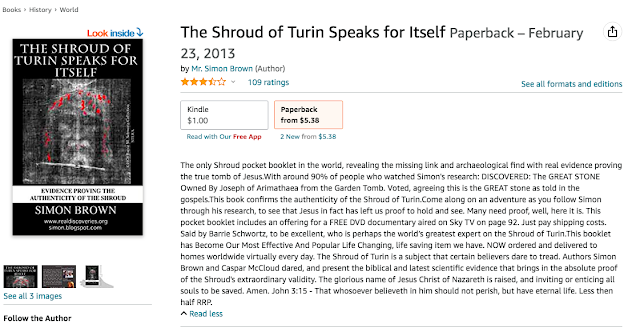
The Shroud of Turin Speaks for Itself Paperback.

la Sabana Santa de Turin habla por si mismo (Spanish Edition)

The Evidence and The True Face of The Shroud film


Articles on history’s greatest scientists, Sir Isaac Newton.